Pakistan Today and The Road Ahead
Pakistan today and the road ahead. If you were to describe Pakistan in one sentence, it might be something like this: a young nation with an old soul, still learning to balance its dreams with its realities. From cricket fields that make entire cities pause, to bustling IT hubs, to army engineers building defence marvels ۔ Pakistan is both a work in progress and a force to be reckoned with.

But the story of Pakistan today isn’t just about where it stands; it’s also about where it’s headed. Let’s walk through the current achievements, the stubborn challenges, and the vision for a future that lives up to the promise of the Pakistan Resolution.
Contemporary Achievements
1. Advances in IT and Digital Transformation
Once upon a time, “tech” in Pakistan meant a dusty desktop in a cyber café. Today, it’s young software developers working on apps that land in Silicon Valley pitches, fintech startups making headlines, and freelancing professionals ranking among the top in the world. Pakistan is now one of the largest freelance economies, with thousands of skilled professionals serving clients in the US, Europe, and the Middle East.
IT parks are springing up, and cities like Islamabad, Lahore, and Karachi are home to co-working spaces buzzing with innovation. Internet penetration has increased, e-commerce is thriving, and mobile banking is gaining mainstream adoption. The digital tide is hard to ignore, and it’s changing the game for small business owners and entrepreneurs across the country.
2. Sports: More than Cricket
Yes, cricket remains the national obsession; you can feel it in the air whenever Pakistan plays India. But there’s more to the sports story. From squash champions making comebacks on the global stage, to football leagues in Balochistan and KP, and female athletes breaking stereotypes in track events and weightlifting, Pakistan is quietly diversifying its sports portfolio.
Sports are also becoming a tool for soft power. Cricket diplomacy has thawed tensions more than once, and the PSL has brought international players and fans to Pakistan, boosting its image abroad.
3. Defence Technology and Strategic Capability
Defence might not be a dinner-table conversation for everyone, but Pakistan’s advancements in military technology are worth noting. From indigenous drone development to upgrades in missile systems, and from modernising the air force to expanding naval capabilities, Pakistan has kept pace with regional security demands.
Its defence exports, once negligible, are growing, and the country has a reputation for producing disciplined, well-trained military personnel. This feeds directly into one of its strongest diplomatic cards: peacekeeping.
4. Expanding Role in Regional and International Diplomacy
Pakistan has long been seen as a key player in South Asia’s political chessboard, but its role is expanding beyond the neighbourhood. It has mediated in Afghanistan talks, balanced ties with both the US and China, and maintained strategic relations with the Gulf states.
On the international stage, Pakistan is among the top contributors to United Nations peacekeeping missions, sending thousands of troops to conflict zones in Africa and beyond. These missions not only build goodwill but also project Pakistan as a responsible global partner.
Ongoing Challenges
Let’s be real, Pakistan’s progress is impressive, but the road is full of potholes.
1. Political Instability and Governance Issues
If there were a world championship for political drama, Pakistan would have more trophies than its cricket team. Frequent government changes, polarisation, and a lack of consensus on long-term policies slow down development. Governance suffers when political survival takes priority over institutional reform.
2. Education: Still Climbing the Mountain
Despite having brilliant minds, Pakistan’s literacy rate lags behind global averages. Access to quality education remains uneven, especially in rural areas. The gap between elite private schools and overcrowded public institutions is widening, leaving millions of children without the skills needed for a modern economy.
An estimated 22.8 million children aged 5-16 are out of school.
Currently, Pakistan has the world’s second-highest number of out-of-school children (OOSC) with an estimated 22.8 million children aged 5-16 not attending school, representing 44 per cent of the total population in this age group. In the 5-9 age group, 5 million children are not enrolled in schools, and after primary school age, the number of OOSC doubles, with 11.4 million adolescents between the ages of 10-14 not receiving formal education. Disparities based on gender, socio-economic status, and geography are significant; in Sindh, 52 per cent of the poorest children (58 per cent girls) are out of school, and in Balochistan, 78 per cent of girls are out of school.
Nearly 10.7 million boys and 8.6 million girls are enrolled at the primary level, and this drops to 3.6 million boys and 2.8 million girls at the lower secondary level.https://www.unicef.org/pakistan/education
3. Health: Urban-Rural Divide
Pakistan’s health sector is like a patchwork quilt, with excellent hospitals in big cities, but limited facilities in rural districts. Maternal and child health, malnutrition, and preventive care still require urgent attention. While private hospitals are investing in modern tech, public health infrastructure needs a serious overhaul.
4. Poverty and Economic Pressure
Around a quarter of the population lives below the poverty line. Inflation hits the poor hardest, and youth unemployment remains high. Economic stability depends heavily on remittances, which, while valuable, aren’t a substitute for sustainable industrial growth.
It’s accurate to say that in 2025, approximately 45% of Pakistan’s population is living in poverty according to the updated international threshold of $4.20 per day (2021 PPP). However, it’s crucial to emphasise that this reflects changes in how poverty is measured, not a sudden deterioration in living standards. The data is also based on older surveys from 2018–19 and doesn’t account for more recent crises or economic shifts.
Vision for the Future
Pakistan’s future isn’t a riddle; the pieces are all there ، they just need to be put together in the right order.
 Pakistan’s Youth: A Big Opportunity
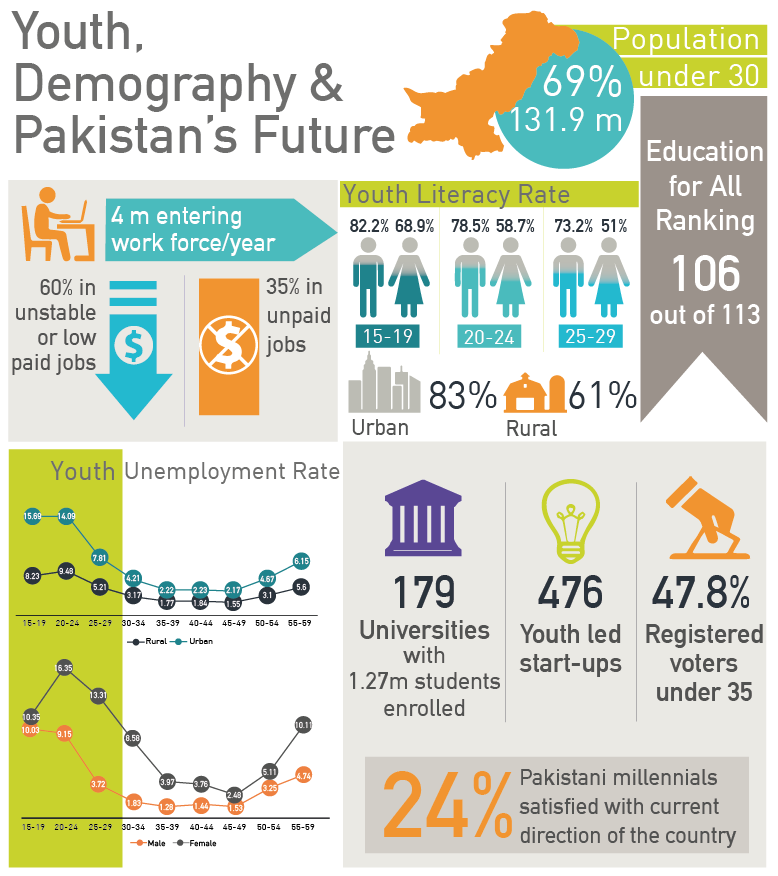
More than 60% of Pakistan’s people are under 30 years old. This is a very big strength. If we guide and train this youth force in the right way, it can bring jobs, new businesses, and faster growth for the country.
Simple strategies to use the power and energies of young people:
1. Skill Training, Not Just Degrees
- Schools and colleges should teach skills like computers, repairing machines, farming technology, designing, and online work.
- Skills + education = better jobs.
2. Support Small Businesses (Startups)
- Many young people want to start their own business.
- The government and banks can give small loans and training to help them.
- Even small shops, farms, and online businesses can grow into big ones.
3. Digital & Online Jobs
- The internet can connect Pakistani youth with the world market.
- Learning freelancing, app making, graphic design, and coding can create millions of jobs.
- Every young person with a smartphone can be a digital worker.
4. Youth in Farming
- Farming is still the backbone of Pakistan.
- With new tools, better seeds, and smart farming, young people can make farming modern and profitable.
5. Apprenticeships & Practical Training
- Big companies can give training programs where young people work and learn at the same time.
- This prepares them for real jobs, not just theory.
6. Sports and Creativity
- Youth have energy. Sports, arts, and media can also create careers.
- Supporting young talent can bring money, fame, and unity to Pakistan.
7. Youth in Decision Making
- The government should listen to youth voices.
- Youth councils in schools, colleges, and cities can give ideas on how to solve problems.
Pakistan’s young people are like a river full of energy. If we build the right channels (skills, jobs, opportunities), this energy will flow into an economic boom. If ignored, it may overflow and cause problems.
2. Strengthening Democratic Institutions
Strong democracies aren’t built in election seasons; they’re built in between them. Strengthening local governments, ensuring judicial independence, and making policymaking transparent can restore public trust. Political stability can’t be legislated into existence, but it can be nurtured through consistent rules and respect for institutions.
3. Reviving the Spirit of the Pakistan Resolution
Back in 1940, the Pakistan Resolution wasn’t just a political document ، it was a vision for dignity, rights, and self-determination. Reviving that spirit today means making sure every citizen feels represented, protected, and hopeful.
In a modern context, that could mean equal opportunities for women, religious freedom, and policies that favour human welfare over political scoring. It means putting the collective good ahead of short-term gain.
The Balancing Act Ahead
The road ahead for Pakistan is neither straight nor smooth. But nations aren’t built in a day, and they certainly aren’t defined only by their problems. The country has shown resilience in the face of disasters ، from earthquakes to floods, and adaptability in global crises, such as the COVID-19 pandemic.
The challenge is to channel that resilience into everyday governance, education reform, healthcare, and economic planning. Imagine if the same passion Pakistanis have for cricket were poured into improving public schools or cleaning up cities. That’s not a dream ، it’s a choice.
Closing Thoughts
Pakistan today and the road ahead is like a novel still being written, with chapters of triumph and tension, hope and hardship. Its contemporary achievements in technology, sports, defence, and diplomacy show that progress is possible. Its ongoing challenges remind us that progress needs maintenance. And its vision for the future ، if taken seriously, could finally bring the promise of the Pakistan Resolution into the lives of its people.
The question is, will Pakistan walk that road with the discipline of a marathon runner or the bursts of a sprinter? History will tell, but one thing’s for sure: the world is watching, and so are its own people.
https://mrpo.pk/independence-day-pakistans-journey/