
Navigating Multipolarity in an Age of Blocs
Executive Summary
The formalization of the Iran-China-Russia trilateral strategic pact in January 2026 marks a decisive inflection point in 21st-century geopolitics, accelerating the transition to a contested, multipolar world order. For Pakistan—a state grappling with profound economic fragility, entrenched security dilemmas, and a foreign policy historically defined by strategic hedging—this development presents an existential challenge and a rare strategic opportunity. This research argues that Pakistan’s historical model of oscillating between great powers is no longer viable. In response, it must execute a deliberate and sovereign “strategic recalibration,” moving from reactive hedging to proactive balancing. This new doctrine must prioritize economic security as national security, pursue a non-exclusive multi-alignment strategy that engages all power centers, and be driven by a reformed, long-term strategic apparatus focused on building indigenous capacity. The ultimate objective is to transform Pakistan from a perpetually vulnerable state into a resilient, self-reliant actor capable of leveraging its unique geography to ensure stability and prosperity in a fragmented world.
1.0 Introduction: The Imperative for Change
The signing of the Iran-China-Russia pact is not an isolated event but the culmination of long-term trends. It formalizes an alternative geopolitical axis explicitly opposed to Western unilateralism and dedicated to creating parallel financial, energy, and security architectures. For Pakistan, this shift collapses the strategic space for ambiguity. The old paradigm—relying on the United States for security aid and China for diplomatic and economic support—is increasingly unsustainable. Pakistan faces a perfect storm: a debt-dependent economy in recovery, climate vulnerabilities threatening its agricultural base, and a primary military rivalry with India, which itself is deepening ties with the U.S.-led Quad. Continuing a passive, transactional foreign policy risks relegating Pakistan to the periphery of emerging blocs, stripping it of agency and leaving it exposed to the whims of larger powers. This paper outlines a comprehensive framework for Pakistan’s strategic evolution in this new age.
2.0 The Foundational Principle: From Dependence to Sovereign Capacity
The core failure of Pakistan’s past alliances has been their reinforcement of dependency rather than the building of sovereign, indigenous capacity. Whether relying on U.S. military aid or Chinese infrastructure loans, partnerships have often addressed immediate crises while neglecting long-term capability development. The new strategic doctrine must invert this model. Every external engagement must be evaluated through a single lens: does it enhance Pakistan’s internal economic resilience, technological base, and industrial depth? The goal is to forge a foreign policy where external partnerships are tools for building internal strength, not substitutes for it.
3.0 The Strategic Framework: Multi-Alignment and Principled Balancing
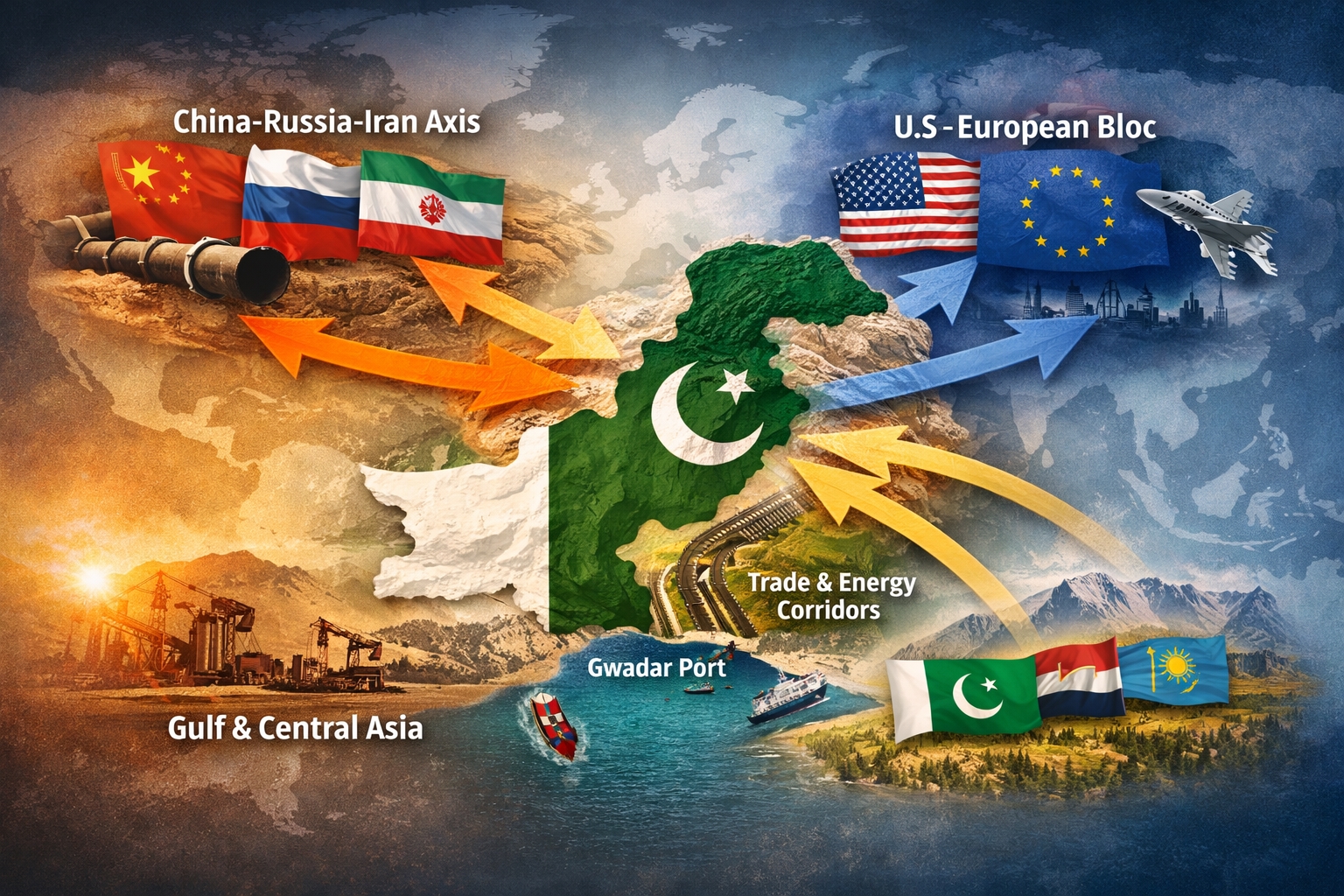
Pakistan must reject the binary choice between a U.S.-European bloc and a China-Russia axis. Its national interests are too complex and its needs too diverse to be met by one camp alone. Instead, it must adopt a policy of “principled multi-alignment.”
- Engaging the China-Russia Axis: Securing Strategic Depth & Economic Alternatives
- With China: The All-Weather Strategic Partnership must evolve. Beyond CPEC infrastructure, Pakistan must negotiate for technology transfer, vocational training partnerships, and joint ventures in value-added manufacturing. The relationship should become a catalyst for Pakistan’s export competitiveness, not just its import of Chinese goods and capital.
- With Russia/Iran Axis:This relationship offers critical alternatives. Priorities include finalizing the Pakistan Stream Gas Pipeline to diversify energy sources, exploring barter trade mechanisms to circumvent dollar-based sanctions, and engaging in pragmatic security coordination on Afghanistan. The aim is to develop optionality, not to replace one dependency with another.
- Re-engaging the U.S.-European Bloc: Accessing Capital, Technology, and Markets
- With the United States:Move beyond the transactional “aid-for-security” model. Pakistan should lobby aggressively for Generalized System of Preferences (GSP) Plus-style trade access to Western markets, positioning itself as a competitive, democratic manufacturing alternative to China. Security cooperation should focus on counter-terrorism intelligence and securing defense platforms without political strings.
- With Europe:Leverage the European Union’s need for stable partners. Pitch Pakistan as a key state for climate resilience partnerships (e.g., under the EU’s Global Gateway initiative) and a potential hub for “friend shoring” for European companies. The narrative should shift from a security problem to an investment opportunity.
- Anchoring in Regional Pragmatism: The Indispensable Foundation
A foreign policy untethered from geography is doomed. Pakistan’s immediate neighborhood provides the most critical avenue for building strategic autonomy.- Gulf States:Transform relationships from remittance-and-loan dependency into equity-based investment partnerships. Offer Saudi Arabia and the UAE stakes in Pakistan’s agricultural, mining, and renewable energy sectors, tied to long-term offtake agreements. This converts debt into productive capital.
- Central Asia via Afghanistan:This is Pakistan’s most underutilized strategic asset. A dedicated, sustained diplomatic effort—potentially alongside China and Russia—is needed to stabilize trade and transit agreements with the Taliban government. Success here positions Pakistan as the indispensable “Gateway to Eurasia,” capturing transit fees and becoming a trade hub.
- India: Seeking a Modus Vivendi:While a full resolution remains distant, a stable, non-hostile status quo is an economic and strategic imperative. Pakistan may consider unilaterally reaffirmation of the 2003 LoC ceasefire, reopen trade channels, and advocate for people-to-people exchanges. A cold peace that enables commerce is a prerequisite for national economic revival.
4.0 A Blueprint for Action: Institutional Reform & Transitional Phasing
Vision requires execution. Pakistan’s domestic governance structures are currently ill-equipped to manage a sophisticated, long-term multi-alignment strategy. A successful transition requires institutional reform and clear phasing.
- Phase 1: Institutional Foundation & Diplomatic Stabilization (Years 0-2)
- Action 1: Reform the National Security Council (NSC).The existing NSC must be transformed from an ad-hoc crisis meeting into a permanent, strategically focused executive body. It should be mandated to produce and monitor a rolling 10-year Integrated National Security Strategy, explicitly linking foreign, economic, and defense policy. It must be insulated from political volatility.
- Action 2: Launch “Economic Diplomacy” Units.Reorganize key embassies (Washington, Beijing, Brussels, Riyadh) to house commercial sections staffed by technical experts from finance, trade, and technology, with clear performance targets for investment and market access.
- Goal:Establish the machinery for coherent strategy and secure immediate economic confidence through diversified engagement.
- Phase 2: Strategic Integration & Resilience Building (Years 2-5)
- Action 1: Operationalize the “Gateway to Eurasia” Initiative.Create a dedicated cross-government task force to fast-track infrastructure (rail, road, border facilities) connecting Gwadar to Afghanistan and Central Asia. Actively market this corridor to Gulf and European investors as a secure, efficient trade route.
- Action 2: Formalize a “Climate & Economic Resilience” Pact with the EU.Based on the Global Shield framework, secure pre-arranged financing for climate adaptation projects, directly linking climate diplomacy to economic security.
- Goal:Cement Pakistan’s role as a regional connectivity node and lock in long-term partnerships that address its core vulnerabilities.
- Phase 3: Consolidation & Sovereign Capacity Leap (Years 5+)
- Action:Based on Phase 1 & 2 gains, launch a National Technology & Industrial Sovereignty Drive. Use partnerships to establish flagship projects in areas like semiconductor assembly, pharmaceutical API production, and renewable energy technology manufacturing.
- Goal:Shift Pakistan’s economic base from commodity exports and low-end manufacturing to higher value-added sectors, fundamentally altering its position in global value chains.
5.0 Managing Risks and Expectations
This path is fraught with challenges. Secondary Sanctions from the U.S. for engaging Russia/Iran are a major risk. Mitigation requires meticulous legal work to structure deals (e.g., in local currencies, for non-sanctioned goods) and transparent diplomacy to assure Western counterparts of Pakistan’s intent to balance, not betray. Partner Distrust (e.g., China wary of deeper U.S. ties, U.S. suspicious of CPEC) is inevitable. Pakistan must communicate with unwavering clarity that its multi-alignment is a sovereign necessity for survival in a multipolar world, not duplicity. It must back this with consistent, predictable actions.
6.0 Conclusion: Pakistan as a Reflective Sovereign Actor
The world is not simply choosing a new master; it is dismantling the old throne. In this environment, Pakistan’s greatest asset is its refusal to be permanently aligned. By decisively reforming its strategic institutions and pursuing a foreign policy dedicated to building internal strength through external engagement, Pakistan can navigate the rivalry between blocs. It can evolve from a state perpetually shaped by crises into a “reflective sovereign actor”—one that offers stability to its region, provides insight and communication between competing powers, and secures its own future through the durable foundations of economic resilience and diplomatic agility. The moment for strategic recalibration is not coming; it has arrived.