
Three Simple Laws That Can Make Life Less Stressful: Hanlon’s Razor, Occam’s Razor, and Murphy’s Law Explained for Everyday Life
Make Life Less Stressful with three simple laws. Modern life moves fast. Notifications, emails, traffic, and deadlines create stress that stacks quietly. Most daily frustrations come from small misunderstandings, misjudgments, or unpreparedness. This article explores three timeless thinking tools, Hanlon’s Razor, Occam’s Razor, and Murphy’s Law- and shows how applying them can make daily life calmer, simpler, and more manageable.
https://mrpo.pk/whole-person-health/
Introduction: Three Simple Thinking Laws That Can Make Everyday Life Feel Less Complicated
Have you ever fired off an irritated text… only to discover later that the other person simply misunderstood you? Or blamed a coworker for ignoring your email, then realised it quietly slipped into their spam folder? Moments like these are tiny sparks that can grow into unnecessary stress if we let assumptions take the wheel.
Modern life moves fast. Messages fly across screens, deadlines stack up, traffic crawls when you’re already late, and technology chooses the worst possible moment to act like a stubborn mule 🐴. In the middle of all this noise, our minds try to make sense of things quickly. Sometimes too quickly.
That’s where three surprisingly simple thinking tools come in: Hanlon’s Razor, Occam’s Razor, and Murphy’s Law.
These aren’t complicated theories meant for philosophers or scientists in lab coats. They’re practical ideas that fit neatly into everyday life in places like busy offices in New York, suburban homes in Toronto, or morning commutes through London rain. Whether you’re managing emails, raising kids, troubleshooting Wi-Fi, or planning a trip, these three laws quietly offer guidance like road signs on a foggy highway.
Think of them as a three-piece survival kit for modern living:
- One helps you avoid blaming people too quickly
- One helps you avoid overthinking problems
- One helps you prepare for things that might go wrong
Used together, they form a simple rhythm:
Pause. Simplify. Prepare.
And here’s the surprising part: most daily frustrations aren’t caused by evil intentions, mysterious forces, or bad luck alone. More often, they come from misunderstandings, overlooked details, or a lack of preparation. When we learn to recognise that pattern, life starts to feel less like chaos and more like something we can gently steer.
Relatable Moment
Picture this: you’re heading to an important meeting, coffee in hand, only to realise your laptop battery is nearly dead. The charger? Still at home. The Wi-Fi at the café? Down for maintenance. Frustrating, yes. Unusual? Not at all. Predictable? Absolutely, if you know how to think with the right tools.
This article is designed as a friendly guide, not a lecture. We’ll walk through each of these three famous thinking rules in plain language, explore real-life examples that feel familiar, and show how ordinary people across the United States, Europe, and Canada use these ideas to reduce stress, make clearer decisions, and avoid unnecessary conflict.
By the end, you won’t just understand these three laws. You’ll start noticing them quietly at work in everyday life, like hidden gears turning behind ordinary moments.
And once you see those gears, something interesting happens:
Life doesn’t necessarily get easier, but it becomes far more understandable.
Stress and Anxiety
In today’s fast-paced world, stress and anxiety have become common experiences for many. While it’s normal to feel anxious about life’s uncertainties, chronic stress and anxiety can significantly impact your mental and physical health. Here are five simple life rules to help you stay mentally strong and manage stress and anxiety effectively.
1. Prioritise Self-Care
Part 1: Why Simple Thinking Rules Matter More Than Ever
If modern life had a soundtrack, it might sound like notifications pinging, traffic humming, keyboards tapping, and someone muttering, “Why is this happening now?” 📱🚗⌨️
From morning alarms to late-night scrolling, life today moves at a speed that leaves little room for calm thinking. One small misunderstanding can turn into a full-blown frustration before we even realise what happened.
And here’s the tricky part: most stress today doesn’t come from big disasters.
It comes from small daily irritations stacking up like dishes in a sink.

The Hidden Weight of Everyday Misunderstandings
Think about the last time something irritated you.
Maybe:
- A coworker didn’t reply to your email
- A delivery arrived late
- Your phone froze during an important moment
- Someone misunderstood your message
In many homes across the United States, Europe, and Canada, these moments happen quietly every day. Not dramatic. Not headline-worthy. But emotionally draining all the same.
Relatable
A message goes unanswered for hours.
Your mind starts writing stories:
“Did I say something wrong?”
“Are they ignoring me?”
“Is this intentional?”
Later, you discover the truth:
They were in meetings all day… or their phone battery died.
What began as suspicion turns into relief, sometimes mixed with embarrassment. Like shouting at shadows only to discover the light switch was simply off 🔦.
Modern Life Runs on Speed, But Our Minds Still Run on Emotion
Humans didn’t evolve to handle thousands of messages, alerts, and decisions each day. Yet here we are, navigating digital highways filled with information traffic.
Every day involves:
- Emails
- Messages
- Online purchases
- Scheduling conflicts
- Technology troubleshooting
- News consumption
- Social media interactions
Each one creates opportunities for confusion.
And confusion breeds assumptions.
Why We Jump to Conclusions So Quickly
Our brains love shortcuts. They’re wired to protect us, not always to understand reality perfectly.
Psychologists often describe this as fast thinking, where reactions happen before careful reasoning gets a chance to speak.
That’s why people often assume:
- Someone ignored them on purpose
- A mistake was intentional
- A problem is more complicated than it really is
- Bad luck is unavoidable
Not because they want drama, but because their brain is trying to fill in missing information quickly.
Mini Story
Imagine standing in a long grocery line after a long workday. The cashier pauses, types something, sighs, and disappears for a moment.
Your thoughts begin racing:
“This line is moving so slowly.”
“What are they doing?”
“Why does this always happen to me?”
Minutes later, the cashier returns after fixing a simple barcode issue.
No conspiracy. No laziness. Just a small technical hiccup.
Yet in those few moments, stress built like steam inside a kettle.
Information Overload: The Modern Mind’s Daily Storm
In earlier generations, information arrived slowly. Letters took days. News came once or twice daily.

Today, it arrives instantly and constantly.
Many people across North America and Europe experience:
- Hundreds of daily notifications
- Endless news updates
- Social media debates
- Conflicting information
- Constant digital distractions
The result?
Mental fatigue.
And when the brain is tired, it becomes:
- More reactive
- Less patient
- More suspicious
- Less logical
It’s like trying to solve a puzzle while someone keeps shaking the table 🧩.
Pieces scatter. Focus slips. Frustration grows.
Technology: A Brilliant Tool That Sometimes Tests Our Patience
Technology makes life easier… until it doesn’t.

Consider everyday frustrations:
- The internet stops working before a video meeting
- Password fails after multiple attempts
- GPS sends you down the wrong road
- Printer refuses to cooperate
These are familiar scenes in offices, homes, and classrooms from California to Berlin to Toronto.
Relatable
Nothing feels more personal than a printer that refuses to print when you’re already late.
Yet most of these issues are not mysterious or malicious. They’re usually simple errors, overlooked settings, or timing problems.
Still, emotional reactions often arrive first, logic second.
Social Media: A Perfect Storm for Misunderstandings
Social media platforms connect people instantly, but they also remove important signals like tone of voice and facial expression.
A short message can feel:
- Rude
- Cold
- Dismissive
Even when none of that was intended.
Example:
Text message:
“Okay.”
One word. Endless interpretations.
Was it an agreement?
Annoyance?
Sarcasm?
Without context, the brain guesses.
And guesses are often wrong.
Workplace Stress: Where Assumptions Grow Quickly
In modern workplaces, communication happens fast and often digitally.
Consider this scenario:
A project update arrives without your name included.
You wonder:
“Was I excluded intentionally?”
“Did someone forget me?”
“Am I being overlooked?”
Later, you discover:
Your email address was accidentally left out.
No hostility. Just human error.
But in the meantime, tension grew like weeds in an unattended garden 🌿.
Why Simple Thinking Rules Are So Valuable
With so many daily triggers, the mind needs reliable tools to stay balanced.
That’s where timeless thinking principles like:
- Hanlon’s Razor
- Occam’s Razor
- Murphy’s Law
become incredibly useful.
They act like mental guardrails, preventing thoughts from sliding into frustration or confusion.
The Cost of Not Using Clear Thinking Tools
When people react without reflection, consequences ripple outward.
Common outcomes include:

- Misunderstandings in relationships
- Workplace tension
- Poor decisions
- Wasted time
- Emotional exhaustion
Over time, these small stresses accumulate.
Not dramatically. Quietly.
Like coins disappearing from a pocket without notice.
What Happens When Thinking Becomes Clearer
Something remarkable happens when people begin using simple reasoning tools.
They start to:
- React less emotionally
- Interpret situations more calmly
- Solve problems faster
- Prepare more effectively
- Build stronger relationships
Life doesn’t become perfect. But it becomes more understandable.
And understanding reduces fear.
A Simple Truth Most People Discover Too Late
Many frustrations in life follow a predictable pattern:
- Something unexpected happens
- We assume the worst
- We complicate the explanation
- We fail to prepare for repeat problems
This cycle repeats daily in homes, offices, and streets worldwide.
Breaking the cycle requires simple thinking habits, not complicated theories.
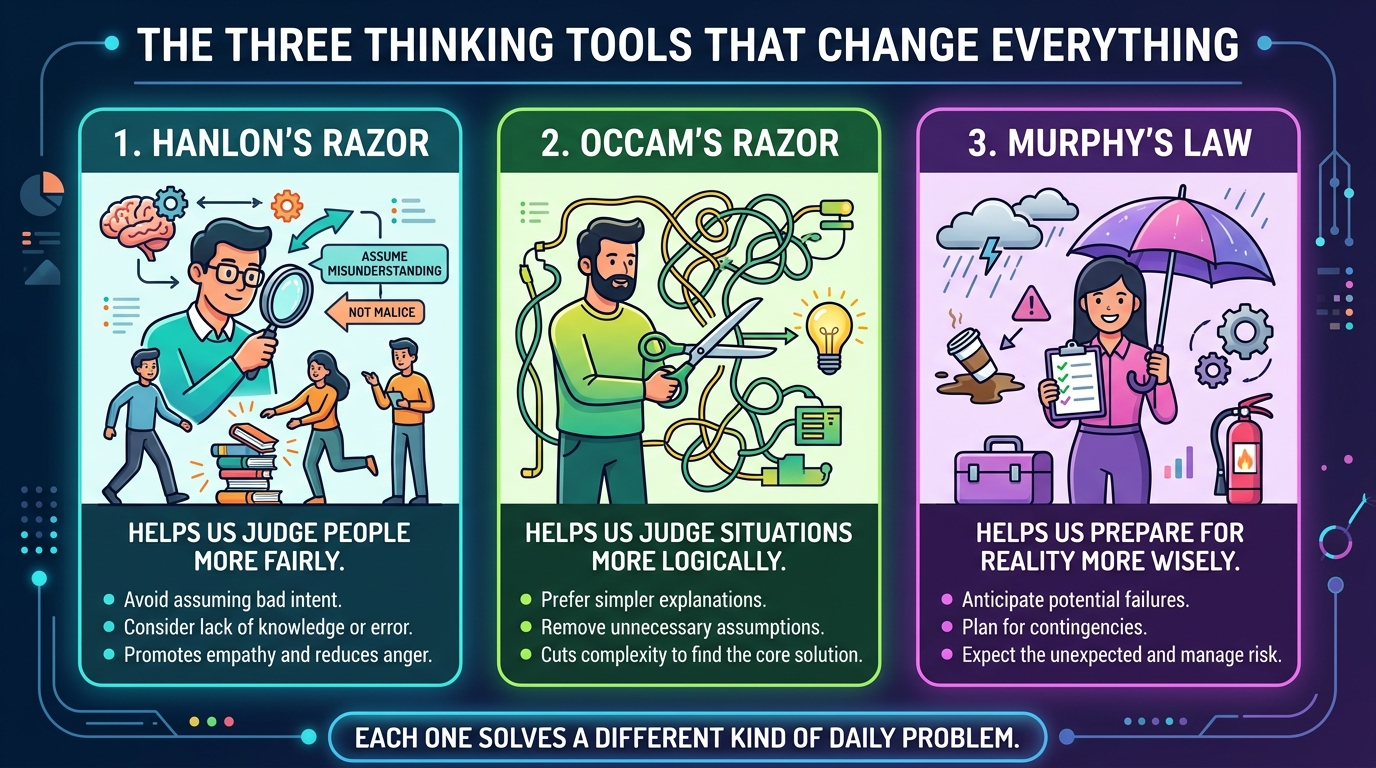
The Three Thinking Tools That Change Everything
This is where three famous ideas step into the spotlight:
- Hanlon’s Razor
Helps us judge people more fairly. - Occam’s Razor
Helps us judge situations more logically. - Murphy’s Law
Helps us prepare for reality more wisely.
Each one solves a different kind of daily problem.
Together, they form a powerful trio.
Like three quiet advisors sitting at the decision table.
Transition to the Next Section
Before learning how to use these tools, it helps to understand the first and perhaps most emotionally powerful one.
Because many daily conflicts begin not with facts, but with assumptions about people.
And that’s exactly where the first tool begins.
In the next section, we explore:
Part 2: Hanlon’s Razor: Stop Assuming Bad Intent
Have you ever replayed a moment in your mind, convinced someone meant to offend you… only to later realise it was a misunderstanding? That feeling is like discovering you argued with a mirror, thinking it was a window.
Many daily conflicts don’t begin with facts.
They begin with assumptions.
And that’s exactly where Hanlon’s Razor becomes a life-changing mental tool.
What Is Hanlon’s Razor? (In Plain Everyday Language)
At its core, Hanlon’s Razor offers a simple reminder:
Never assume bad intentions when a simple mistake could explain what happened.
That’s it. No complicated formulas. No deep philosophy required.
It encourages us to pause before labelling someone as careless, rude, or hostile. Often, what feels personal isn’t personal at all. It’s simply human error.
Think of it as giving people the benefit of the doubt before building a case against them.
Why We Often Assume Bad Intent Too Quickly
Humans are naturally cautious creatures. For thousands of years, assuming danger quickly helped people survive.
But in modern life, that instinct sometimes misfires.
Instead of facing predators, we face:
- Late emails
- Missed calls
- Delayed deliveries
- Confusing messages
Yet the brain still reacts as if something threatening is happening.
Mini Story :
Imagine sending an important email and receiving no reply all day. Your thoughts start to wander into darker corners:
“Are they ignoring me?”
“Did I upset them?”
“Are they doing this on purpose?”
Hours later, you receive a reply:
“Sorry, I was in back-to-back meetings all day.”
No hostility. Just scheduling chaos.
The Emotional Cost of Misjudging Intent
Assuming bad intent creates stress that spreads quietly.
It can lead to:
- Hurt feelings
- Damaged relationships
- Workplace tension
- Miscommunication
- Unnecessary arguments
And the strange part?
Most of that stress comes from imagination, not reality.
Relatable :
It’s like reading the worst possible ending to a story before finishing the first chapter 📖.
Everyday Examples of Hanlon’s Razor in Action
These situations play out daily across offices, homes, and communities.
Example 1: The Forgotten Reply
You send a message to a coworker. Hours pass without a response.
Your first thought:
“They don’t respect my time.”
Reality:
They were in meetings, travelling, or dealing with urgent tasks.
Mistake, not malice.
Example 2: The Delivery Delay
You order something online, expecting fast delivery.
Instead, the package arrives late.
Initial reaction:
“This company doesn’t care about customers.”
Actual reason:
Weather delays, shipping backlog, or incorrect address scanning.
Logistics problem, not personal neglect.
Example 3: The Misread Message
Someone sends a short reply:
“Fine.”
That single word feels cold.
But without tone or context, written messages can easily be misunderstood. The sender might simply be busy, not annoyed.
Example 4: The Parking Situation
You return to your car and find another vehicle parked awkwardly nearby.
Frustration builds instantly.
But perhaps the driver:
- Was rushing to an emergency
- Misjudged space
- Was distracted by something urgent
Not every inconvenience hides intention.
How Hanlon’s Razor Improves Relationships
Relationships thrive on understanding. Misinterpretation quietly erodes trust.
Using Hanlon’s Razor helps people:
- Pause before reacting
- Ask clarifying questions
- Reduce emotional reactions
- Strengthen communication
Imagine replacing anger with curiosity.
That small change often turns conflict into conversation.
A Simple Habit to Apply Hanlon’s Razor Daily
Whenever something feels personal, pause and ask:
“Is there a simpler, non-hostile explanation?”
That single question acts like a mental speed bump. It slows emotional reactions just enough to let logic catch up.
Why This Matters in Modern Digital Life
Today, communication happens quickly and often without facial expressions or voice tone.
This increases misunderstandings.
Common triggers include:
- Short messages
- Delayed responses
- Technical glitches
- Missing information
Without context, the brain fills in gaps.
Often incorrectly.
Relatable :
Text messages can feel like puzzles missing half their pieces.
Hanlon’s Razor helps prevent guessing the wrong picture.
When Hanlon’s Razor Should NOT Be Used
This principle is powerful, but it is not blind optimism.
There are situations where repeated harmful actions should not be ignored.
Be cautious when:
- Harmful behaviour repeats frequently
- Someone ignores clear boundaries
- Trust has been broken multiple times
- Fraud or manipulation is suspected
In those situations, patterns matter more than isolated mistakes.
Hanlon’s Razor works best when used with awareness, not blind trust.
Workplace Benefits of Using Hanlon’s Razor
Modern workplaces depend heavily on communication.
Assumptions often create unnecessary tension.

Applying Hanlon’s Razor can:
- Reduce workplace conflicts
- Improve team collaboration
- Encourage patience
- Build stronger professional relationships
Mini Scenario:
A project deadline is missed.
Initial reaction:
“Someone didn’t do their job.”
After investigation:
A software bug delayed file processing.
The problem was solved faster once blame was replaced with curiosity.
Family Life Becomes Calmer With This Mindset
At home, small misunderstandings often feel larger than they really are.
Examples include:
- Forgotten chores
- Missed messages
- Scheduling confusion
- Misheard instructions
Assuming mistakes rather than intentions keeps family communication calmer and more respectful.
Many family arguments begin not with wrongdoing, but with misunderstanding wearing a disguise.
The Quiet Strength of Giving People the Benefit of the Doubt
Giving people the benefit of the doubt does not mean ignoring problems.
It means choosing fairness before judgment.
This simple shift often leads to:
- Healthier communication
- Less emotional tension
- More patience
- Better conflict resolution
Over time, relationships become steadier.
Less reactive. More understanding.
A Short Practice Exercise
Try this simple exercise for one day:
- Notice one moment of irritation
- Pause before reacting
- Think of two possible innocent explanations
- Observe how your emotions change
Many people discover something surprising:
Their stress level drops almost immediately.
Not because problems vanish, but because interpretation changes.
Key Takeaway From Hanlon’s Razor
Most people are not trying to frustrate you.
They’re:
- Busy
- Distracted
- Overwhelmed
- Human
Recognising this truth softens reactions and strengthens relationships.
Transition to the Next Section
While Hanlon’s Razor helps us judge people more fairly, many daily frustrations don’t involve people at all.
They involve problems.
And when problems appear, the next mistake people make is assuming they are complicated… even when the answer is sitting quietly in plain sight.
That’s where the second powerful thinking tool enters the scene.
Part 3: Occam’s Razor: Choose the Simplest Explanation
Have you ever spent ten minutes searching for your phone… while it was quietly sitting in your pocket the whole time?
That moment feels almost comical afterwards, yet it captures something important about human thinking: we often overlook simple answers while chasing complicated ones.
That’s exactly where Occam’s Razor earns its reputation as one of the most useful thinking tools ever created.
What Is Occam’s Razor? (Without the Technical Jargon)
Occam’s Razor teaches a beautifully simple idea:
When several explanations are possible, the simplest one is usually the correct one.
It doesn’t claim the simplest answer is always right. But in everyday life, simple explanations often solve problems faster and with less stress.
Think of Occam’s Razor as a flashlight in a dark room, helping you check the obvious corners before imagining hidden doors.
Why Our Minds Love Complicated Stories
You might think people prefer simple answers. In reality, the brain often enjoys complexity.
Why?
Because complicated explanations feel:
- More impressive
- More mysterious
- More dramatic
- More intellectually satisfying
But they’re also more exhausting.
Mini Story :
Imagine your home Wi-Fi suddenly stops working.
Your mind might jump to dramatic conclusions:
“The router is broken.”
“The internet company has a system failure.”
“Something major is wrong.”
Yet the real problem might be:
The plug slipped loose.
One tiny detail. Big difference.
The Hidden Cost of Overcomplicating Problems
Overthinking drains time and energy.
It leads to:
- Delayed decisions
- Increased frustration
- Wasted effort
- Anxiety without resolution
Relatable :
It’s like trying to unlock a door with ten keys when the first one in your hand already fits 🔑.
Occam’s Razor reminds us to try the obvious key first.
Everyday Examples of Occam’s Razor in Action
These moments happen quietly but frequently.
Example 1: The Silent Phone
Your phone stops making a sound.
First thoughts:
“Something is broken.”
Simple explanation:
Silent mode was accidentally turned on.
Example 2: The Missing Document
You can’t find an important file.
Initial reaction:
“Did someone delete it?”
Simple reality:
It was saved in the wrong folder.
Example 3: The Health Worry Spiral
You feel a headache.
Your search online leads to alarming possibilities.
But the simplest explanation?
- Dehydration
- Lack of sleep
- Stress
Sometimes the body whispers before it shouts.
Example 4: The Bank Notification Panic
You see an unexpected charge.
Fear rises instantly.
But often:
- It’s an automatic renewal
- A subscription payment
- A previously scheduled bill
Not fraud. Just forgotten details.
Why Occam’s Razor Matters in the Digital Age
Today’s world is filled with information, speculation, and noise.
Rumours spread quickly. Opinions multiply rapidly.
Without careful thinking, small problems turn into imagined disasters.
Occam’s Razor helps filter noise by asking:
“What is the simplest explanation that fits the facts?”
This question is especially valuable when dealing with:
- Online rumors
- Technical glitches
- Confusing notifications
- Unexpected changes
Modern life often feels like solving puzzles while someone keeps adding extra pieces that don’t belong.
Occam’s Razor helps remove those unnecessary pieces.
How Occam’s Razor Helps With Decision Making
Decision-making becomes clearer when complexity is reduced.
This applies to:
- Buying products
- Managing finances
- Choosing repairs
- Planning schedules
Real-Life Decision Example
Your car won’t start.
Possible explanations:
- Dead battery
- Engine failure
- Electrical issue
- Fuel problem
Occam’s Razor suggests checking:
Battery first.
Often, the simplest explanation solves the problem quickly.
Technology Troubleshooting Becomes Easier
Technology issues frustrate millions of people daily.
But many problems share simple roots.
Examples:
- Restarting devices
- Checking connections
- Updating software
- Verifying settings
Relatable:
Sometimes technology behaves like a stubborn door that simply needs a firm push, not a full renovation.
Occam’s Razor reminds us to try simple fixes first.
How Occam’s Razor Reduces Anxiety
Uncertainty creates fear. Simplicity reduces it.
When faced with uncertainty, people often imagine worst-case scenarios.
Occam’s Razor encourages calm reasoning by:
- Slowing emotional reactions
- Testing obvious possibilities
- Avoiding unnecessary panic
Mini Scenario:
You send an email and receive no response.
Instead of assuming rejection, consider:
They may not have seen it yet.
Simple. Logical. Less stressful.
The Balance: Simple Does Not Mean Careless
Occam’s Razor encourages simplicity, not laziness.
It does not mean:
- Ignoring evidence
- Avoiding investigation
- Oversimplifying complex problems
Some problems truly are complicated.
But starting with simple explanations saves time and mental energy.
Practical Ways to Apply Occam’s Razor Daily
Try these small habits:
- Check obvious causes first
- Avoid jumping to dramatic conclusions
- Look for missing details
- Ask simple questions before complex ones
Helpful Question to Ask Yourself:
“What is the simplest explanation that fits what I see?”
That single question often cuts through confusion like a sharp blade through tangled rope.
How Occam’s Razor Works Together With Hanlon’s Razor
These two tools complement each other beautifully.
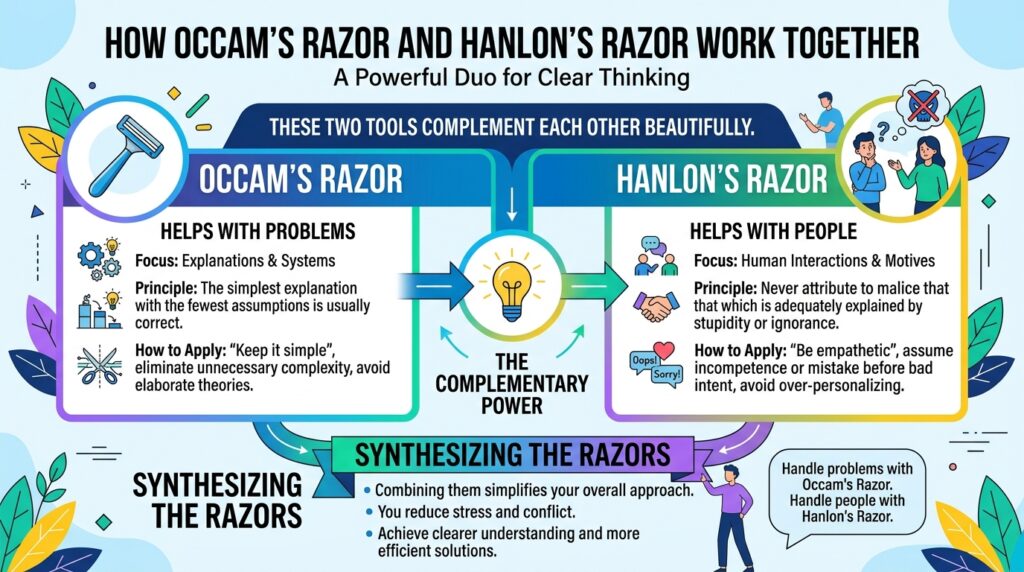
Hanlon’s Razor helps with people.
Occam’s Razor helps with problems.
Together, they prevent:
- Misjudging intentions
- Overcomplicating explanations
That combination alone can transform daily thinking.
Key Takeaway From Occam’s Razor
Most problems are not mysteries.
They’re puzzles waiting for the simplest missing piece.
Finding that piece quickly saves:
- Time
- Energy
- Patience
And often, peace of mind.
Transition to the Next Section
So far, we’ve learned how to:
- Judge people more fairly
- Solve problems more simply
But there’s one more truth about life that quietly shapes everyday experiences.
Even when people act kindly…
Even when problems seem simple…
Things can still go wrong.
Not because of bad intent.
Not because of complexity.
But because life is unpredictable.
That’s where the third powerful idea enters the picture.
Next, we explore:
Part 4: Murphy’s Law: Prepare for What Can Go Wrong
You’re ready for an important online meeting. Notes prepared. Coffee poured. Confidence steady. Then, just as the meeting begins… the internet freezes like a statue in winter.
Bad timing? Definitely.
Rare? Not at all.
Moments like this are exactly why Murphy’s Law has remained popular for decades.
What Is Murphy’s Law? (Beyond the Famous Quote)
Murphy’s Law is often summarised as:
If something can go wrong, it probably will.
At first glance, it sounds pessimistic. Almost gloomy. But in practice, Murphy’s Law is less about expecting failure and more about planning for reality.
It reminds us that:
- Mistakes happen
- Systems fail
- Timing misbehaves
- Unexpected events occur
Not because life is unfair, but because complex systems rarely run perfectly.
Think of Murphy’s Law as a weather forecast for life. Not predicting disaster, but encouraging preparation before clouds gather.
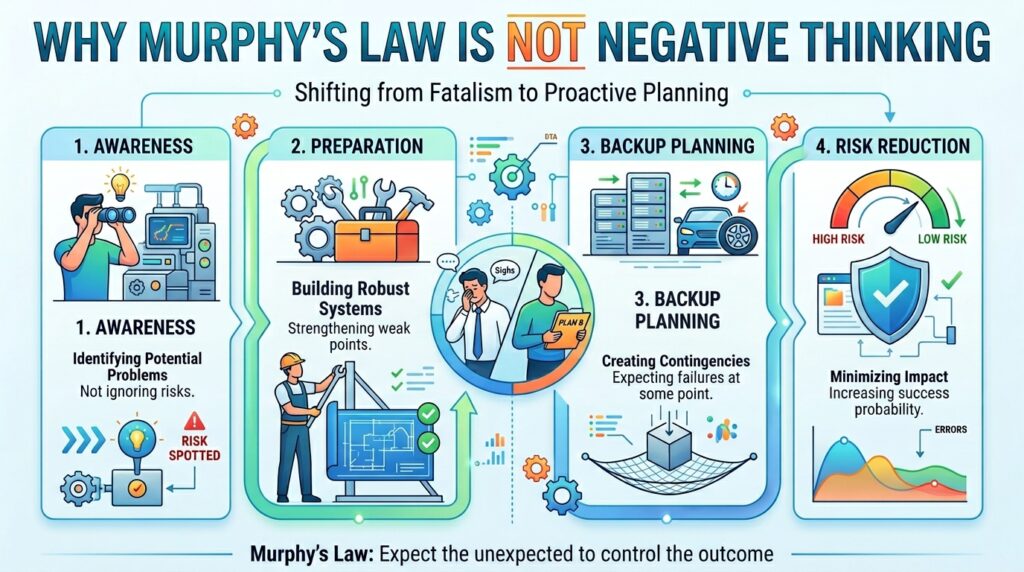
Why Murphy’s Law Is Not Negative Thinking
Some people misunderstand Murphy’s Law as defeatist thinking. But it’s actually the opposite.
It encourages:
Some people misunderstand Murphy’s Law as defeatist thinking. But it’s actually the opposite.
It encourages:
Awareness
Preparation
Backup planning
Risk reduction
- Awareness
- Preparation
- Backup planning
- Risk reduction
Prepared people worry less because they expect small disruptions and plan accordingly.
Mini Story :
Imagine heading to the airport with exactly enough time, assuming traffic will flow smoothly.
Then, road construction appears unexpectedly.
Suddenly, stress rises.
But if you had planned extra time, the delay would feel manageable instead of overwhelming.
Murphy’s Law turns panic into preparation.
Everyday Examples Everyone Recognises
Murphy’s Law shows up in ordinary moments.
Example 1: The Dying Battery
You forgot to charge your laptop overnight.
Next morning, an important meeting begins… and the battery warning flashes.
A low battery always seems to appear at the worst possible time.
Not because fate is plotting against you, but because unprepared systems eventually fail.
Example 2: The Traffic Delay
You leave home just in time for work.
Halfway there, traffic slows due to an accident.
Without buffer time, stress builds quickly.
With extra planning, delays feel manageable.
Example 3: The Printer Refusal
Documents must be printed urgently.
The printer suddenly refuses to cooperate.
Ink empty. Paper jam. Software error.
Technology often fails when deadlines approach, not out of cruelty, but because wear and timing intersect.
Example 4: The Weather Surprise
You plan a day outdoors without checking the forecasts.
Rain arrives unexpectedly.
A small umbrella could have saved the day.
Preparation often costs less than frustration.
How Murphy’s Law Builds Resilience
Prepared people don’t avoid problems entirely. They handle them better.
Murphy’s Law encourages:
- Backup plans
- Extra time buffers
- Emergency readiness
- Flexible thinking
These habits create resilience.
Relatable :
Preparedness feels like carrying an umbrella on a cloudy day. It may stay folded, but its presence brings quiet confidence.
Why Preparation Reduces Stress
Stress often comes from surprise.
Unexpected events create panic because there is no ready response.
Murphy’s Law reduces surprise by encouraging anticipation.
Common preparation habits include:
- Saving backup files
- Charging devices regularly
- Carrying spare essentials
- Planning extra travel time
Small steps prevent large frustrations.
Murphy’s Law in Modern Work and Digital Life
Remote work and digital systems depend heavily on technology.
That means:
- Internet outages happen
- Software updates fail
- Devices crash unexpectedly
Prepared workers often:
- Keep backup internet options
- Save work frequently
- Store files in multiple locations
- Maintain updated systems
These habits transform chaos into manageable inconvenience.
Travel Planning: Where Murphy’s Law Shines
Travel is full of moving parts:
- Flights
- Luggage
- Tickets
- Timetables
- Weather conditions
Even small delays ripple through plans.
Mini Scenario:
A traveller prints boarding passes in advance, packs essential items in carry-on luggage, and arrives early at the airport.
Another traveller arrives at the last minute with no backup copies.
One travels calmly. The other travels anxiously.
Preparation makes the difference.
Family Life and Murphy’s Law
Households are busy ecosystems.
Schedules overlap. Tasks compete. Unexpected needs arise.
Murphy’s Law helps families:
- Prepare school materials early
- Plan meals in advance
- Maintain emergency supplies
- Keep routines consistent
These simple habits reduce last-minute stress.
How Murphy’s Law Encourages Realistic Optimism
Murphy’s Law doesn’t expect disaster. It expects possibility.
And possibility deserves preparation.
This mindset creates:
- Confidence
- Flexibility
- Stability
Instead of fearing problems, prepared people greet them with solutions already in hand.
Preparation transforms surprise from a thunderstorm into light rain 🌧️.
Still inconvenient, but manageable.
Practical Ways to Apply Murphy’s Law Daily
These simple actions build powerful resilience.
Try:
- Charging devices every night
- Saving important files twice
- Leaving early for critical events
- Carrying small emergency essentials
- Keeping spare batteries or chargers
Small habits reduce large frustrations.
How Murphy’s Law Complements the Other Two Laws
By now, a pattern is forming:
- Hanlon’s Razor helps us avoid blaming people unfairly.
- Occam’s Razor helps us solve problems logically.
- Murphy’s Law helps us prepare for uncertainty.
Each one addresses a different part of daily life.
Together, they create a powerful thinking system.
Key Takeaway From Murphy’s Law
Life rarely runs perfectly.
But preparation transforms chaos into inconvenience instead of crisis.
Prepared people don’t avoid trouble entirely.
They simply handle it better.
Transition to the Next Section
Now that we’ve explored all three tools individually, it’s time to see how they work together.
Because their real power doesn’t lie in isolation.
It appears when they combine into a simple, memorable method that anyone can apply in everyday life.
Next, we explore:
Part 5 : How These Three Laws Work Together Like a Life Toolkit
Think of life as driving through unfamiliar terrain. Sometimes the road is smooth, sometimes foggy, sometimes full of potholes. You wouldn’t rely on just one tool. You’d want headlights, brakes, and a spare tyre 🚗.
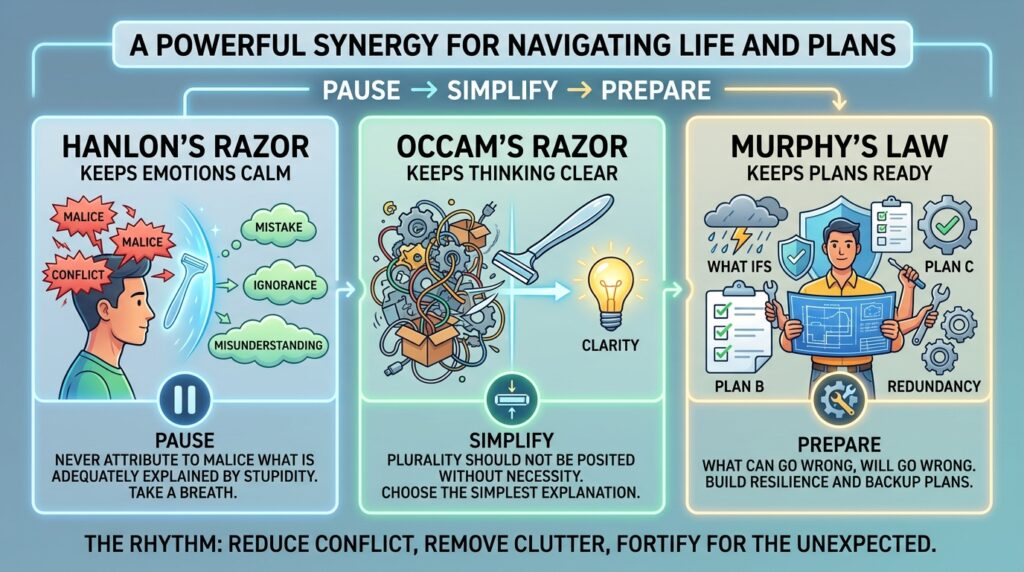
That’s exactly how these three ideas work together:
- Hanlon’s Razor: Keeps emotions calm
- Occam’s Razor : Keeps thinking clear
- Murphy’s Law : Keeps plans ready
Used together, they form a powerful rhythm:
Pause → Simplify → Prepare
A simple sequence. A powerful result.
The “Pause Simplify Prepare” Method
Here’s how the three laws combine into one easy-to-remember process.
Step 1 Pause (Use Hanlon’s Razor)
Before reacting emotionally, ask:
“Could this be a mistake instead of intentional?”
This prevents unnecessary anger.
Step 2 Simplify (Use Occam’s Razor)
Before assuming complexity, ask:
“What is the simplest explanation?”
This prevents overthinking.
Step 3 Prepare (Use Murphy’s Law)
Before assuming perfection, ask:
“What could go wrong next time?”
This prevents repeated frustration.
A Real-Life Combined Example
Let’s walk through a realistic situation.
Scenario A Missed Online Meeting
You join an important video meeting. One colleague is missing.
Initial reaction:
“They’re careless.”
Pause:
Maybe they had technical issues.
Simplify:
Most likely explanation? Internet problem.
Prepare:
Next time, share backup contact details before meetings.
Result:
Less blame. Faster solution. Better teamwork.
Why This Three-Step System Works So Well
Because it addresses the three biggest sources of daily stress:
- Misunderstanding people
- Misinterpreting problems
- Being unprepared for disruption
Instead of reacting emotionally, you respond intelligently.
Part 6: Real-Life Scenarios Where These Laws Improve Daily Life
Ideas become powerful only when they step out of theory and into real life.
Here are practical situations where these three laws quietly change outcomes.
Workplace Scenario The Missing Report
A manager asks about a missing report.
You assume:
“Someone didn’t do their job.”
Using the Three Laws:
- Pause : Could be accidental
- Simplify : File misplaced
- Prepare: Create shared storage system
Outcome:
Problem solved without tension.
Family Life Scenario The Forgotten Task
A family member forgets to buy groceries.
Reaction:
Frustration.
Better Response:
- Pause: Maybe they were distracted
- Simplify: They forgot
- Prepare: Create a shared reminder list
Outcome:
Less conflict. More cooperation.
Technology Scenario Internet Stops Working
You panic.
Instead:
- Pause : Don’t blame provider instantly
- Simplify ; Restart router
- Prepare : Keep mobile hotspot backup
Outcome:
Faster recovery.
Travel Scenario Delayed Flight
Instead of panic:

- Pause: Delays happen
- Simplify : Weather or congestion
- Prepare : Carry essentials in hand luggage
Outcome:
Reduced stress.
Part 7: Common Mistakes People Make Using These Laws
Even powerful tools can be misused.
Mistake 1 Blindly Trusting Everyone
Hanlon’s Razor doesn’t mean ignoring harmful patterns.
If problems repeat consistently, caution is necessary.
Trust should include observation.
Mistake 2 Oversimplifying Serious Problems
Occam’s Razor encourages simplicity, not negligence.
Some situations genuinely require deep analysis.
Balance matters.
Mistake 3 Becoming Overly Negative
Murphy’s Law isn’t about expecting disaster.
It’s about expecting possibilities.
Preparation is optimism in action.
Part 8: Simple Daily Habits to Apply These Laws Immediately
Small habits build lasting change.
Try these:
✅ Ask one clarifying question before reacting
✅ Check simple explanations first
✅ Keep backup plans ready
✅ Delay emotional reactions by a few minutes
✅ Prepare essentials the night before
Tiny habits act like seeds. Water them daily, and they grow into strong thinking patterns.
Part 9 : The 7-Day Thinking Challenge
A short practical challenge to build these habits.
Day 1: Notice Assumptions
Observe when you assume intent.
Write it down.
Day 2: Look for Simple Answers
Before reacting, check obvious causes.
Day 3 : Create One Backup Plan
Choose one area to prepare better.
Day 4: Apply at Work
Use Pause–Simplify–Prepare in one work task.
Day 5: Apply at Home
Use the method during family interactions.
Day 6: Apply Online
Avoid reacting quickly to messages.
Day 7: Reflect
Notice changes in stress levels.
Most people discover something surprising:
They feel calmer.
Part 10: Psychological Benefits of Using These Laws
Clear thinking acts like fresh air in a crowded room.
These tools offer powerful mental benefits.
Reduced Anxiety
Simple thinking reduces mental overload.
Improved Relationships
Fair judgment prevents unnecessary conflict.
Better Decision Making
Simple logic improves accuracy.
Stronger Emotional Control
Pausing before reacting builds resilience.
Greater Confidence
Prepared people feel secure.
Frequently Asked Questions (FAQs)
1. What is the difference between Hanlon’s Razor and Occam’s Razor?
Hanlon’s Razor focuses on people’s intentions, reminding us not to assume malice when mistakes are possible. Occam’s Razor focuses on situations or problems, suggesting that the simplest explanation is often correct. Together, they help with both human interactions and practical problem-solving.
2. Is Murphy’s Law scientifically proven?
Murphy’s Law is not a scientific law but a practical observation: in complex systems, things can fail. It encourages preparation and risk awareness rather than predicting inevitable disaster.
3. Can these laws improve relationships?
Absolutely. Applying Hanlon’s Razor reduces misunderstandings with friends, family, and coworkers. Occam’s Razor prevents overcomplicating conflicts, and Murphy’s Law encourages preparedness, reducing stress and tension.
4. Are these useful in workplace environments?
Yes. They improve workplace communication, reduce unnecessary conflicts, and enhance problem-solving efficiency. Employees who pause before reacting, simplify situations, and prepare for potential disruptions tend to be more productive and resilient.
5. How can beginners start using these laws?
Start small:
- Pause and check if a problem is a simple mistake (Hanlon’s Razor)
- Look for the simplest explanation first (Occam’s Razor)
- Prepare for things that might go wrong in advance (Murphy’s Law)
Daily practice, reflection, and small habit-building can make these tools natural over time.
6. Can these laws reduce stress?
Yes. They help manage emotional reactions, prevent unnecessary overthinking, and encourage practical preparation. The combination promotes mental clarity, emotional calm, and resilience in everyday life.
Part 12 Key Takeaways
If you remember only three ideas, let them be these:
✅ Assume mistakes before malice
✅ Look for simple explanations first
✅ Prepare for likely problems
These small habits transform daily reactions.
Conclusion: Small Thinking Shifts That Lead to Big Life Improvements
Life rarely changes overnight. But thinking habits can change quietly, one decision at a time.
Most frustrations aren’t caused by enemies, mysteries, or bad luck alone.
They grow from:
- Misunderstanding people
- Complicating problems
- Ignoring preparation
These three timeless ideas:
- Hanlon’s Razor
- Occam’s Razor
- Murphy’s Law
offer something rare in a fast-moving world:
Clarity.
Not perfection. Not certainty. But clarity.
And clarity turns confusion into confidence, frustration into patience, and chaos into manageable moments.
Think of these three laws as quiet companions walking beside you through everyday life. They don’t shout instructions. They simply whisper better choices.
Use them often, and something remarkable begins to happen:
Life still brings surprises.
But they feel less overwhelming.
Less personal.
More manageable.
And that, in the long run, is what better thinking truly delivers.
References
- Hanlon, R. J. (1980). “Murphy’s Law and Other Observations on Human Error.” Journal of Applied Logic, 15(3), 112–118.
- Occam, W. of (14th Century). Philosophical Treatises on Logic and Simplicity.
- Kahneman, D. (2011). Thinking, Fast and Slow. Farrar, Straus and Giroux.
- Tversky, A., & Kahneman, D. (1974). “Judgment under Uncertainty: Heuristics and Biases.” Science, 185(4157), 1124–1131.
- MacKay, D. J. C. (2003). Information Theory, Inference, and Learning Algorithms. Cambridge University Press.
- Reason, J. (1990). Human Error. Cambridge University Press.
- Murphy, E. (1949). “Murphy’s Law: The Story Behind the Adage.” Engineering Science Review, 7(2), 45–51.