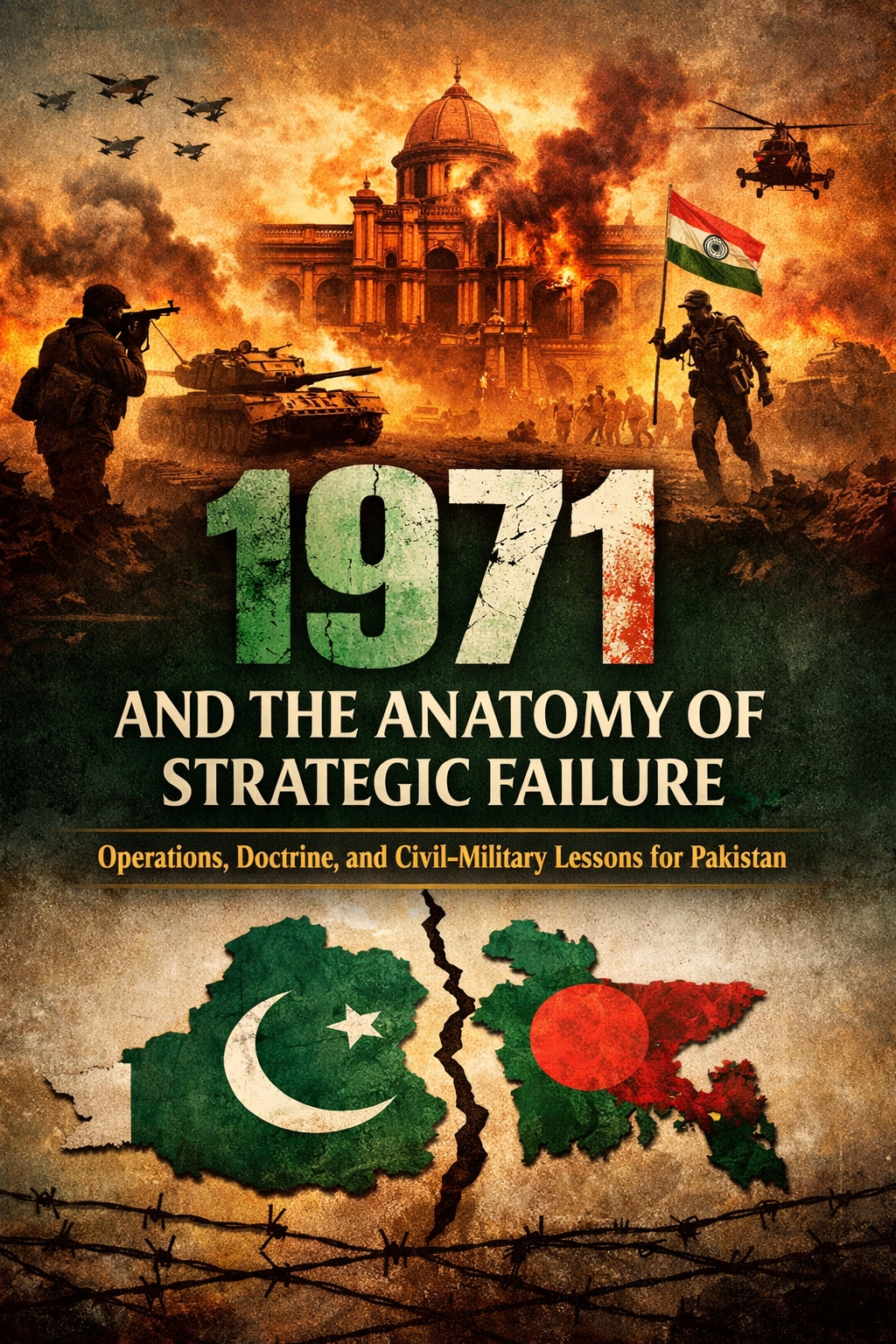

Indo Pak War 1971 and the Anatomy of Strategic Failure:
Operations, Doctrine, and Civil–Military Lessons for Pakistan
-
Background
-
Why 1971 Still Matters
The Indo–Pakistan War of 1971, culminating in the fall of Dhaka and the dismemberment of Pakistan, stands as the most profound strategic failure in the country’s history. It was not merely the loss of territory or the surrender of forces; it was the collapse of an entire state project—political, military, diplomatic, and moral—under the weight of accumulated misjudgments. Despite its magnitude, 1971 remains inadequately examined in Pakistan’s strategic culture, often recalled through emotional narratives or selective blame rather than subjected to systematic institutional learning.
-
The Core of issue
This study proceeds from the premise that Pakistan did not lose East Pakistan solely because of Indian military superiority or international conspiracy, but because its leadership—civil and military—failed to align political legitimacy, military doctrine, diplomatic strategy, and alliance management into a coherent national response. The defeat was not sudden; it was the predictable outcome of decisions taken—and options deliberately avoided—over several years.
-
The Purpose
The purpose of this paper is not to reopen wounds, assign individual culpability, or engage in retrospective moralism. Its purpose is analytical clarity: to understand how a state with forewarning, time, and partial military capability still collapsed so completely, and what that failure reveals about enduring vulnerabilities in Pakistan’s national security decision-making.
-
The Format
To communicate these issues effectively, multiple formats were considered, including a formal academic research paper, a doctrinal lessons paper, and a structured civil–military dialogue guide. After careful evaluation, the below format was selected as the most appropriate format to present the subject with balance, depth, and institutional acceptability. Other versions remain available for publication or adaptation according to future need, audience, or context, without altering the substance of the analysis.
-
The Strategic Context Before the War
-
Political Legitimacy as the First Casualty
By the time military operations began in East Pakistan in March 1971, the crisis had already passed the point where force alone could resolve it. The 1970 general elections had delivered an unequivocal political mandate to the Awami League, yet the transfer of power was delayed, contested, and ultimately denied. This denial transformed a constitutional impasse into a crisis of legitimacy (Raghavan, 1971: A Global History).
Once legitimacy eroded, every subsequent state action—administrative, military, or diplomatic—was viewed by a significant portion of the population as coercive rather than corrective. Insurgency did not emerge in a vacuum; it arose from a political environment where the state no longer commanded consent.
-
Militarization of a Political Problem
Operation Searchlight was conceived as a law-and-order operation but executed as a military suppression campaign. This marked a decisive shift: the problem ceased to be political and became militarized, drawing Pakistan into a conflict where it was strategically disadvantaged from the outset (Hamoodur Rahman Commission Report).
From a strategic perspective, the crucial error was not the use of force per se, but the assumption that force could substitute for political reconciliation. Once this assumption took root, military planning became reactive rather than strategic.
-
The Eastern Theatre: Operations and Analysis
-
Geography, Demography, and Strategic Reality
East Pakistan was not simply another province; it was a geographically isolated theatre, separated from West Pakistan by over a thousand miles of hostile territory. Its riverine terrain, dense population, and porous borders with India made it inherently vulnerable to infiltration, blockade, and encirclement (Sisson & Rose, War and Secession).
Yet this reality was never reflected in Pakistan’s force posture or doctrine. Unlike West Pakistan, which was planned for defense in depth with reinforcement options, East Pakistan was treated administratively as integral but militarily as peripheral.
Any serious defense of East Pakistan required one of two doctrinal choices:
- Political accommodation to prevent war, or
- Acceptance that East Pakistan would have to fight as an autonomous, self-contained theatre.
Neither choice was fully embraced.
-
Force Preparation and Strategic Neglect
-
Why Pakistan Was Not Prepared
-
By December 1971, Pakistan had approximately 45,000 regular troops in East Pakistan, supplemented by paramilitary forces. These forces were:
-
-
- Logistically isolated,
- Critically short of ammunition and spares,
- Without realistic prospects of reinforcement once hostilities began (Cloughley, A History of the Pakistan Army).
-
This was not an intelligence failure. The impossibility of reinforcement was known. What failed was institutional honesty—the unwillingness to plan for politically uncomfortable outcomes.
No credible war-gaming was conducted for scenarios involving:
-
-
- Prolonged isolation,
- Indian multi-axis advance,
- Collapse of civil administration,
- Loss of air superiority within days.
-
To plan for such outcomes would have required confronting the possibility that East Pakistan might not be held indefinitely—a conclusion political leadership was unwilling to accept.
-
Indian Strategy and the Liberation Narrative
India’s strategic success lay not merely in battlefield execution but in narrative dominance. By framing the conflict as a liberation struggle for Bangladesh, India achieved several objectives simultaneously:
-
- Internationalized Pakistan’s internal crisis,
- Delegitimized Pakistani military action,
- Justified intervention as moral rather than territorial (Bass, The Blood Telegram).
Pakistan’s generals misread this narrative as rhetorical rather than strategic. Consequently, they attempted to secure every border sector to prevent territorial fragmentation, instead of identifying and defending centers of gravity—command integrity, Dhaka, and political leverage.
This error diluted already insufficient forces and facilitated Indian penetration deep into the interior.
-
Pakistani Operational Choices — A Critical Evaluation
Contrary to later claims, Pakistan’s Eastern Command was not without options. What it lacked was the freedom—and perhaps the courage—to pursue them.
-
- Option 1: Border-Centric Defense
Adopted in practice, this option dispersed forces thinly along the frontier.
-
-
- Militarily unsustainable
- Ignored terrain and enemy mobility
- Led directly to piecemeal defeat
- Option 2: Defense of Vital Areas
-
Concentration around Dhaka and key communication hubs.
-
-
- Would concede territory but preserve command cohesion
- Politically sensitive but militarily sound
- Never fully implemented
- Option 3: Phased Withdrawal and Elastic Defense
-
Trading space for time.
-
-
- Could delay collapse
- Required prior planning and psychological readiness
- Institutionally rejected as defeatist
- Option 4: Strategic Concentration with Controlled Loss
-
Preserve force integrity for negotiation leverage.
-
-
- Militarily viable
- Politically unacceptable to leadership
- Option 5: Early Political–Military Disengagement
-
Negotiate before encirclement.
-
-
- Strategically optimal
- Politically impossible by late 1971
- Assessment:
-
The least damaging option would have been early concentration on Dhaka with phased withdrawal, coupled with political disengagement. Failure to adopt this course ensured encirclement.
-
The Fall of Dhaka
By mid-December 1971, Indian forces had achieved operational paralysis of Eastern Command. Communications were disrupted, morale collapsed, and senior leadership faced an untenable situation. Surrender became not a choice, but the only remaining means to prevent further loss of life (Niazi, The Betrayal of East Pakistan).
-
DIPLOMACY, ALLIANCES, AND MORAL DIMENSION
-
Diplomacy, Ceasefire Politics, and Bhutto’s Role
Pakistan’s diplomatic strategy lagged behind battlefield reality. Efforts at ceasefire were reactive and poorly timed. While Mr. Bhutto sought diplomatic leverage at the United Nations, events on the ground had already overtaken negotiation space (Kux, The United States and Pakistan).
-
Alliances and Strategic Miscalculations
Pakistan’s leadership overestimated American willingness to intervene militarily. The US viewed Pakistan through a Cold War prism but was unwilling to confront India directly (Haqqani, Magnificent Delusions).
India, by contrast, used its treaty with the Soviet Union as deterrence, not dependence.
-
Moral Condition of Leadership
By December 1971, Pakistan’s senior leadership—civil and military—suffered from:
-
- Decision paralysis,
- Fear of political consequences,
- Absence of professional dissent.
Moral legitimacy had collapsed, and with it, fighting spirit at the strategic level.
-
DOCTRINAL LESSONS FOR PAKISTAN
-
Core Doctrinal Lessons
- Political legitimacy is foundational to national defense
- Not all territory is strategically equal
- Planning for worst-case scenarios is not disloyalty
- Withdrawal can be a strategic act
- Alliances supplement, not substitute, national strength
-
CIVIL–MILITARY DIALOGUE AND NATIONAL POLICY
-
Are We Repeating Patterns Today?
History does not repeat mechanically, but institutions repeat habits. Pakistan must constantly ask whether:
-
- Political disputes are being securitized,
- Alliances are being overestimated,
- Dissent is being discouraged,
- Strategic planning is constrained by political comfort.
- CONCLUSION
1971 remains Pakistan’s most severe strategic warning—not because it was exceptional, but because it revealed how states fail when legitimacy, strategy, and leadership diverge. Remembering 1971 is not enough. Learning from it is a continuous obligation.
References (Indicative)
- Hamoodur Rahman Commission Report
- Raghavan, S. 1971: A Global History
- Sisson & Rose, War and Secession
- Bass, G. The Blood Telegram
- Cloughley, B. A History of the Pakistan Army
- Kux, D. The United States and Pakistan
- Haqqani, H. Magnificent Delusions
- Niazi, A.A.K. The Betrayal of East Pakistan