Ego: Friend, Foe, and Everything in Between
Ego Friend, Foe, and Everything in between, one evening, I watched two kids argue over a toy car. Both claimed, “It’s mine!” Neither wanted to back down. The funny part? The toy actually belonged to their neighbour. I couldn’t help but laugh, but it struck me how much that moment resembled adults fighting over credit at work, countries fighting over borders, or couples refusing to apologise after an argument. What drives these standoffs? Ego.
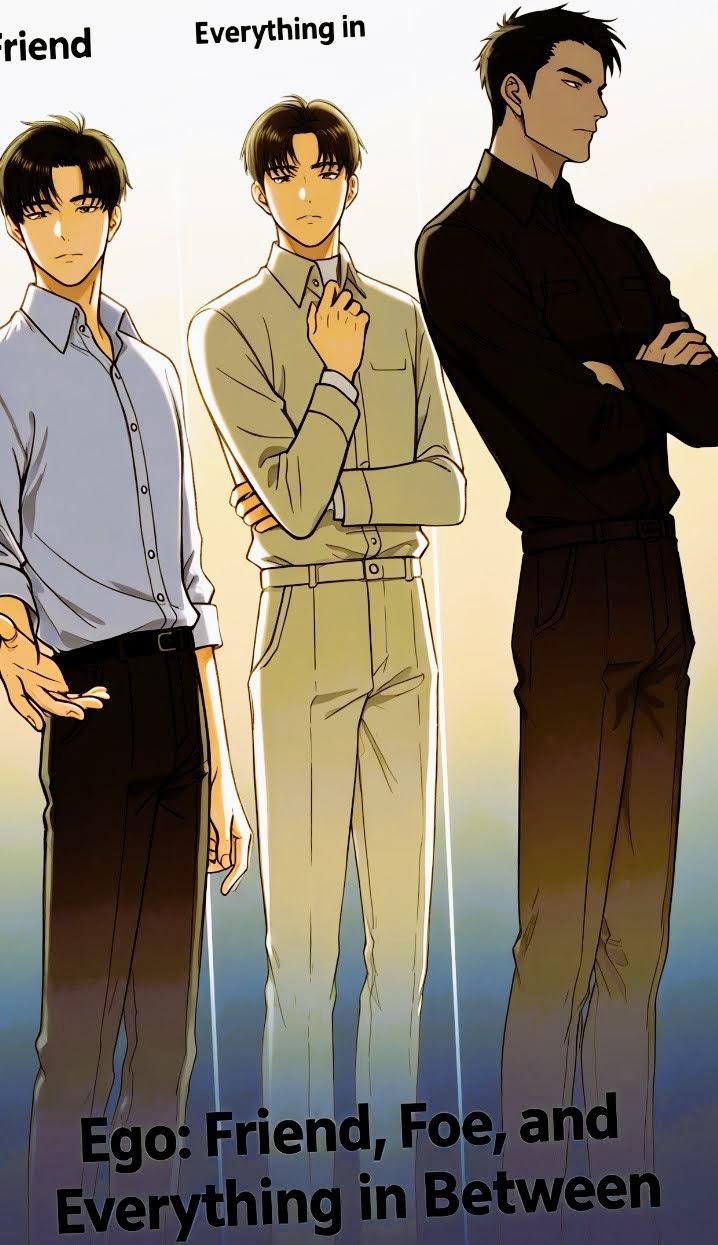
Ego: The Invisible Driver of Personality and Society
What comes to mind when you hear the word “ego”? For many, it raises images of pride, arrogance, or someone who just can’t stop talking about themselves. But ego is much more than just a big ego or a fragile one. It’s a complex and essential part of who we are, shaping everything from our self-identity to our relationships and even society at large. If ego were a character in a movie, it would be the unseen lead, influencing the plot twists and character arcs in ways we often overlook.
Understanding Ego: What It Really Means
At its core, the ego is the sense of “I” or “me”, the part of our mind that experiences the world from a personal perspective. Imagine it as the captain of your mental ship, steering your thoughts, feelings, and actions. But unlike a captain who navigates with a clear map, ego sometimes gets lost in illusions of grandeur or insecurity, leading to behaviours that can either empower or undermine us.
What Exactly Is Ego?
Ego, in psychoanalytic theory, that portion of the human personality which is experienced as the “self” or “I” and is in contact with the external world through perception. It is said to be the part that remembers, evaluates, plans, and in other ways is responsive to and acts in the surrounding physical and social world.
The ego is our sense of self. It’s the voice that says, “I am important, I matter.” When balanced, it’s the engine behind self-respect and courage. It helps you raise your hand in class, ask for a promotion, or defend yourself when you’re wronged.
But the ego has a shadow side. When it swells beyond reason, it demands attention, craves superiority, and resists humility. That’s when ego morphs from friend to foe.
Characteristics of Ego: The Good, the Bad, and the Misunderstood
The ego wears many hats. On the positive side, it helps us build self-confidence and assert our needs, fostering resilience and ambition. Picture a young artist who believes in their potential despite countless rejections; that’s a healthy ego at work.
On the flip side, ego can turn into a double-edged sword. When inflated, it breeds arrogance, defensiveness, and a refusal to acknowledge mistakes. A classic example is the corporate executive who can’t accept feedback because it dents their inflated self-image. Conversely, an underdeveloped or fragile ego might lead to self-doubt and a desperate need for approval, much like a teenager battling social anxiety.
The Two Faces of Ego
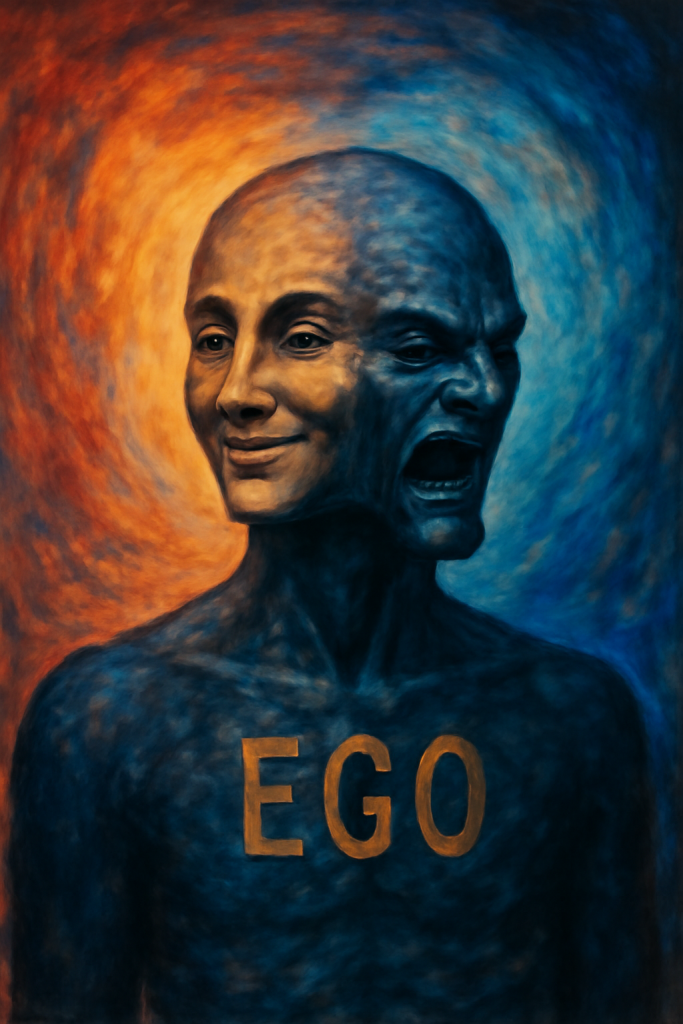
- The Healthy Ego: A strong but humble sense of self. It gives confidence, resilience, and dignity.
- The False Ego: A mask of arrogance, always seeking validation and fearing criticism. It thrives on comparisons and often leaves a trail of broken relationships.
Metaphor: Ego is like fire. In the hearth, it warms the house. Unchecked, it burns it down.
The Story of Satan: A Lesson in Ego
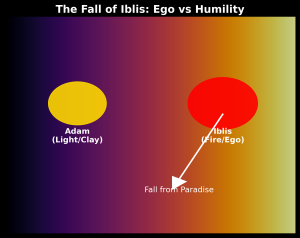
In Islamic tradition, the story of Satan (Iblis) is the ultimate reminder of the dangers.
Before his fall, Iblis wasn’t evil. He was one of the most devoted worshippers of Allah. Angels admired his piety, his knowledge, and his obedience. But when Allah created Adam and commanded the angels and Iblis to bow, the angels obeyed. Iblis refused.
His reasoning? “I am made of fire, Adam is made of clay. I am superior.”
That pride and arrogance cost him Paradise. Despite centuries of worship, one act of disobedience, rooted in ego, was enough to cast him out of Janna. His story warns us that an unchecked ego can undo even the highest spiritual rank.
The Psychology of Ego: Freud’s Perspective
To bring things down from the spiritual to the psychological, let’s look at Freud’s model of the human mind. He broke it into three parts:
- Id: The childlike part of us that wants instant pleasure. Think of it as the voice saying, “Eat the cake now, forget the diet.”
- Superego: The strict parent in your head, focused on rules, morals, and ideals. It scolds you with, “Don’t you dare touch that cake, you’ll regret it.”
- Ego: The referee between the id and superego. It negotiates: “Okay, maybe just one slice of cake after dinner.”
In Freud’s view, the ego isn’t just pride; it’s a balancing act between desire and morality. A strong, healthy ego keeps us grounded in reality. A weak or inflated ego tips the balance, leading to unhealthy behaviour.
Ego’s Role in Human Personality: The Inner Tug-of-War
Our personalities are a patchwork quilt, and ego is one of the threads holding it together. It influences our motivations, interactions, and how we cope with challenges. Ever argued with a friend and realised you were both stubbornly defending your own “rightness”? That’s ego playing tug-of-war.
Ego acts like a filter, colouring how we interpret feedback, success, or failure. It’s why two people can experience the same event differently; one sees a challenge, another a threat to their ego. Learning to recognise when ego is helping versus hurting can transform personal growth and relationships.
The story of Iblis and Freud’s model shares a core lesson: ego shapes how we live. A balanced ego makes us confident, resilient, and fair. An inflated ego makes us rigid, defensive, and often destructive.
- In families, the ego can create walls where bridges should be.
- In workplaces, it can turn cooperation into competition.
- In society, it can spark conflict on a massive scale.
Impact of Ego on Society: Bridging or Burning Connections?
On a societal level, ego shapes culture, politics, and social norms; collective egos fuel movements and innovations but also conflicts and divisions. For example, national pride can inspire unity and progress, but when it turns into a sense of superiority, it sparks rivalry and discord.
In everyday interactions, ego influences empathy and cooperation. A community thrives when its members subdue individual egos for the common good. Conversely, societies struggle when ego-driven behaviour fosters inequality, intolerance, or power struggles.
- Reflect daily: Ask, “Am I acting out of confidence or arrogance?”
Ego is not just personal, it’s collective. Leaders driven by arrogance wage wars. Communities fractured by pride lose their harmony. On the other hand, balanced egos have driven some of humanity’s greatest achievements, civil rights movements, groundbreaking inventions, and acts of courage.
Balancing Ego: Practical Tips for Everyday Life
Managing ego is like tuning a musical instrument; it requires attention and practice. Here are some practical steps:
- Self-awareness: Regularly check in with your feelings and motivations. Are your actions driven by egoic need or authentic desire?
- Listen actively: Sometimes your ego needs to take a back seat.
- Embrace humility: Accept mistakes as growth opportunities rather than threats to your ego. Success is never yours alone.
- Practice empathy: See situations from others’ perspectives to soften the ego’s grip.
- Mindful communication: Speak and listen with openness, avoiding defensiveness.
- Reflect on your triggers: Notice when your ego flares and pause before reacting.
- Learn to say sorry: Apologies are ego’s kryptonite.
- Reflect daily: Ask, “Am I acting out of confidence or arrogance?”
We can’t eliminate ego; it’s part of us. But we can guide it:
Final Thoughts
Ego is a double-edged sword. It can give us the strength to climb mountains or push us off cliffs of our own making. The story of Iblis shows how ego, even after a lifetime of worship, can lead to downfall. Freud’s model reminds us that the ego is not evil; it’s essential. But it must be guided, not worshipped.
So the real question is: Do you control your ego, or does it control you?
Wrapping Up Ego’s Story
Ego is neither villain nor hero; it’s the unseen force shaping human experience. Like any powerful tool, it can build or break, depending on how we wield it. By understanding ego’s nuances, growing from its lessons, and keeping it in check, we navigate life with greater clarity, kindness, and connection. So, the next time ego tries to take centre stage, remember: even the best actors need a good director.