Here’s a startling thought: What if someone told you that you could get therapy from your phone at 3 AM without waiting months for an appointment, without spending $200 per session, and without worrying about a therapist being too tired to help or secretly judging you?
https://mrpo.pk/ai-mental-health-care-digital-therapy/
Most people would laugh and think it’s a joke. But here’s what’s genuinely wild: it’s not a joke anymore. It’s real, it’s working for millions of people, and you’ve probably never heard about it because it doesn’t fit the traditional therapy narrative we’ve all grown up with.
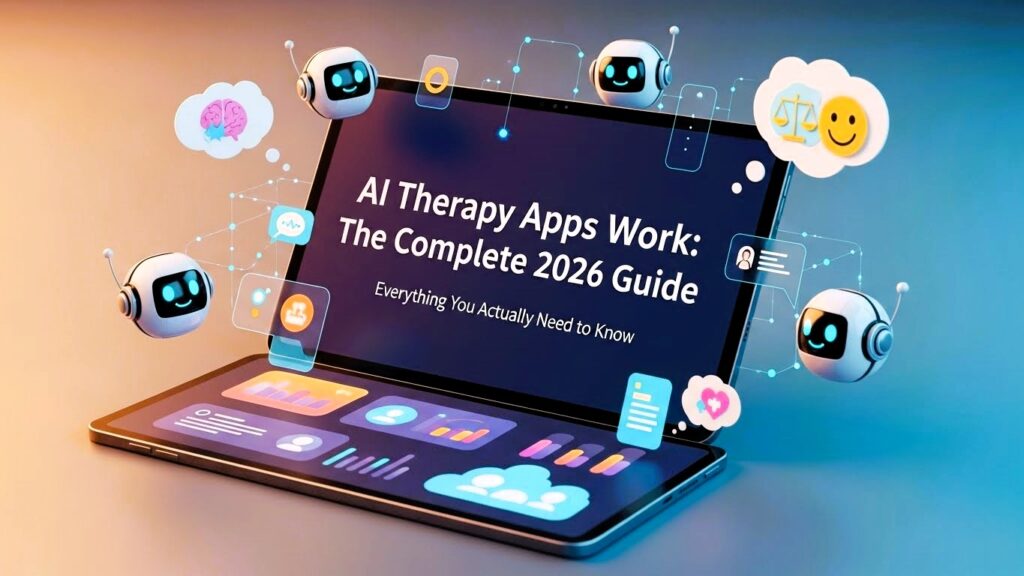
Artificial intelligence (AI) has become a useful tool in health care, helping doctors take advantage of vast amounts of data to make informed decisions and recommend precise treatment plans for individuals seeking care. In mental health care, AI chatbot therapy platforms also use large amounts of data to instantly communicate with those seeking emotional support.
But is AI therapy as valuable as therapy with a trained human professional? Here you can discover how AI therapy works and the types of mental health concerns it can address, as well as limitations and potential risks. https://www.forbes.com/health/mind/ai-therapy/
The Mental Health Crisis Nobody Talks About: The Access Problem
Before diving into AI therapy, let’s acknowledge the elephant in the room. There are roughly 100,000 licensed therapists in the United States. The population is 330 million people. For every single therapist available, there are approximately 3,300 people who need one.
This isn’t a failure of the mental health profession. It’s a mathematical impossibility. You can’t train enough therapists fast enough. The schooling takes years. The burnout is real. The costs are astronomical.
Meanwhile, people are waiting 6 months for an appointment, paying $150–300 per session they can’t afford, living in rural areas with zero mental health options, and suffering in silence because the traditional system was designed for a different era.
This is the gap AI mental health tools are filling. Not replacing human therapists. Filling the gap.
What Exactly Is AI Mental Health Care?

Let’s skip the jargon and get to the point.
AI mental health care is software trained on therapy techniques that talks to you, listens to what you’re going through, and uses psychology-based methods to help you feel better. Think of it as a therapist who has studied thousands of successful therapy sessions, learned the patterns of what helps people with anxiety and depression, and is available to talk whenever you need it.
Most AI mental health apps are built around Cognitive Behavioural Therapy (CBT), which is fundamentally simple: our thoughts influence our feelings, which influence our actions. By gently challenging unhelpful thought patterns, these apps help you break cycles that keep you stuck.
Here’s the honest part upfront: the AI doesn’t feel anything. It’s not losing sleep over your problems. But it does analyse your words, recognise patterns, and respond with suggestions backed by decades of psychological research about what actually works.
The most researched and effective apps include Woebot (free, focuses on quick daily check-ins), Wysa (mood tracking with personalised exercises), Therabot (the first to prove significant results in a major clinical trial), and even ChatGPT (versatile, if you’re good at follow-up questions).
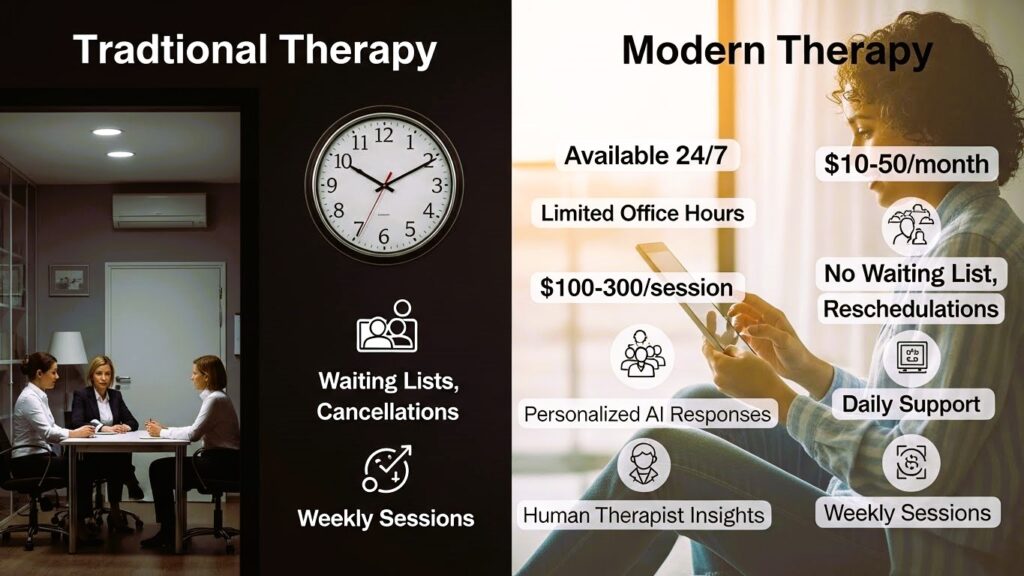
The core differences from traditional therapy:
-
Available 24/7, not just during office hours
-
Costs $10–50 per month instead of $100–300 per session
-
No waiting list. No rescheduling. No, “I’m sorry, I had a cancellation next month”
-
Learns your patterns and personalises responses
-
Frequent support (daily) instead of weekly sessions
How It Actually Works: The Step-by-Step Process
Step 1: Download and Get Started (Genuinely Takes 2 Minutes)
Pick an app. Let’s use Woebot since it’s free and straightforward. Download, create an account with your email or Google login, and you’re in.
No 10-page intake form. No questionnaire that feels like a prison psychologist assessment. No waiting for approval. Just in.
Step 2: Initial Check-In
The app asks how you’re feeling. Casual. “How’s your vibe today?” or “Rate your mood on a scale.” Not invasive. Just gathering baseline information.
This is where the AI starts learning about you.
Step 3: The Conversation Begins
You start talking about what’s on your mind. The app responds as a human therapist would, but with structured psychology underneath.
If you say, “I’m really anxious about my presentation tomorrow,” it doesn’t just say “, That sounds tough.” Instead, it might ask:
-
“What specifically are you worried will happen?” (Identifying the actual fear, not vague dread)
-
“Have you handled presentations before?” (Reminding you of past successes)
-
“What’s one thing you could do right now to feel more prepared?” (Moving from anxiety to action)
This is CBT working. It sounds simple because it is. That simplicity is why it works.
Step 4: Mood Tracking and Pattern Recognition
Here’s where it becomes powerful: the app remembers. It tracks your mood across days and weeks, identifies patterns, and shows them back to you.
Most people have no idea when their anxiety spikes or what triggers it. Seeing this visualisation is often the first real insight into your own mind.
You might notice: “My stress always peaks on Mondays before meetings because I haven’t prepared the night before.”
That’s the lightbulb moment. That’s where change begins.
Step 5: Personalised Coping Tools
Based on what you’ve shared, the app suggests specific tools:
-
Guided breathing exercises for anxiety spirals
-
Thought-challenging worksheets for depression
-
Behavioural activation (structured activities that lift mood)
-
Sleep hygiene routines
-
Journaling prompts
-
Mindfulness exercises
You try them. The app learns what actually helps you and suggests it more often.
Step 6: Ongoing Support, Not Scheduled Sessions
Traditional therapy: 50 minutes once a week. The rest of the week, you’re on your own managing symptoms.
AI therapy: Daily support throughout the week. Panic attack at midnight? Open the app. Bad day? Check in during lunch. Spiralling about something? Support at 3 AM.
Does It Actually Work? The Evidence
Let me be blunt: if something claims to help your mental health, you should see actual data, not marketing fluff or testimonials from people with a financial interest.
Good news, there’s surprisingly solid research here.
The Dartmouth Clinical Trial (2025)
In March 2025, Dartmouth researchers published the first major randomised controlled trial of an AI therapy chatbot. They tested Therabot with 210 people who had clinical-level depression and anxiety.
The results exceeded expectations:
-
Depression symptoms dropped by 51%
-
Anxiety symptoms dropped by 31%
-
These improvements matched traditional outpatient therapy
Users spent about 6 hours total with the app over 8 weeks, equivalent to roughly eight traditional therapy sessions. Not bad for something you can use while sitting in traffic or lying in bed.
The Meta-Analysis: Consistency Across 18 Studies
When researchers looked at 18 different randomised controlled trials involving 3,477 people, the pattern was clear: AI therapy chatbots produced reliable, measurable improvement across diverse populations.
Key findings:
-
Depression and anxiety both showed significant improvement
-
Benefits started showing around week 4
-
Maximum improvements are visible by week 8
-
Effects were consistent even with different platforms
This wasn’t a magic cure. But it was a consistent, reliable improvement.

Real-World Campus Results
The University of Western Cape deployed Wysa across its 24,000-student campus. Here’s what happened:
-
35% reduction in depression scores among regular users
-
32% reduction in anxiety scores
-
91% of users rated the tools as helpful
-
Campus counselling demand dropped by 4%
This wasn’t a replacement for human counselling. It was meaningful support for people who would have otherwise gone unsupported.
Why It Actually Works
Research points to several mechanisms:
Immediate availability: When you’re anxious at 2 AM, you don’t wait for your Thursday appointment. Support is now. That immediacy matters.
Consistency: An AI won’t have a bad day. Won’t be distracted by personal problems. Won’t rush you. That reliability creates safety.
Personalisation: After a few conversations, the app knows what triggers you and what helps you specifically. It adjusts recommendations accordingly.
Frequency: Weekly therapy is standard. Daily AI support is more intensive. That frequent reinforcement of coping skills accelerates both learning and change.
The Step-by-Step Guide to Actually Using This in Real Life
Knowing it works in studies is one thing. Actually integrating it into your chaotic, real life is another.
Choosing the Right App
Different apps have different personalities:
Woebot: Quick, structured check-ins. Feels more like a friendly game than therapy. Best if you like efficiency and prefer not to overthink things.
Wysa: More focus on mood tracking and personalised exercises. Slightly more guided. Better if you want actionable suggestions tailored to you.
Therabot: Most clinically rigorous. Best if you want evidence-based approaches, though less charming than the others.
ChatGPT: Most versatile. Works if you’re good at asking thoughtful follow-up questions and don’t need hand-holding.
Try two or three free versions for a week each. Don’t overthink it.
Habit Stacking: How to Actually Keep Using It
The biggest mistake people make: treating this like they’ll suddenly find time for it when they can’t find time for anything else.
Instead, stack it with something you already do:
-
After you brush your teeth, → Open the app for 3 minutes
-
Before bed → Do a 5-minute mood check-in while lying down
-
On your morning commute → One conversation during the bus ride
-
While waiting in line → Better than scrolling through news
The goal isn’t long, deep sessions. Research shows short, frequent check-ins are actually more effective than long, irregular ones.
Starting Ridiculously Small
Most people quit because they expect too much too fast.
Week 1: Just explore the app. Get comfortable. Answer questions. Notice how you feel. No pressure to “do therapy.”
Week 2–3: Try one suggested exercise. One.
Week 4+: Build from there.
This sounds almost embarrassingly simple, but it’s exactly why successful users keep using these apps and others quit after three days.
What to Share and What Not To
The AI works best when you’re honest. It doesn’t judge. Tell it:
- That you’re anxious about being judged
That you’re avoiding someone or something
That you’re frustrated that your life isn’t where you expected
That you’re exhausted from pretending to be fine
That you have catastrophic thoughts about things that haven’t happened - Don’t use it for:
Medical advice (chest pain = doctor, not an app)
Getting diagnosed (apps can’t diagnose, only help with symptoms)
Crises (suicidal thoughts = crisis line, not an app)
Processing complex trauma (requires a trained human therapist)
Tracking What Actually Changes
After 3 weeks, write down:
-
What was your anxiety level at the start? (1–10 scale)
-
What is it now?
-
What situations triggered you before? Are they triggering you the same way?
-
What coping skill actually helped?
-
What surprised you about yourself?
This isn’t a diary. This is evidence. It helps you see whether this is actually working for you specifically.
The Honest Truth: Real Limitations
If I’m giving you the research-backed benefits, I have to give you the honest limitations. AI therapy cannot and should not:
Diagnose you. An app can help manage anxiety symptoms, but can’t tell you whether you have generalised anxiety disorder, social anxiety, panic disorder, or something else. Diagnosis requires a human professional who understands your full context.
Replace trauma therapy. If you’ve experienced significant trauma, abuse, or complex PTSD, you need a trained trauma therapist. The AI doesn’t have the nuance to navigate that safely.
Detect crises. An AI can’t hear the tremor in your voice or notice behavioural signs that mean you’re genuinely at risk. Suicidal thoughts, self-harm urges, or psychosis require immediate human help.
Prescribe medication. If you need psychiatric medication, you need a psychiatrist or doctor who can do a full evaluation. The app can support you while taking medication, but can’t replace that clinical assessment.
Navigate really complex family dynamics or personality disorders. These require clinical judgment that the current technology doesn’t possess.
Understand cultural nuance perfectly. The app tries to be culturally sensitive, but humans understand the specific weight of expectations within a culture, the shame around mental health in certain communities, and the specific pressures you face. An app gets it broadly; a therapist from your culture gets it deeply.
The Privacy Reality Check
Most AI mental health apps collect your data. Some handle it better than others. This is worth thinking about:
-
Some apps have been fined for sharing data with Facebook and TikTok
-
Your conversations are stored on company servers
-
If there’s a breach, your mental health information could be exposed
-
Not all apps are fully HIPAA-compliant (the law protecting medical privacy)
How to protect yourself:
-
Actually read the privacy policy (yes, I know)
-
Check if the app is HIPAA-compliant
-
Use a pseudonym if you want extra anonymity
-
Don’t share information you absolutely don’t want exposed
-
Assume nothing is completely private unless explicitly stated
This isn’t meant to scare you away, just be aware. Many leading apps take privacy seriously. Verify before diving in.
The Myth That’s Actually Wrong
Most people think, “AI therapy isn’t real therapy because a machine can’t care about me.”
What the research actually shows: People form genuine therapeutic relationships with AI.
In the Dartmouth study, participants reported feeling understood and supported. They initiated conversations, especially late at night when struggling. They came back because it helped, not because forced.
One participant noted: “I was able to open up about things I was ashamed to tell a human therapist.”
Here’s the paradox: the very impersonal nature of talking to an AI removes stigma for some people. You can be completely honest with a machine in ways you might not be with a person who could judge you.
Does the AI “care”? No. But does it help you care for yourself better? Yes. And that’s actually the point.
AI Therapy vs. Human Therapy: When to Use Each
Use AI therapy when:
-
You have mild to moderate anxiety or depression
-
You need support more frequently than weekly
-
You can’t access therapy due to cost or geography
-
You want to practice coping skills between therapy sessions
-
You need 24/7 support for stress management
-
You’re trying to build better mental habits
-
You’re not in acute crisis
Use human therapy when:
-
You’re having suicidal or self-harm thoughts
-
You have a diagnosed condition requiring medication management
-
You’re processing trauma or abuse
-
You have personality disorders
-
Your symptoms severely impact daily functioning
-
You’ve tried AI therapy for 8 weeks with no improvement
The honest reality: These aren’t either/or. The most effective approach is both. Use AI therapy daily for maintenance and support. See a human therapist for the deep, complex work. Research shows that people combining both get better results than either approach alone.
What Actually Changes: Real-World Examples
Let’s move past statistics and talk about experience.
A college student using Woebot for 4 weeks:
Started the app in a panic spiral before exams. Used it to ground herself when anxiety spiked. Learned to recognise catastrophic thinking patterns. Stopped believing every anxious thought was true. Took exams without the paralysing fear.
A parent using Wysa during high stress:
Started tracking when they felt most irritable. Noticed patterns (always worse when hungry, tired, alone with kids). Used breathing exercises and mood-lifting activities. Realised they weren’t broken; they were overwhelmed. Began treating themselves like they’d treat a friend in crisis.
A person in early depression recovery using daily check-ins:
Can see concrete evidence of improvement when depression lies to you and says nothing’s getting better. Behavioural activation suggestions got them off the couch. Mood tracking proved that bad days were getting further apart. Built a routine that stuck because it was frequent, not just weekly.
These aren’t paid testimonials. These are patterns that consistently show up in research studies.
The Setup: How to Start Today
If you have 10 minutes right now:
-
Pick one app (flip a coin if you can’t decide)
-
Download it
-
Create an account
-
Do the initial check-in
-
Come back tomorrow
That’s literally all you need to do.
If you want to maximise chances of sticking with it:
-
Tell someone you’re trying it (accountability helps)
-
Schedule a specific time daily
-
Set a phone reminder
-
Give yourself permission to try it and hate it (you can quit)
-
Evaluate after 4 weeks, not 3 days
The realistic timeline for results:
-
Weeks 1–2: Feeling like maybe there’s help. Slight relief from being heard.
-
Weeks 3–4: First real shifts in thinking or mood.
-
Weeks 4–8: Noticeable improvement in anxiety/depression. Better coping skills working in real life.
-
Week 8+: Maintenance mode. Patterns feel automatic. You’re struggling less.
Not everyone experiences it this way. Some see benefits immediately. Others take longer. But research suggests if you notice nothing after 8 weeks, it’s probably not the right fit.
Why This Actually Matters
AI mental health tools aren’t a luxury or an experimental gimmick. They’re filling a gap that desperately needs filling.
They’re letting people in rural areas get support. They’re helping people who can’t afford $200 therapy sessions. They’re providing immediate help to people in crisis when a therapist isn’t available. They’re bridging the impossible math of mental health access.
Are they perfect? No. Should they replace human therapy for serious conditions? No. But should we have dismissed them as “fake therapy” when research shows they actually work? Absolutely not.
The evidence is clear: they help. Not for everything. Not for everyone. But for a lot of people, in a lot of situations, they produce measurable, clinically significant improvements.
Final Word: You Don’t Need Permission
You don’t need permission to start. You don’t need to hit rock bottom. You don’t need to have been diagnosed with depression or clinical anxiety. If you’re struggling, overwhelmed, anxious, stressed, or feeling stuck, tools exist.
Will an AI app solve your life? No.
Will it give you some relief, some tools, some clarity, and maybe help you feel less alone at 3 AM? Absolutely.
And sometimes, that’s the difference between suffering in silence and starting to actually deal with things.
Start small. Stay realistic. Use it as one tool among many. And if it helps, great. If it doesn’t, try something else.
But at least try. Because the research says it probably will.
Frequently Asked Questions
Q: Is this actually confidential?
A: Mostly, but read the privacy policy. It’s stored on servers, so it’s not as private as talking to your therapist in person. Don’t share information you’re not willing to risk becoming public.
Q: How much does this cost?
A: Free to $50/month typically. Try free versions first.
Q: Can I use this instead of medication?
A: No. If you’re on psychiatric medication, keep taking it. Use the app to support medication, not replace it.
Q: What if I don’t like the app after a few days?
A: Delete it and try another. They all have different personalities.
Q: Is this just for people with diagnosed mental illness?
A: No. Anyone dealing with stress, anxiety, bad habits, or life challenges can use these.
Q: Will people know I’m using AI therapy?
A: Only if you tell them. It’s just an app on your phone.
Q: How is this different from just journaling?
A: Journaling is passive. AI therapy is interactive. It responds, suggests, redirects, and personalises based on what you’re saying. It’s like having a coach; journaling is talking to yourself.
Q: My therapist said not to use AI. Should I listen?
A: Depends on your situation. If you have complex trauma or serious mental illness, they’re probably right. If you have mild anxiety, they might be working from outdated information. Have the conversation with them.
Q: What if I get emotionally attached to the AI?
A: That’s not a common problem. The AI is clearly an app. What people experience is gratitude for getting help, not romantic feelings toward the software.
Disclaimer: The content in this article is intended for informational and educational purposes only. It provides insights, tips, and general guidance on health, beauty, and wellness, but it is not a substitute for professional medical advice, diagnosis, or treatment.
Always consult a qualified healthcare professional for personal medical concerns. For more information about our approach to health and wellness content, please read our Health & Wellness Disclaimer.
References:
Bureau of Labor Statistics, occupational data on mental health professionals (2024)
Dartmouth study on Therabot effectiveness (2025), published in Nature Digital Medicine; meta-analysis of 18 RCTs by Zhong et al. (2024)
Scoping review of AI-driven digital interventions in mental health, PMC (2025)
Jacobson et al., Therabot clinical trial results, Dartmouth (2025)
Meta-analysis of AI chatbot effectiveness, Science Direct (2024)
Wysa case studies, University of Western Cape partnership outcomes
Examination of AI in online mental healthcare, examining frequency vs. intensity effects
Research on habit formation and consistency in mental health interventions
Review of limitations in AI psychotherapy, PMC (2025)
Clinical perspectives on AI chatbot limitations in complex cases, PMC (2025)
FTC enforcement actions against mental health apps sharing user data; privacy risks in AI mental health apps, Private Internet Access analysis (2025)
Therabot study participant therapeutic alliance measures; attitudes toward AI counseling research
Comparative effectiveness research on AI vs. human therapy
Research on hybrid models combining AI and human therapy
Case studies from app users and clinical trial participants
Timeline research on AI therapy effectiveness (4-8 week effectiveness window)
Systematic reviews of AI effectiveness in mental health care across multiple platforms and conditions