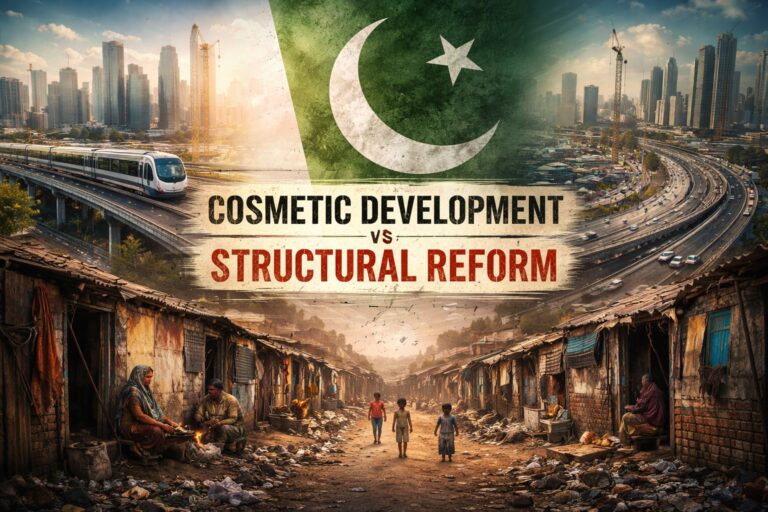
Trump’s Davos Peace Board: Trumplization and the Rise of Personal Diplomacy
When peace depends on a person, not a system, it is not diplomacy. It is a performance with consequences.
Editor’s Note
“Trumplization” is used here as an analytical framework to describe personality-driven diplomacy, not as a personal judgment. This article follows US journalistic standards for opinion and commentary on public figures.
EP Editor’s Perspective
This article examines the emergence of Donald Trump, linking peace initiatives through a structural lens. It does not evaluate intentions but interrogates form, durability, and power logic. The focus is on how personality-anchored diplomacy reshapes global norms, institutions, and expectations, especially when staged at elite platforms like Davos.
Trump’s Board of Peace Signs On in Davos: The Split That Could Redefine Global Power Plays
What to know about Trump’s Board of Peace
- President Trump is planning to unveil the charter of his “Board of Peace” on Thursday, during an event in Davos, Switzerland, set for 10:30 a.m. local time (4:30 a.m. ET).
- Announced last year as part of a Trump-brokered Israel-Hamas ceasefire plan, the Board of Peace has been framed as an international body chaired by the president to help oversee the reconstruction of the Gaza Strip.
- It’s not yet clear how the board will operate and what countries will join. The administration says dozens of world leaders have signed up, though a handful of European countries say they will hold off on joining.
The ink dried in Davos today, and the message landed like a quiet thunderclap: Trump’s Board of Peace isn’t just another think tank, it’s a live experiment in who gets to call the shots on fixing the world’s messes.
January 22, 2026. World Economic Forum crowds milling around Swiss chalets, but one closed-door ceremony stole the spotlight. Starting around 10:30 a.m. local (0930 GMT), President Donald Trump presided over the formal signing of the Board’s charter. No grand speeches dragged on forever, just leaders (or their proxies) stepping up, pen in hand, committing to a body Trump chairs for what the charter calls the long haul.
Gaza stays the starting line: reconstruction oversight, security through the International Stabilisation Force, transitional administration under UN Resolution 2803. But the real talk in the room? This thing’s scope is creeping wider, faster than anyone expected.
Roughly 35 nations out of 50+ invitations showed commitment strong enough to make the list credible. The lineup leans hard into Middle East pragmatists and a few outliers who smell opportunity.
UAE, Saudi Arabia, Egypt, Qatar, Bahrain, Jordan, Morocco, Gulf heavyweights and North African players signed early, often tying it back to the Abraham Accords and a shared interest in keeping Hamas sidelined while cash flows for rebuilding. Israel is locked in, too, with Netanyahu having moved past initial committee qualms.
Turkey (Foreign Minister Hakan Fidan repping Erdogan), Pakistan, Indonesia, Kazakhstan (President Tokayev flew in just for this), Azerbaijan, Belarus, Argentina, Paraguay, Kosovo, Hungary (Orbán’s enthusiastic nod), Armenia, that’s the core bloc. Pragmatic, often U.S.-friendly or normalisation-curious, ready to bet on results over endless UN debates.
The absences cut deeper. France said no outright, too much unilateral power in Trump’s hands, too big a shadow over the UN. Norway and Sweden skipped the whole thing, citing unresolved questions and risks to multilateral norms. The UK confirmed they wouldn’t sign, uneasy about the optics (and whispers of Putin potentially in the mix, Trump claimed acceptance; the Kremlin stayed vague on “studying”). Germany kept quiet on attendance, Italy’s signals mixed (Meloni talked constitutional headaches), Canada “in principle” but details foggy. Most old-school Western allies hung back, watching from the edges.
China and Russia? No visible signatures, no surprise after their UN abstention and steady wariness of anything smelling like a U.S.-led rival to the Security Council. The divide stares you in the face: strong buy-in from Arab states, Muslim-majority players, and a smattering of Global South/former Soviet orbit countries; thin to nonexistent support from Europe and traditional transatlantic partners.
Trump pitched it as peace through speed and strength, finally getting done what the UN couldn’t. Sceptics call it a membership club with a billion-dollar entry fee (voluntary, sure) and one man holding the veto. Either way, the Board’s wheels are turning now. Gaza ops ramp up first, but the map of who showed up in Davos already hints at new fault lines in how the world handles conflict.
Let’s see if the experiment holds or fractures under its own weight.
Peace Walks Into Davos Wearing a Name
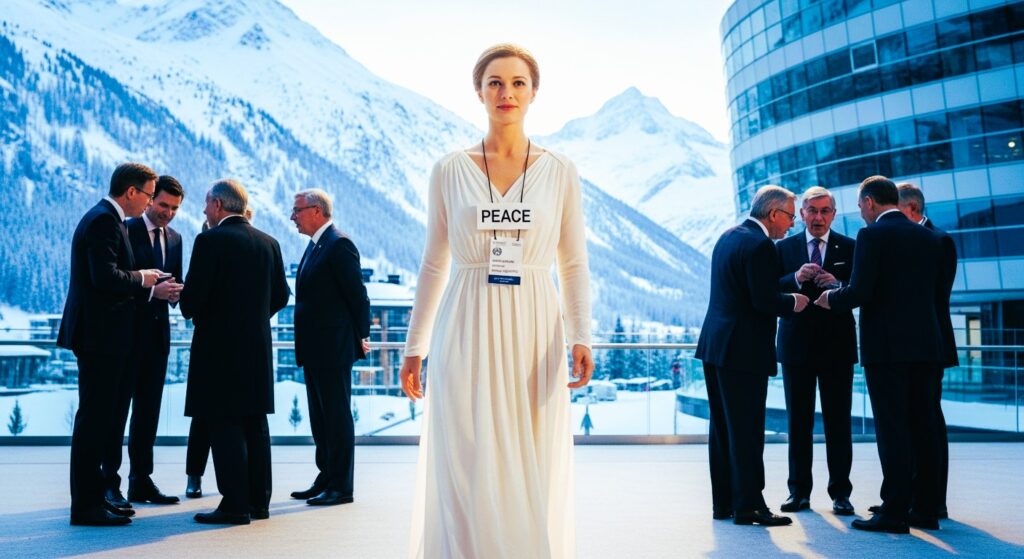
Davos has seen everything: billionaires preaching equality, polluters pledging green futures, and power brokers whispering sincerity over champagne.
What it rarely sees is peace walking in wearing one man’s name.
Trump’s so-called “Board of Peace” appearing on the Davos periphery is not a diplomatic milestone. It is a signal. A reminder. A test balloon. It tells the world something uncomfortable:
Global elites are no longer betting on institutions.
They are hedging on personalities.
This is not peace institutionalised.
This is peace personalised.
The Architecture of Personal-Specific Power
Strip away the branding and the rhetoric, and a simple question remains:
If there is no Donald Trump, what survives?
No charter outlives him.
No mandate exists beyond him.
No institutional memory functions without him.
That makes this initiative personal-specific, not multilateral.
Its legitimacy flows from proximity, not process.
Its authority is borrowed, not earned.
This is not a flaw.
It is the design.
Trumplization: When the Man Becomes the System
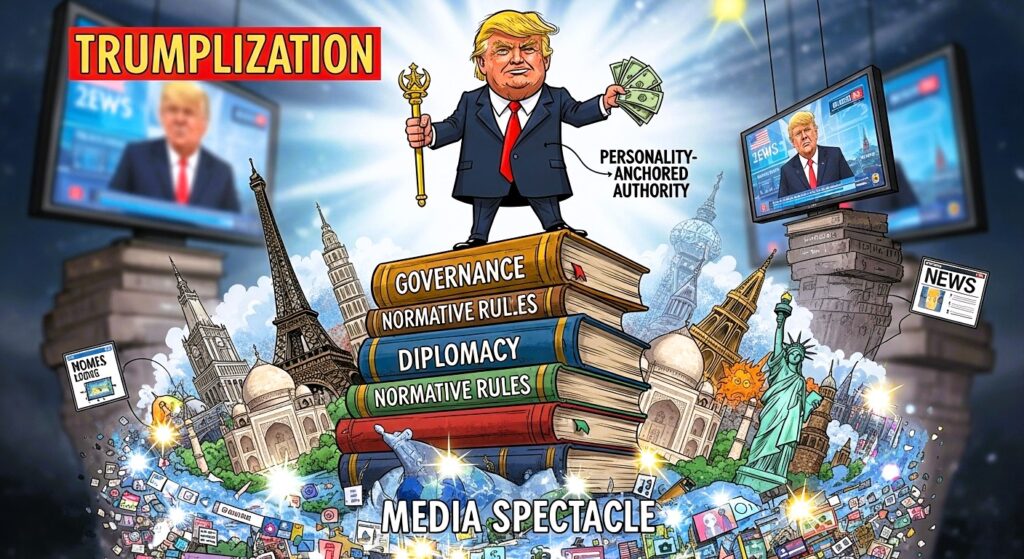
What we are witnessing fits a broader pattern of Trumplization.
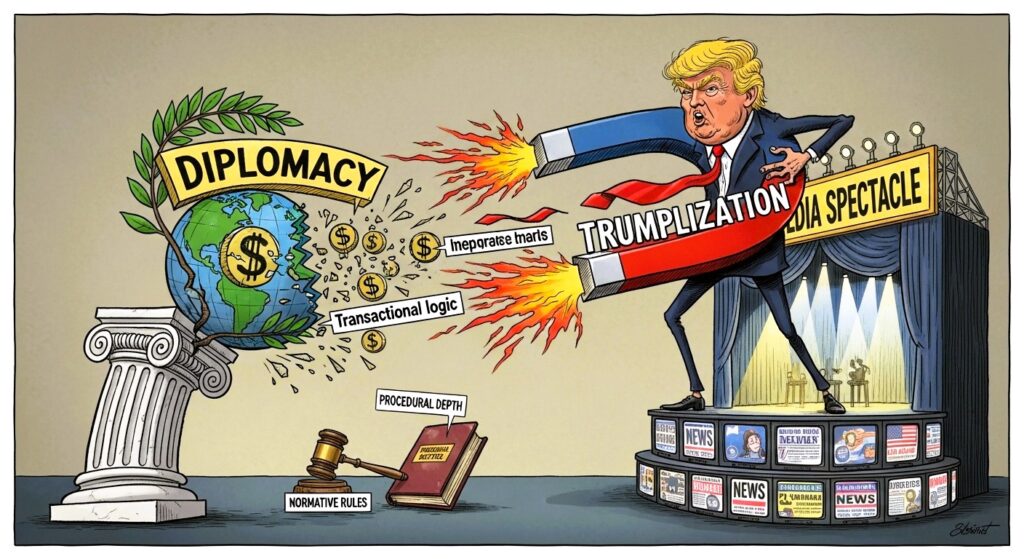
Trumplization is the conversion of governance and diplomacy into:
- Personality-anchored authority
- Transactional logic over normative rules
- Media spectacle over procedural depth
In Trumplized systems, institutions do not disappear.
They are simply bypassed.
Why negotiate frameworks when you can negotiate leverage?
Why build consensus when you can build headlines?
Peace, in this model, is not a treaty.
It is a deal waiting for a camera.
Why Davos Still Opens the Door
Davos does not believe in this board.
Davos insures against it.
The World Economic Forum exists to read power tea leaves early. Trump’s possible return, formal or informal, forces global actors to keep a chair open. Not because they trust the method, but because they fear the alternative: being locked out of influence if Trumplization becomes policy again.
This is not an endorsement.
It is strategic anxiety.
And anxiety is the real currency of Davos.
Diplomacy Without Institutions Is Fast, And Fragile
Supporters argue this approach is pragmatic. They point to speed, flexibility, and the ability to talk to anyone. They are not entirely wrong.
But speed without structure creates a dangerous illusion of success.
Personal-specific diplomacy has three fatal weaknesses:
- No continuity: it dies when the personality exits
- No accountability: outcomes answer to no electorate
- No replication: nothing can be scaled or institutionalised
Peace achieved this way is not durable.
It is conditional.
And conditions change.
The Deeper Signal: Declining Faith in the Old Order
The real story is not Trump.
It is the system that made him plausible again.
The appearance of a Trump-linked peace mechanism at Davos reflects a deeper collapse of confidence in:
- Multilateral diplomacy
- UN-style consensus building
- Rule-based global governance
When institutions fail repeatedly, the world begins shopping for shortcuts.
Trumplization is one such shortcut.
History warns us: shortcuts in diplomacy often end in detours through chaos.
Is This Peace or a Prelude?
Call it what it is.
This is not a peace board.
It is a political rehearsal space.
A place to signal relevance.
To remind allies and adversaries alike that access may once again flow through one desk, one phone, one name.
Peace here is not the destination.
It is the language of return.
Final Thought: The Cost of Naming Things Wrong
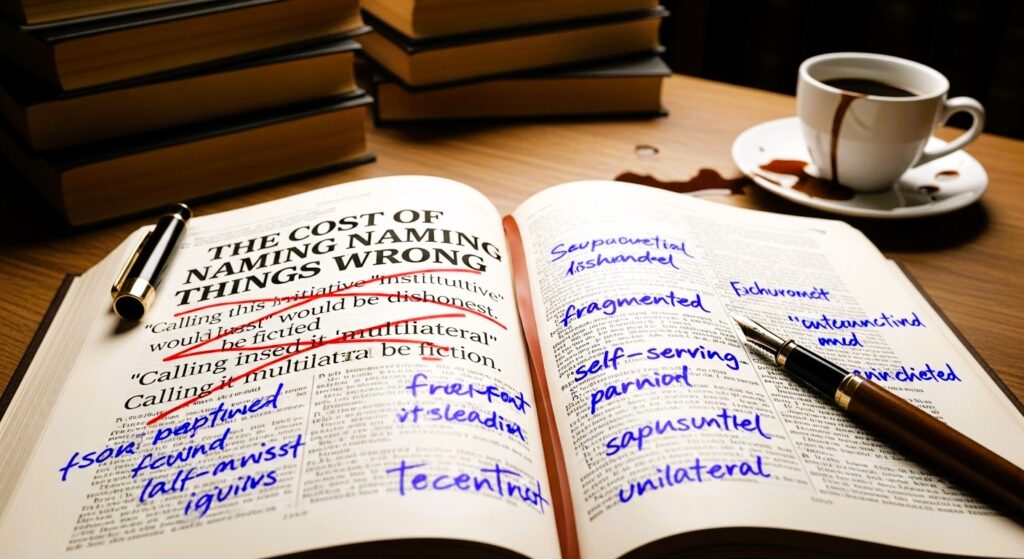
Calling this initiative “institutional” would be dishonest.
Words matter. Names shape expectations.
Calling it “multilateral” would be fiction.
It is personal-specific diplomacy operating in the age of Trumplization.
And until the world rebuilds trust in institutions, personalities will keep filling the vacuum, loudly, efficiently, and temporarily.
Peace deserves better than that.https://mrpo.pk/the-age-of-trumplization/
FAQs
Q1: What is Trumplization in global diplomacy?
A: Trumplization describes the shift from institution-based diplomacy to personality-driven power, where outcomes depend on an individual rather than formal systems.
Q2: What is Trump’s Davos peace board?
A: A Trump-linked initiative presented as a peace platform, operating outside traditional diplomatic institutions and heavily dependent on Trump’s personal influence.
Q3: Why is Trump’s peace initiative described as personal-specific?
A: Its authority, relevance, and effectiveness rely almost entirely on Donald Trump himself. Without him, the initiative lacks structure, mandate, and continuity.
Q4: Why does Davos engage with Trump-linked initiatives?
A: Not out of endorsement, but as strategic hedging to maintain access to Trump’s influence if his style of Trumplized diplomacy resurfaces.
Q5: Is personal-specific diplomacy effective?
A: It can be fast and flexible but is fragile, lacking accountability, durability, and institutional safeguards needed for long-term peace.