
The Age of Trumplization: Power, Pressure, and the Shadow of Colonialism
EP:
The Age of Trumplization article presents a critical, analytical perspective on historical and contemporary patterns of power and influence. It does not target any individual, nation, or group, and all terms or concepts used are intended descriptively, not pejoratively. The goal is to explore systemic dynamics, historical legacies, and policy choices to foster understanding and informed discussion.
Readers are encouraged to engage thoughtfully, question assumptions, and view the analysis as part of a broader conversation about power, responsibility, and global equity. Terms like Trumplization are used descriptively to capture observable patterns, not as personal or political attacks.

Most people think colonialism ended decades ago.
It didn’t. It just learned how to dress better.
Empires no longer arrive with flags and gunboats. They arrive with sanctions, leverage, debt, and deals framed as “offers you can’t refuse.” The tools changed. The instinct didn’t. And in recent years, that instinct has taken on a sharper edge, some now describe as Trumplization.
This article introduces the term Trumplization, not as an insult or slogan, but as a concept. It describes the normalization of transactional, power-first politics, where leverage replaces diplomacy, institutions are sidelined, and dominance is pursued openly rather than covertly. Trumplization focuses on patterns of behavior, not personalities.
How Did Decolonization Reshape the World?
Imagine this: A revolutionary leader stands above a large crowd to declare his nation’s independence. He proclaims, “All men are created equal. They are endowed by their creator with certain inalienable rights; among them are life, liberty, and the pursuit of happiness.”
Did you think of the American colonies in 1776? Maybe you pictured George Washington or Thomas Jefferson on the streets of Philadelphia.
How about Vietnam? In 1945, more than 150 years after the U.S. Declaration of Independence, Vietnamese revolutionary Ho Chi Minh invoked those same words when declaring his country free from French colonial rule.
Who articulated many of the same goals as the United States’ founding fathers. And he was hardly alone. In the years following World War II, dozens of countries gained their independence, bringing an end to an age of colonialism in which mostly European empires ruled nearly a third of the world’s population.
https://education.cfr.org/learn/reading/how-did-decolonization-reshape-world
What Colonialism Was, Historically Speaking
Colonialism, at its core, was a system of control. One society extended power over another to extract value, resources, labour, land, or strategic advantage while denying the colonised real agency.
It wore different masks:
- Settler colonialism, where outsiders stayed and replaced.
- Extractive colonialism, where wealth was stripped and shipped out.
- Cultural colonialism, where language, identity, and memory were reshaped.
From the 15th century onward, colonialism powered global expansion. By the 19th century, it had hardened into a doctrine. By the mid-20th century, it officially “ended.” On paper. Reality was messier.
Europe’s Central Role
European empires didn’t just conquer territory. They engineered dependency.
Britain, France, Spain, Portugal, Belgium, and the Netherlands redrew maps, split communities, and organised economies around extraction. Railways led to ports, not people. Education-trained clerks, not citizens. Borders were drawn for convenience, not coherence.
Colonial rule wasn’t chaos. It was methodical. And devastatingly effective for the colonisers.
The United States and a Different Model
The United States often positioned itself as anti-colonial. Historically, that was only half true.
Internally, expansion came through the displacement of Indigenous peoples. Externally, the U.S. experimented with formal colonies, the Philippines, Puerto Rico, and Guam, before pivoting to something subtler.
Instead of ruling directly, it shaped outcomes:
- Economic dominance instead of governors
- Military bases instead of flags
- Influence instead of occupation
This wasn’t classic colonialism. It was power without paperwork.
The Worst Things Colonialism Did
Colonialism didn’t just steal resources. It broke systems.
It hollowed out local economies and replaced them with dependency. It erased languages and histories. It normalised violence as an administration. It left behind borders that guaranteed conflict and institutions designed to fail once control was withdrawn.
Perhaps its most serious damage was psychological. Colonialism trained people to doubt themselves—and trained elites to rule on behalf of others. That damage didn’t disappear with independence.
The After-Effects We Still Live With
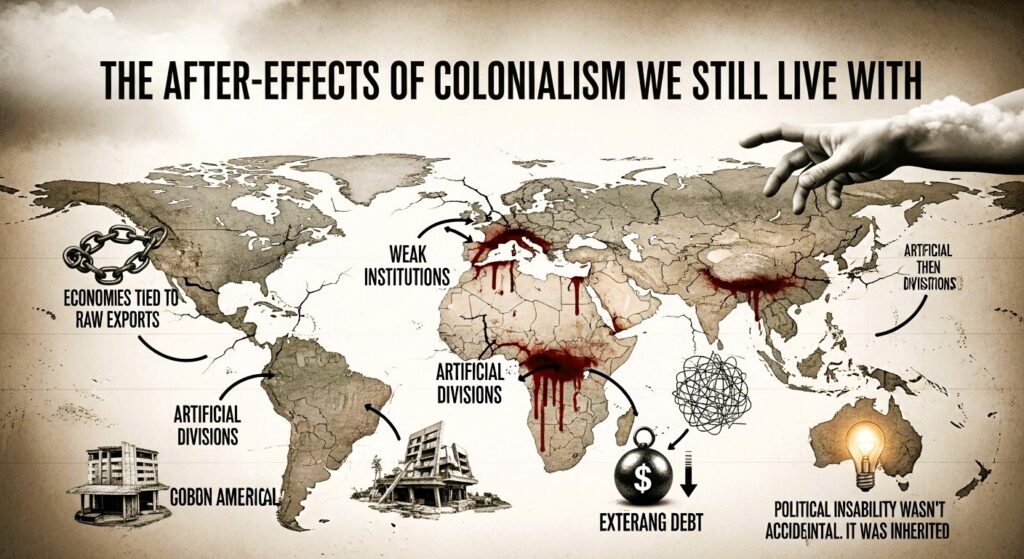
Many post-colonial states entered independence already wounded:
- Economies tied to raw exports
- Weak institutions
- Artificial divisions
- External debt
Political instability wasn’t accidental. It was inherited. Global inequality didn’t emerge naturally. It was designed, then preserved.
From Colonialism to Neo-Colonialism
Modern power rarely needs occupation. It prefers pressure.
Sanctions. Financial systems. Trade leverage. Diplomatic isolation. These tools can reshape nations without ever crossing borders.
This is where Trumplization enters the conversation.
Trump, Power, and the Colonial Echo
Under Trumplization, this approach became unusually explicit.
- Venezuela faced crushing sanctions framed as moral pressure, but felt as economic strangulation.
- Iran was subjected to “maximum pressure,” abandoning multilateral agreements in favor of unilateral force.
- Greenland was discussed not as a people or polity, but as a strategic asset.
None of this was colonialism in the old sense. But the logic was familiar: power decides, others adjust. That familiarity is what unsettled many outside the West.
Is This a New Colonial Era?
Not exactly. But it’s a reminder.
When institutions weaken, power fills the gap. When rules erode, leverage speaks louder. Trumplization didn’t invent this impulse. It stripped away the politeness that once hid it. And that honesty, paradoxically, made the system easier to see.
What Can the World Do?
There are no easy fixes. But there are directions.
Stronger international law matters. So does reforming global finance. Regional cooperation matters more than dependency. And intellectual decolonisation, reclaiming narrative and confidence—may matter most of all.
Awareness alone isn’t resistance. Structure is.
Final Reflection
Colonialism never vanished. It evolved. Today, it doesn’t always arrive with soldiers. Sometimes it arrives with spreadsheets, sanctions, and smiles. The age of Trumplization didn’t create this reality. It simply reminded the world how thin the line between order and dominance really is. And once you see it, you can’t unsee it.
FAQs
1. Is Trumplization the same as Trumpism?
No. Trumpism refers to a political movement; Trumplization describes a broader method of transactional power politics.
2. Did colonialism ever truly end?
Formally, yes. Structurally, many of its mechanisms persisted in new forms.
3. Is the U.S. unique in practising neo-colonial power?
No. Other major powers employ similar tools, albeit with distinct styles and narratives.
4. Are sanctions a form of colonialism?
Not inherently, but when used coercively without accountability, they can replicate colonial dynamics.
5. Why does this resonate more in the Global South?
Because many societies have lived with the consequences of external control, even after independence.
6. Can global institutions counter this trend?
Only if they are reformed to reduce power imbalances rather than reinforce them.
References
- Frantz Fanon, The Wretched of the Earth
- Aimé Césaire, Discourse on Colonialism
- Kwame Nkrumah, Neo-Colonialism: The Last Stage of Imperialism
- United Nations reports on sanctions and development
- Academic literature on realpolitik and post-colonial studies