
Pakistan logistics system: From Road Dependency to an Integrated Multimodal Transport System
Rethinking Pakistan’s Inland Logistics
Abstract
Pakistan’s inland logistics system is overwhelmingly dominated by road-based freight transportation, carrying over ninety per cent of domestic cargo. While roads offer flexibility and door-to-door reach, their excessive use for long-haul and bulk logistics has generated severe economic, infrastructural, environmental, and social costs. Railways, inland waterways, and air cargo remain underutilised despite their efficiency advantages. This research paper critically examines Pakistan’s existing logistics framework with special emphasis on the negative externalities of a road-heavy system, including congestion, road damage, accident costs, fuel inefficiency, and governance distortions. It proposes an integrated, economically viable, door-to-door multimodal logistics model incorporating road, rail, sea, inland waterways, and selective air cargo. The paper concludes that deliberate modal rebalancing supported by institutional and digital reform is essential for sustainable national development.
1. Introduction
Logistics is a strategic enabler of economic growth, trade competitiveness, industrial productivity, and national integration. In Pakistan, logistics has evolved in a largely unplanned and road-centric manner. Over time, highways have become the default carrier not only for short-haul and last-mile freight but also for long-haul and bulk cargo that is inherently more suitable for rail or water transport.
This imbalance has created a structurally inefficient system where high-cost modes are used for low-value, high-volume freight, resulting in rising transportation costs, accelerated infrastructure decay, traffic hazards, and environmental stress. The existence of an extensive but underperforming rail network, navigable rivers with latent potential, major seaports, and a growing aviation sector indicates that Pakistan’s logistics challenge is not a lack of assets but a failure of integration, prioritization, and governance.
This paper aims to (a) critically analyze the existing inland logistics system with special focus on road-heavy freight movement, (b) assess its multidimensional negative impacts, and (c) propose a practical multimodal door-to-door logistics framework aligned with Pakistan’s economic and geographic realities.
2. Overview of Pakistan’s Existing Inland Logistics System
2.1 Modal Share and Structural Imbalance
Pakistan’s freight movement is approximately distributed as follows:
- Road transport: ~90–94%
- Rail transport: ~6–8%
- Inland waterways: negligible
- Air cargo: marginal and selective
This distribution is highly inefficient when compared with logistics-efficient economies where rail and waterways carry the bulk of long-haul freight. The imbalance reflects decades of policy bias toward road construction, underinvestment in rail modernization, weak institutional capacity, and fragmented logistics planning.
2.2 Functional Characteristics of the Current System
- Roads serve simultaneously as short-distance delivery channels and long-distance bulk freight corridors
- Railways remain passenger-oriented with limited freight prioritization
- Ports rely overwhelmingly on trucks for hinterland evacuation
- Dry ports, warehousing, and cold-chain facilities remain inadequate and uneven
- Limited adoption of integrated digital logistics systems
3. Critical Analysis: Negatives of a Road-Heavy Logistics System
3.1 Chronic Road Congestion and Network Saturation
Heavy freight vehicles occupy a disproportionate share of Pakistan’s highways and urban access roads. Slow-moving and overloaded trucks reduce effective road capacity, create bottlenecks near ports and industrial zones, and increase travel time uncertainty. Congestion imposes hidden economic costs through lost productivity, delayed deliveries, and inefficient fuel consumption across the entire transport ecosystem.
3.2 Excessive Road Damage and Escalating Maintenance Costs
Road pavements deteriorate exponentially under heavy axle loads. A small number of overloaded trucks inflict damage equivalent to thousands of passenger vehicles. Consequences include premature pavement failure, shortened road life cycles, frequent rehabilitation, and massive public expenditure on maintenance. The road-heavy logistics model externalizes its true infrastructure costs onto the national exchequer.
3.3 Traffic Accidents and Safety Hazard Costs
Heavy trucks contribute disproportionately to fatal and severe road accidents due to size, braking limitations, driver fatigue, and weak enforcement. Economic losses include loss of productive human life, long-term medical and rehabilitation costs, property damage, insurance losses, and judicial and enforcement expenses. These represent a substantial but largely unaccounted drain on national productivity.
3.4 Fuel Inefficiency and Energy Security Risks
Road freight transport is the least fuel-efficient mode per ton-kilometer. Pakistan’s dependence on imported petroleum means excessive road freight directly increases the fuel import bill, heightens vulnerability to global oil price shocks, and exacerbates balance-of-payments pressures.
3.5 Environmental and Public Health Externalities
Heavy logistics traffic contributes to greenhouse gas emissions, particulate pollution, noise, and environmental degradation, particularly in urban corridors. These effects translate into higher healthcare costs, reduced workforce productivity, and declining quality of life.
3.6 Urban Infrastructure Stress and Spatial Disorder
Freight trucks operating in cities damage urban roads, disrupt public transport systems, create parking bottlenecks, and reduce urban livability. Cities such as Karachi, Lahore, and Faisalabad increasingly bear logistics-induced congestion and spatial disorder.
3.7 Governance and Informality Distortions
Road-based freight is difficult to regulate due to informality, axle overloading, fragmented ownership, and weak enforcement. These distort pricing mechanisms, reward non-compliance, and perpetuate inefficiency and safety risks.
4. Comparative Cost and Efficiency Analysis of Transport Modes
Table: Comparative Characteristics of Freight Transport Modes
| Parameter | Road | Rail | Inland Waterway | Air (Selective) |
| Cost per ton-km | High | Medium | Low | Very High |
| Fuel efficiency | Low | High | Very High | Low |
| Infrastructure damage | Very High | Low | Minimal | Minimal |
| Accident risk | High | Low | Very Low | Low |
| Environmental impact | High | Medium | Low | High |
| Suitability for bulk cargo | Poor | Excellent | Excellent | Unsuitable |
| Suitability for perishables | Medium | Medium | Low | Excellent |
| Door-to-door capability | Excellent | Limited | Limited | Limited |
Inference: Roads should be confined to first- and last-mile delivery; rail and waterways should carry long-haul and bulk freight, while air transport should be used selectively for high-value, time-sensitive goods.
5. Agriculture, Perishables, and the Limited Role of Air Cargo
Pakistan is an agricultural country with substantial potential to export fresh and processed food items, floriculture products, meat, and dairy. However, limited food preservation capacity, post-harvest losses, and weak cold-chain infrastructure constrain export competitiveness. In this context, air cargo assumes strategic importance for a narrow but critical segment of high-value, time-sensitive agricultural products.
Despite this need, Pakistan’s air cargo capacity remains insufficient. Dedicated freighter aircraft are limited, airport cold-storage facilities are inadequate, and farm-to-airport logistics lack coordination. While air transport is inherently expensive and unsuitable for bulk freight, its selective and targeted use for premium agricultural exports is economically justified. The insufficiency of air cargo capacity thus represents a missed opportunity for value maximization rather than a contradiction of multimodal efficiency.
Air Cargo as the Weak Link in Pakistan’s Export Strategy – Mr Pakistan
6. Proposed Integrated Multimodal Logistics Framework
6.1 Strategic Modal Rebalancing
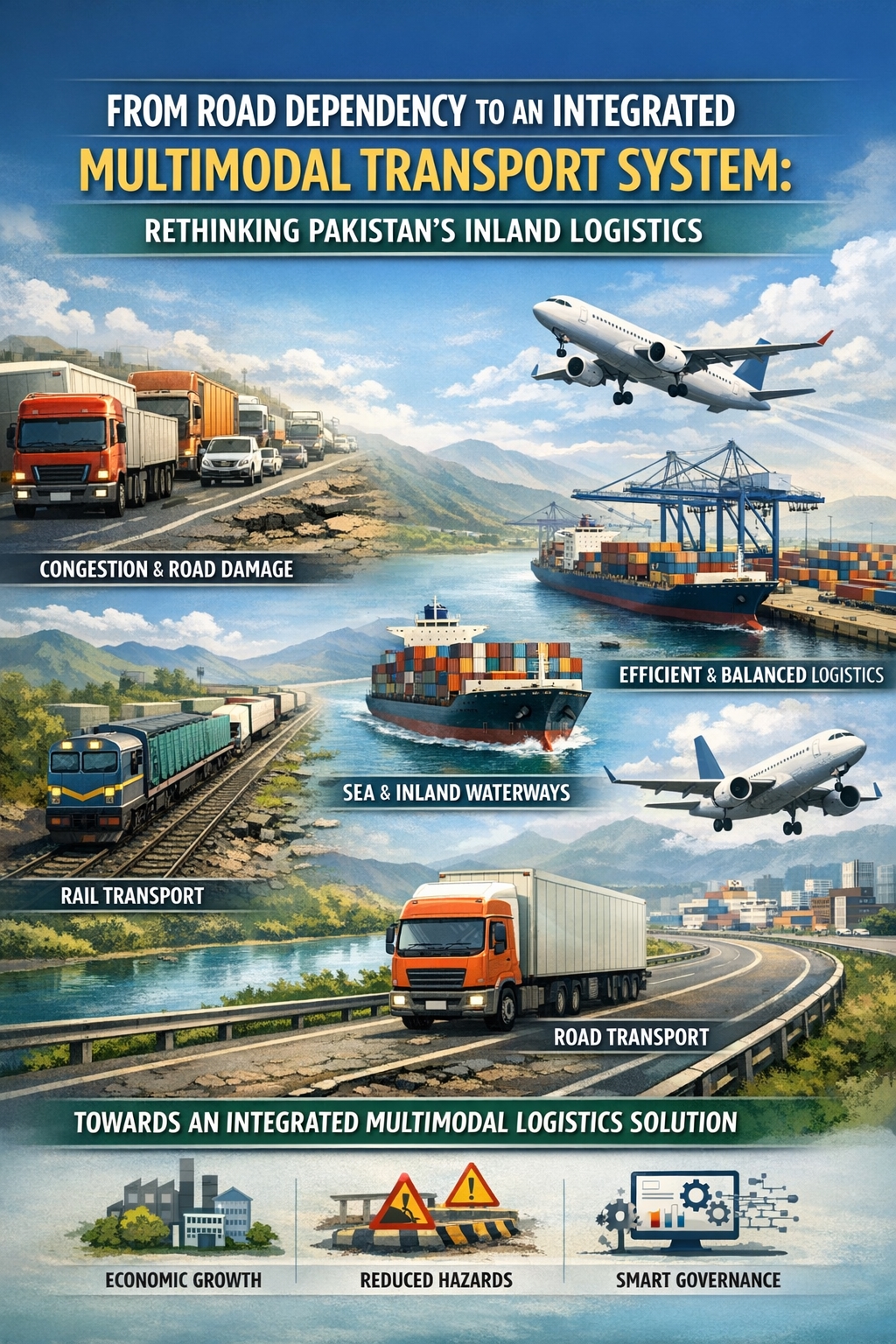
- Rail as the backbone for long-distance inland freight
- Inland waterways for bulk commodities where feasible
- Roads for first-mile and last-mile connectivity
- Air transport restricted to high-value, time-sensitive cargo
6.2 Multimodal Logistics Hubs and Dry Ports
Develop regional logistics hubs integrating rail terminals, warehouses, cold storage, customs facilities, and road access. These hubs will act as transfer nodes enabling seamless door-to-door movement while reducing highway congestion.
6.3 Dedicated Freight Rail Corridors
Expand and modernize freight-oriented rail corridors linking ports with industrial and agricultural centers. Prioritize signaling upgrades, rolling stock expansion, and operational autonomy for freight services.
6.4 Digital Integration and Smart Logistics
Implement a national logistics platform integrating cargo tracking, route optimization, multimodal scheduling, and unified documentation and customs clearance.
6.5 Policy and Institutional Reforms
- Strict enforcement of axle-load regulations
- Pricing mechanisms reflecting true infrastructure and environmental costs
- Incentives for rail and inland water transport
- Public–private partnerships in logistics infrastructure
7. Illustrative Door-to-Door Multimodal Logistics Flow
- Cargo originates at farm, factory, or import terminal
- Short-haul road transport to nearest logistics hub or rail terminal
- Long-haul movement via rail or waterway
- Transfer at inland dry port or logistics hub
- Final delivery by optimized road transport
- Selective air shipment for high-value perishables where required
8. Recommendations
Short-Term (1–3 Years)
- Enforce axle-load limits rigorously
- Revitalize rail freight operations
- Pilot multimodal logistics hubs
Medium-Term (3–7 Years)
- Expand dedicated freight rail corridors
- Develop inland waterway pilots
- Upgrade airport cold-chain and air cargo handling capacity
Long-Term (7–15 Years)
- Establish national modal-share targets
- Rail electrification and green logistics adoption
- Human capital development in logistics, food technology, and supply chain management
9. Conclusion
Pakistan’s road-heavy logistics system imposes unsustainable economic, infrastructural, environmental, and social costs. Congestion, road damage, accident losses, fuel inefficiency, and governance failures collectively undermine national competitiveness. A multimodal logistics transformation centered on rail and inland waterways—supported by roads for last-mile delivery and selective air cargo for high-value perishables—is a strategic necessity for sustainable development, fiscal stability, and export-led growth.
10. Future Research Directions
- Quantitative cost–benefit analysis of modal shift scenarios
- Detailed agro–air cargo feasibility studies
- Impact assessment of logistics reform on agricultural exports and regional connectivity