
Narcissist: Meaning, Mindset, and the Hidden Cost
Narcissist, have you ever interacted with someone who persistently reframes situations around themselves, leading you to doubt your own sense of reality? Yeah. That’s probably a narcissist. And no, it’s not just a trendy insult; it’s a psychological iceberg, mostly hidden beneath charm, competence, and occasional generosity.
Narcissism isn’t about vanity. It’s about fragile egos masquerading as grandiosity. It’s about people who live in the mirror, and sometimes, if they’re in positions of influence, they drag everyone else into their reflection.
This isn’t gossip. It’s survival, and understanding it is your mental hygiene.
Intro (Mini-Series Framing )
Ever wondered why some people charm effortlessly, yet leave chaos in their wake? That’s narcissism at work, a mix of ego, strategy, and fragile self-worth. This article explores the mindset, behaviour, and hidden cost of narcissists, laying the foundation for understanding related patterns, like the “Me Indispensable Syndrome” and the broader societal impact of malignant narcissistic leadership.
This is Part 1 of our series on narcissism, human behavior, and leadership. For a deeper dive into how narcissism manifests in control and identity, check out Part 2: “Me Indispensable Syndrome: When Identity Becomes Power.”

Understanding the Mind of a Narcissist
Narcissists are not who they appear to be. They’re both easy and hard to love.
Despite having a seemingly strong personality, narcissists lack a core self. Their self-image and thinking and behavior are other-oriented in order to stabilize and validate their self-esteem and fragile, fragmented self.
The gods sentenced Narcissus to a life without human love. He fell in love with his own reflection in a pool of water and died hungering for its response. Like Narcissus, narcissists only “love” themselves as reflected in the eyes of others. It’s a common misconception that they love themselves. They may actually dislike themselves immensely. Their inflated self-flattery, perfectionism, and arrogance are merely covers for the self-loathing they don’t admit — usually even to themselves. Instead, it’s projected outward in their disdain for and criticism of others. They’re too afraid to look at themselves because they believe the truth would be devastating. Emotionally, they may be dead inside, and hungering to be filled and validated by others. Sadly, they’re unable to appreciate the love they do get and they alienate those who give it.
What Is a Narcissist, Really?
A narcissist is someone whose self-worth depends almost entirely on external validation. They are preoccupied with image, recognition, and control. They crave admiration but struggle with empathy.
Here’s the kicker: beneath the inflated exterior often lies a fragile, anxious core, desperate to feel significant. Think of Narcissus staring into his reflection, except with a lot more texting, reputation management, and manipulation.
Traits That Usually Surface
- Excessive need for admiration: praise isn’t enough; it must be constant.
- Grandiosity: exaggerated self-importance, often packaged in charisma.
- Lack of empathy: understanding without caring.
- Fragile ego: small criticism triggers outsized reactions.
- Entitlement: rules are for others.
- Manipulation: relationships and situations are tools, not connections.
Narcissistic Personality vs. Narcissistic Traits
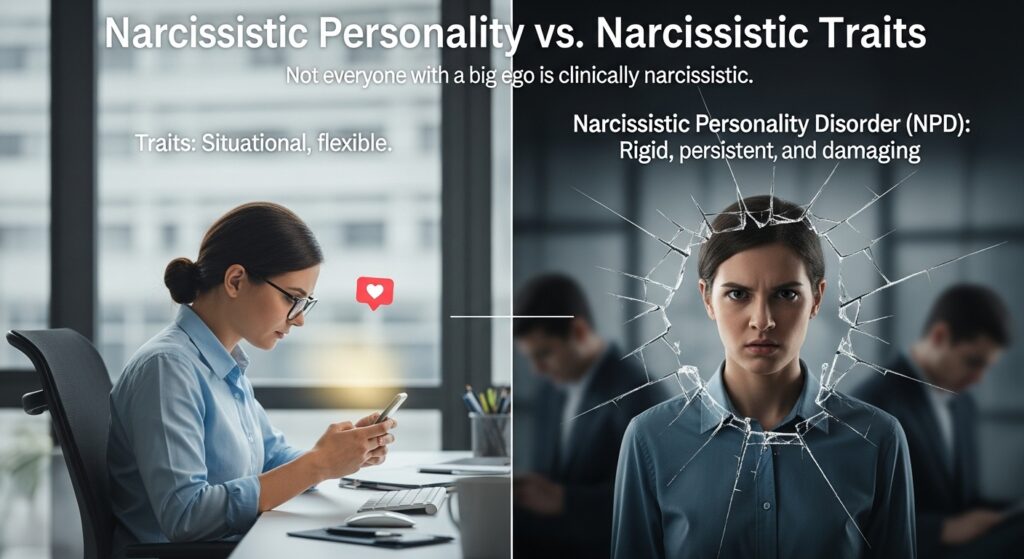
Not everyone with a big ego is clinically narcissistic. Narcissism exists on a spectrum:
- Traits: Situational, flexible. You might see them at work or in social media personas.
- Narcissistic Personality Disorder (NPD): Rigid, persistent, and damaging across relationships and life functioning.
Most people fall somewhere in between. True narcissists live near the extreme, and that’s where the cost starts to show.
The Narcissistic Mindset
EP: “As Dr W. Keith Campbell notes, narcissists’ self-esteem is often fragile and externally dependent, which drives their constant need for admiration and control.”
Here’s the uncomfortable truth: narcissists don’t feel inherently lovable. Their self-esteem is a paper-thin construction maintained by admiration, compliance, and control.
Inside their head:
“If I am not admired, I am nothing. If I am not central, I am erased. If I am criticized, I am destroyed.”
This mindset explains patterns you might have noticed: over-controlling behaviour, obsession with being “right,” and chronic blame-shifting. It’s not arrogance. It’s a coping mechanism for a terrified inner child.
The “Me Indispensable” Syndrome

One phrase captures this perfectly: “Me indispensable.”
This isn’t confidence. It’s a psychological red flag. Narcissists often believe:
“Without me, this relationship, team, or even organization will collapse.”
This belief justifies their constant centrality, obsession with control, and resistance to criticism. It explains why they hoard responsibility, resist delegation, and subtly punish autonomy in others.
The danger? Systems—emotional, organisational, or societal become fragile. When one person believes they are irreplaceable, everyone else becomes disposable.
Types of Narcissists
Not all narcissists roar; some whisper.
- Grandiose: Loud, dominant, and attention-hungry. Think boardroom alpha.
- Vulnerable (Covert): Insecure, passive-aggressive, and guilt-tripping. Often hard to spot.
- Malignant: Narcissism meets cruelty and paranoia. This one wrecks everything in its path if unchecked.
- Communal: The self-proclaimed saviour, moralist, or activist. “I’m the best human you’ll ever meet”—while subtly manipulating everyone.
How Narcissism Develops
Narcissism isn’t born, it’s crafted.
- Conditional love in childhood
- Emotional neglect or inconsistent attention
- Excessive praise without emotional grounding
- Trauma, abandonment, or chronic insecurity
- Cultural and social reinforcement of image over substance
In short, it’s a defensive architecture disguised as confidence.
The Hidden Cost
EP: “Experts warn that when narcissists hold central authority, institutions can become fragile because the system relies on their ego rather than processes (Kernberg, 2016).”
In relationships, narcissists often follow a predictable cycle:
- Love-bombing/idealisation: charm overload.
- Devaluation: criticism, withdrawal, control.
- Confusion/gaslighting: your reality becomes negotiable.
- Exhaustion: emotional and psychological drain.
At work or in leadership:
- Credit flows upward; blame flows downward.
- Institutions weaken.
- Systems falter because ego replaces process.
Societies, organisations, and individuals pay the hidden cost quietly, often only noticing once the damage is extensive.
Can Narcissists Change?
Possible? Yes, but rare.
- True change requires self-awareness, motivation, and humility—traits narcissists often lack.
- Mild traits can improve with feedback and therapy.
- Severe narcissism resists change unless the cost of staying the same becomes unbearable.
Healthy Self-Love vs. Narcissism
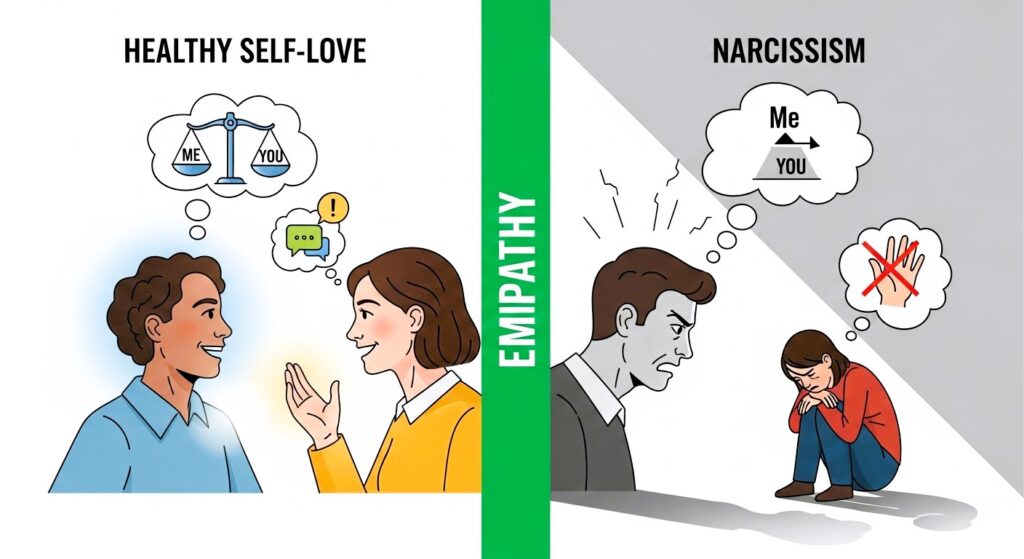
Healthy self-love: coexists with empathy, tolerates criticism, and allows mutual respect.
Narcissism: demands superiority, rejects accountability, and needs others to shrink.
Empathy is the dividing line.
Conclusion: Why Understanding Matters
Narcissism isn’t just a personality quirk. It’s a pattern that shapes relationships, workplaces, and societies.
The moment a narcissist believes they are indispensable, the hidden cost starts to compound. Systems weaken, people shrink, and failure often waits silently behind charm and competence.
Understanding narcissism doesn’t excuse harm. It gives you a mental map, a way to protect your boundaries, and a lens to navigate complexity without losing yourself.
The key takeaway: narcissism matters because systems outlast people, and the fragile ego should never run the show.
FAQs
1. Is narcissism the same as selfishness?
No. Selfishness is situational; narcissism is a persistent pattern affecting relationships and decision-making.
2. Can narcissists truly feel empathy?
Some can understand emotions intellectually, but emotional concern is limited or self-serving.
3. Why are narcissists so charming at first?
Charm is a tool. It secures attention, admiration, and control before patterns of harm appear.
4. Is narcissism on the rise?
Social media, image-driven culture, and instant validation amplify narcissistic traits in the population.
5. How can I protect myself from a narcissist?
Set clear boundaries, detach emotionally when needed, and avoid trying to “fix” them.
6. Can narcissism be treated?
Mild traits can improve with self-awareness and therapy. Severe narcissism rarely changes unless consequences become unavoidable.
Outro (Mini-Series Framing ):
Understanding narcissists isn’t just curiosity—it’s self-preservation. Once you see the patterns, you can spot fragile egos in relationships, workplaces, and society.
Next in our series: Part 2 explores “Me Indispensable Syndrome” and how the belief in being irreplaceable drives control, dependency, and hidden organizational risk.
References:
- American Psychiatric Association. DSM-5-TR: Diagnostic and Statistical Manual of Mental Disorders
- Kernberg, O. Borderline Conditions and Pathological Narcissism
- Campbell, W. K., & Foster, C. A. (2007). The Narcissistic Self
- Malkin, C. Rethinking Narcissism
- Miller, A. The Drama of the Gifted Child