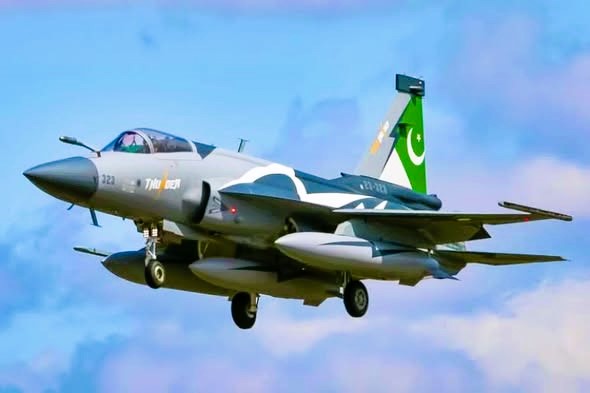

JF‑17 Thunder in India Conflict: Combat, Comparisons, and Global Perspective

The JF‑17 Thunder: Pakistan’s homegrown multirole fighter jet.JF-17 Thunder in India Conflict: The skies above South Asia are often tense, but few aircraft have captured global attention like the JF-17 Thunder. Born from necessity, tested in real combat, and now sought after by multiple nations, the JF‑17 isn’t just a fighter jet; it’s Pakistan’s statement in metal, electronics, and human resolve.
Its story blends innovation, skill, and courage: from the engineers who shaped it, to the pilots who risk everything in the cockpit, to the strategic vision that keeps it relevant for the future.
https://mrpo.pk/the-saudi-pakistan-defence-pact/
Inception & Development of JF‑17 Thunder
- “From Block I to Block III: The evolution of the JF‑17 Thunder.”
In the early 1990s, Pakistan faced a challenge: modernising its air force without draining national resources. The solution came in partnership with China’s Chengdu Aircraft Corporation (CAC), giving birth to the PAC JF‑17 Thunder, a lightweight, multirole fighter.
The design philosophy was simple yet ambitious:
- Affordable without compromising capability
- Modular for easy upgrades
- Combat-ready, built to endure real air battles
From its first flight in 2003 to the latest Block III variant, the JF‑17 has evolved steadily. Beyond technical specs, it became a symbol of national pride: a homegrown fighter that could stand tall against imported giants.
JF‑17 in India–Pakistan Skies
Facing Rafale, Su-30MKI, Tejas, and MiG-29, the JF‑17 proved its combat credentials. Modern air warfare is mostly radar, missiles, and mental endurance.
- Operates in teams, coordinating with other PAF fighters and ground systems
- Equipped with Beyond Visual Range (BVR) missiles and electronic warfare suites
- Mission logic: disruption, endurance, and asset protection
Success isn’t measured in explosions but in missions completed, aircraft preserved, and enemy plans disrupted.
“The JF‑17 doesn’t just fly, it fights smart, enduring the battle before the first missile is fired.”
The CAC/PAC JF-17 Thunder,[a] also known as FC-1 Xiaolong,[b] is a Sino-Pakistani single-engine lightweight supersonic multirole combat aircraft developed jointly by the Chengdu Aircraft Corporation (CAC) of China and the Pakistan Aeronautical Complex (PAC).[1] It is a fourth-generation fighter, designed and developed as a replacement for the third-generation A-5C, F-7P/PG, Mirage III, and Mirage 5 combat aircraft in the Pakistan Air Force (PAF).[2][3] The JF-17 can be used for multiple roles, including interception, ground attack, anti-ship, and aerial reconnaissance. The Pakistani designation “JF-17” stands for “Joint Fighter-17”, with the “Joint Fighter” denoting the joint Pakistani-Chinese development of the aircraft and the “-17” denoting that, in the PAF’s vision, it is the successor to the F-16. The Chinese designation “FC-1” stands for “Fighter China-1”.
The JF-17 can deploy diverse ordnance, including air-to-air, air-to-surface, and anti-ship missiles; guided and unguided bombs; and a 23 mm GSh-23-2 twin-barrel autocannon. Powered by the Chinese Guizhou WS-13 or Russian Klimov RD-93 (JF-17 Blocks 1 and 2) or Klimov RD-93MA (JF-17 Block 3) afterburning turbofan engine, it has a top speed of Mach 1.6.[4] The JF-17 is the backbone and workhorse of the PAF, complementing the Lockheed Martin F-16 Fighting Falcon at approximately half the cost,[5] with the Block II variant costing $25 million.[4] The JF-17 was inducted in the PAF in February 2010.[6][7]
JF‑17 vs Western and Indian Fighters: Cost, Capability, and Global Interest
Fighter Jet Price Comparison
The provided data compares approximate unit prices in USD millions for the JF-17 Block III against select Western and Indian fighters, highlighting the JF-17’s cost advantage. Recent sources confirm JF-17 Block III at $25-30 million, F-16 variants up to $60-70 million (or $85 million for Viper), and Gripen E around $85 million. Indian jets like Tejas range $45-52 million, with Rafale deals implying higher effective costs near $90-100 million or more.bakunetwork+5
| Fighter Jet | Approx. Price (USD Millions) |
|---|---|
| JF‑17 Block III | 25–30 |
| F-16 Viper | 60–70 |
| Gripen E | 85–90 |
| Mirage 2000 | 45–50 |
| FA-50 | 30–35 |
| Tejas (India) | 45–50 |
| Rafale (India) | 90–100 |
Even with modern avionics and weapons, JF‑17 costs roughly 1/3 of a Rafale, yet delivers real combat capability. The Tejas, though indigenous, is nearly double JF‑17’s price.
Other advantages:
- AESA radar, EW suite, and integrated weapon systems
- Flexible integration with drones, AWACS, and modern networked operations
“Affordable, capable, and combat-tested, JF‑17 proves that big things can come in small packages.”
The Men Behind the Machine: Pilots, Training, and Resolve
“PAF pilots: The real strength behind the JF‑17 Thunder.”
Even the best jet is only as good as its pilot. The JF‑17’s edge comes from the Pakistan Air Force pilots who fly it.
- Elite Training: Multi-stage programs, simulations, and electronic warfare drills
- Doctrine over Daring: Focused on mission success and survival
- Mental Conditioning: Calm under pressure during radar locks, missile alerts, and high-stress sorties
- Resolve and Sacrifice: Deep commitment to national defence, understood as Shahadat, selfless service
Technology can level the playing field, but judgment, courage, and coordination tilt the balance. The JF‑17 is, in many ways, a pilot’s mind in metal and electronics.
Future Upgrades & Improvement Plans
“Future upgrades will keep JF‑17 competitive and export-ready.”
- Block III+ Avionics: Improved radar, stealth coatings, upgraded electronics
- New Weapons: Advanced air-to-air and precision strike options
- Engine Upgrades: Higher thrust, better manoeuvrability
- Networked Warfare: Integration with drones, AWACS, data links
- Indigenous Systems: Locally developed radar, sensors, EW modules
These ensure that the JF‑17 remains relevant, combat-effective, and globally attractive for years.
6 FAQs About JF‑17 Thunder
- What is the maximum speed and range of the JF‑17 Thunder?
- Mach 1.6 speed, ~1,350 km combat range
- How did the JF‑17 perform in real combat against India?
- Completed missions, disrupted enemy operations, and proved readiness
- What are the differences between Blocks I, II, and III?
- Block I: Basic avionics
- Block II: Upgraded radar & weapons
- Block III: AESA radar, EW suite, improved cockpit
- Which countries are interested in JF‑17?
- Nations in Asia, Africa, and South America are evaluating affordability and combat experience
- How does JF‑17 compare with F-16 or Gripen?
- Competitive against older variants, with less raw power than top-tier models, but highly cost-effective
- What future upgrades are planned?
- Block III+ with engine, radar, stealth, and networked operations enhancements
References
- Pakistan Air Force official press releases: https://www.paf.gov.pk
- Chengdu Aircraft Corporation technical documentation
- Jane’s Defence Weekly (IHS Markit)
- Defense News, The Diplomat, Scramble.nl, FlightGlobal