Israel, Palestine, and the Politics of Erasure: From 1948 to Trump’s 2025 Agenda
Imagine This…
Israel Palestine and the Politics of Erasure. Imagine waking up one morning to find that someone has sold your house — while you’re still living in it. Worse, the buyer now demands you leave immediately, because apparently they have a “historic claim.” If that sounds absurd, welcome to the story of Palestine. For over a century, the land has been bartered, partitioned, and “promised” by powers far removed from its olive groves, busy markets, and families who called it home for generations.
It’s the world’s longest-running game of Monopoly. Except one player keeps getting hotels on Boardwalk, while the other is told to “Go” without collecting their $200.
https://mrpo.pk/the-abraham-accords/
The Blueprint of a Nation: Who Drew the Map?
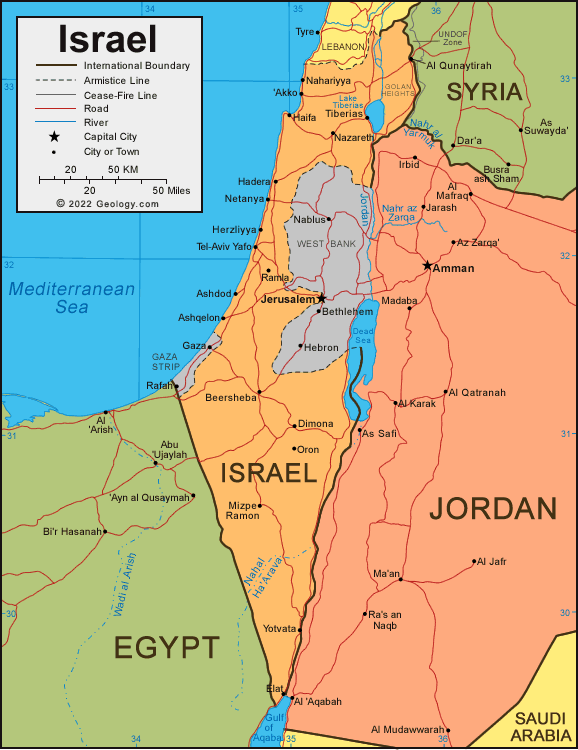
The creation of Israel didn’t happen in a vacuum. Theodor Herzl’s vision of Zionism found its political footing in the Balfour Declaration of 1917, when Britain, then controlling Palestine, promised a “national home for the Jewish people” without consulting its majority Arab inhabitants. Imagine your landlord giving away your living room to a stranger while you’re still on the couch.
By 1947, the UN Partition Plan proposed splitting the land into Jewish and Arab states. The problem? Palestinians were never asked. As legal scholar John Collins argued, self-determination wasn’t even clearly defined in the Universal Declaration of Human Rights (1948), leaving Palestinians without a recognised legal voice (Collins 1980).
International law has since caught up, with repeated UN resolutions affirming Palestinian rights (Bassiouni 1971). But back then? The maps were drawn in ink that ignored the people already living there.
Promises Made, Promises Broken
The British Mandate promised fairness, but delivered chaos. When Britain pulled out in 1948, Palestinians were left stateless while Zionist militias claimed sovereignty. The world offered guarantees, but as historian Hanne Warmenhoven shows, international law was never enforced, and the principle of consultation was denied (Warmenhoven 2020). Image Courtesy: Getty Image
Think of it as signing a contract with clauses promising your safety, only to find those pages mysteriously missing when trouble starts.
The Netanyahu Era: 30 Years of Crying Wolf
If there’s one political survival skill Netanyahu mastered, it’s fear rhetoric. For three decades, he’s been the self-anointed prophet of existential doom, warning of enemies with weapons of mass destruction at every turn: Iraq under Saddam, Gaddafi’s Libya, Assad’s Syria, and, of course, Iran.
Research shows Netanyahu consistently framed these states as existential threats to Israel, often stretching or ignoring available intelligence (Porter 2015). Others call it securitisation: creating threats through language to justify extraordinary policies (Soltaninejad 2022).
As J.G. Leslie put it bluntly: Netanyahu built a “fear and insecurity” narrative to anchor Israel’s foreign policy and extract unwavering Western support (Leslie 2022).
The result? Millions of lives lost in wars in Iraq and Libya, Syria devastated, Iran perpetually under sanctions, and Netanyahu still standing tall, wolf after wolf, often shoulder-to-shoulder with American presidents. The boy who cried wolf usually loses credibility; Netanyahu somehow got promoted to wolf consultant-in-chief.
Fast-Forward to 2025: Enter Trump’s ‘20-Point Agenda’
Now cue Donald Trump, who in his second term has promoted what’s been dubbed his “20-point agenda” for the Middle East. While no single official document bears that exact name, policy analysts note a consistent pattern:
- Prioritise Israel’s security above all else.
- Strengthen Gulf monarchies as allies.
- Isolate and economically strangle Iran.
- Sideline Palestinians from the table.
As Orbis scholar Ofira Seliktar notes, Trump positioned the U.S. as the “custodian of peace” while redefining peace to exclude Palestinian voices (Seliktar 2021). Michael Wilkins shows that Trump’s media and policy framing consistently marginalised Palestinians, while glorifying Israeli concerns (Wilkins 2020).
In short, it’s like planning a wedding where the groom and best man draw up the guest list and forget to invite the bride.
Where Are the Palestinians in the Room?
International law isn’t fuzzy here. The UN General Assembly Resolution 1541 (1960) clearly defined how self-determination must be implemented: independence, free association, or integration with consent (Sakran 2020). The Palestinians have been denied all three.
Moreover, GA Resolution 2625 (1970) recognises that when self-determination is blocked, people may legitimately resist, including armed resistance (Qadri & Dişli 2024). Yet in global discourse, this clause is conveniently forgotten.
Why, then, are Palestinians absent from Trump’s agenda? The uncomfortable answer: because their inclusion would mean recognising their rights, and that undermines the whole show.
The Invisible Crisis: Genocide, Siege, and Silence
Meanwhile, Gaza burns. For over 15 years, the territory has endured blockade, food scarcity, and repeated military assaults. UN reports document catastrophic humanitarian conditions, but Trump’s policies, like Netanyahu’s speeches, pretend this reality doesn’t exist.
Sociologist Iman Shalbak describes it as a transition from self-determination to mere survival governance, where international actors manage the crisis without resolving its roots (Shalbak 2023).
Try explaining to a child that they can’t have breakfast because the border wall doesn’t allow milk trucks through. That’s not geopolitics; that’s cruelty disguised as policy.
Hidden Truths the World Overlooks
Western governments often call Israel “the only democracy in the Middle East.” But what kind of democracy denies half the population under its control any political rights? As Leila Farsakh notes, Palestinians are left with the “right to have rights” only on paper (Farsakh 2017).
The uncomfortable truth: international law is enforced selectively. Kosovo gets independence; East Timor gets recognition, but Palestinians are told to wait indefinitely while settlements expand. In the theatre of geopolitics, Palestinians remain extras in a play about their own home.
Practical Takeaways: What Can You Do?
This story isn’t just history; it’s ongoing. Here’s what readers can do:
- Fact-check the narrative. Don’t rely on one news source; read across perspectives.
- Support accountability. Human rights organisations like Amnesty, HRW, and UNRWA document violations.
- Engage civically. Write to representatives, sign petitions, and hold policymakers accountable.
- Educate. Share resources, talk about international law, and challenge myths when you hear them.
Small ripples, when multiplied, become waves.
Closing Punch: Rewriting the Script
Edward Said once wrote: “Facts do not at all speak for themselves, but require a socially acceptable narrative to absorb, sustain, and circulate them.”
For too long, the narrative of Israel and Palestine has been written by those who profit from fear, exclusion, and silence. But history isn’t a Netflix rerun, it’s a script we can still rewrite.
The question is: will we?
Legal Appendix: What International Law Really Says About Palestine
1. UN Charter (1945)
-
Big idea: Every person has the right to decide their own future.
-
Why it matters: Palestinians have been denied the very principle the UN was built on.
2. Universal Declaration of Human Rights (1948)
-
Big idea: Governments must come from the will of the people.
-
Why it matters: Palestinians never got to vote on losing their land or statehood.
3. UN Partition Plan (1947) – Resolution 181
-
Big idea: Split Palestine into Jewish and Arab states.
-
Why it matters: The plan gave away land without Palestinian consent.
4. Right of Return (1948) – Resolution 194
-
Big idea: Refugees who fled war have the right to go home.
-
Why it matters: Millions of Palestinians still hold keys to houses they can’t return to.
5. “Land for Peace” (1967) – Resolution 242
-
Big idea: Israel must leave the lands it occupied in the 1967 war.
-
Why it matters: Instead, settlements expanded — breaking the deal.
6. Inalienable Rights (1974) – Resolution 3236
-
Big idea: Palestinians have rights that cannot be taken away — independence, sovereignty, return.
-
Why it matters: These rights are still ignored in practice.
7. Uniting for Peace (1950) – Resolution 377
-
Big idea: If the UN Security Council is blocked, the General Assembly can act.
-
Why it matters: The U.S. veto often shields Israel, but this rule offers a way around it.
8. Defining Self-Determination (1960) – Resolution 1541
-
Big idea: People can choose independence, association, or integration — but freely, not by force.
-
Why it matters: Palestine clearly qualifies for independence.
9. Friendly Relations (1970) – Resolution 2625
-
Big idea: If people are denied self-determination, they have the right to resist — and others may support them.
-
Why it matters: International law explicitly legitimises Palestinian resistance to occupation.
Scholarly & Policy Sources
(kept as-is, but now complemented by the UN/legal documents above)
Alasttal, A., & Magassing, A. M. (2022). The role of the United Nations in realizing the right of the Palestinian people to self-determination. Human Rights Journal. Retrieved from link
Bassiouni, M. C. (1971). “‘Self-Determination’ and the Palestinians.” American Journal of International Law. Retrieved from link
Collins, J. A. (1980). Self-determination in international law: The Palestinians. Case Western Reserve Journal of International Law, 12. Retrieved from link
De Waart, P. J. I. M. (1994). Dynamics of Self-Determination in Palestine: Protection of Peoples as a Human Right. Leiden: Martinus Nijhoff Publishers. Retrieved from link
Eiran, E., & Malin, M. B. (2013). The sum of all fears: Israel’s perception of a nuclear-armed Iran. The Washington Quarterly, 36(3), 77–93. doi:10.1080/0163660X.2013.825551
Farsakh, L. (2017). “The ‘right to have rights’: Partition and Palestinian self-determination.” Journal of Palestine Studies, 47(1), 56–69. doi:10.1525/jps.2017.47.1.56
Grabowski, W. (2022). “From speech acts to extraordinary measures: Securitization and hybrid warfare in Iran-Israel relations.” Polish Political Science Yearbook. Retrieved from link
Leslie, J. G. (2022). Fear and insecurity: Israel and the Iran threat narrative. Routledge. Retrieved from link
Porter, G. (2015). “Israel’s construction of Iran as an existential threat.” Journal of Palestine Studies, 45(1), 43–59. Retrieved from link
Sakran, S. (2020). “Revisiting the ‘recognition’ of the Palestinians’ right to self-determination: Peoples as territories.” Groningen Journal of International Law, 7(2), 236–251. doi:10.21827/GROJIL.7.2.236-251
Seliktar, O. (2021). “Iran’s geopolitics and revolutionary export: The promises and limits of the proxy empire.” Orbis, 65(4), 547–567. Retrieved from link
Shalbak, I. (2023). “Human rights in Palestine: From self-determination to governance.” Postcolonial Studies. doi:10.1080/1323238X.2023.2291210. Retrieved from link
Soltaninejad, M. (2022). “Netanyahu’s rhetoric on Iran: Securitization or sincere expression of fear.” World Politics Studies, 12(3), 77–95. doi:10.22059/wsps.2022.347209.1313. Retrieved from link
Warmenhoven, H. (2020). “Searching for self: Realising the right of self-determination for the Palestinian people.” Canberra Law Review, 17. Retrieved from link
Wilkins, K. G. (2020). “US prisms and prejudice through mediating the Middle East.” Media, War & Conflict, 13(2), 139–157. doi:10.1177/1748048519853752
Winter, O. (2020). Existential threat scenarios to the State of Israel. INSS. Retrieved from link
Zohar, S. (2014). An exploration of critical discourse: The Iranian nuclear debate. University of Ottawa. Retrieved from link