
Inside Trump’s 2026 China Summit: The “Great Big Hug” vs. The Four Red Lines
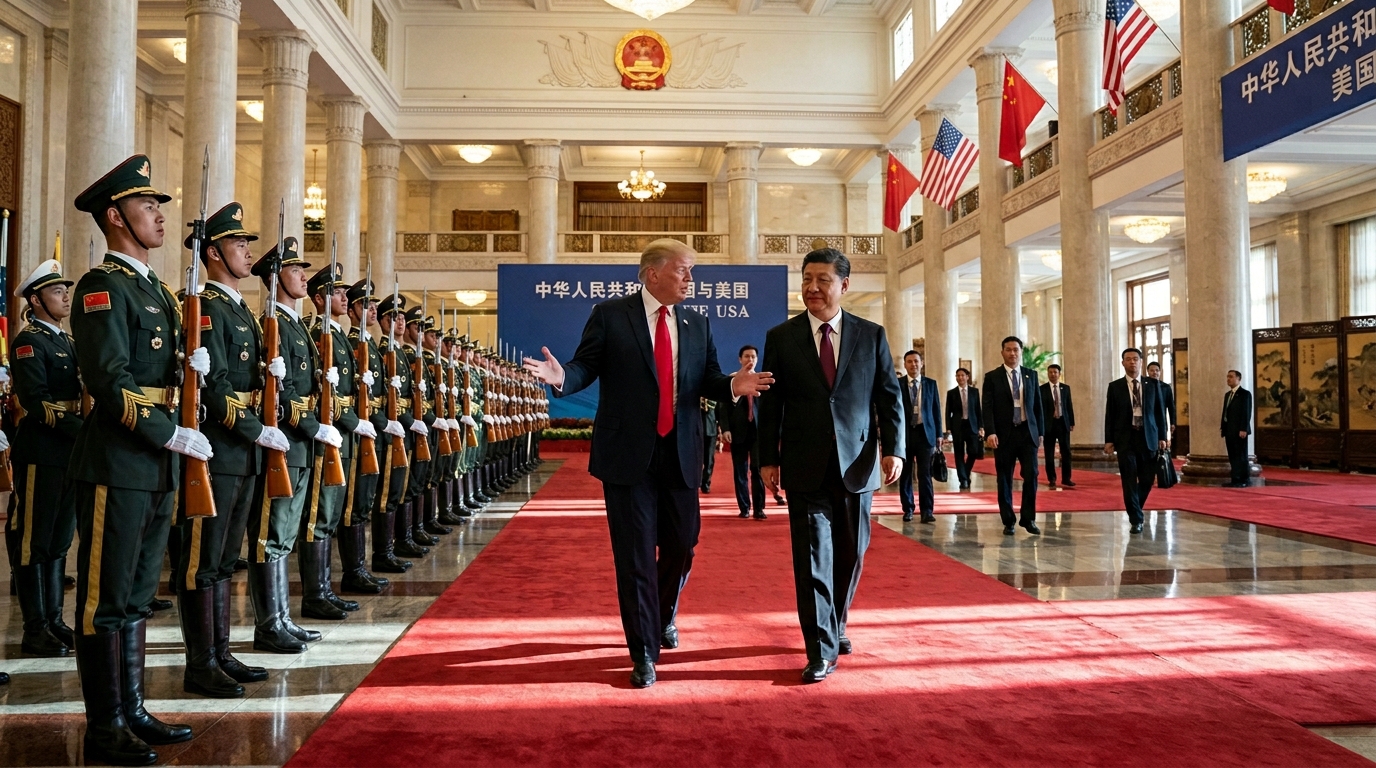
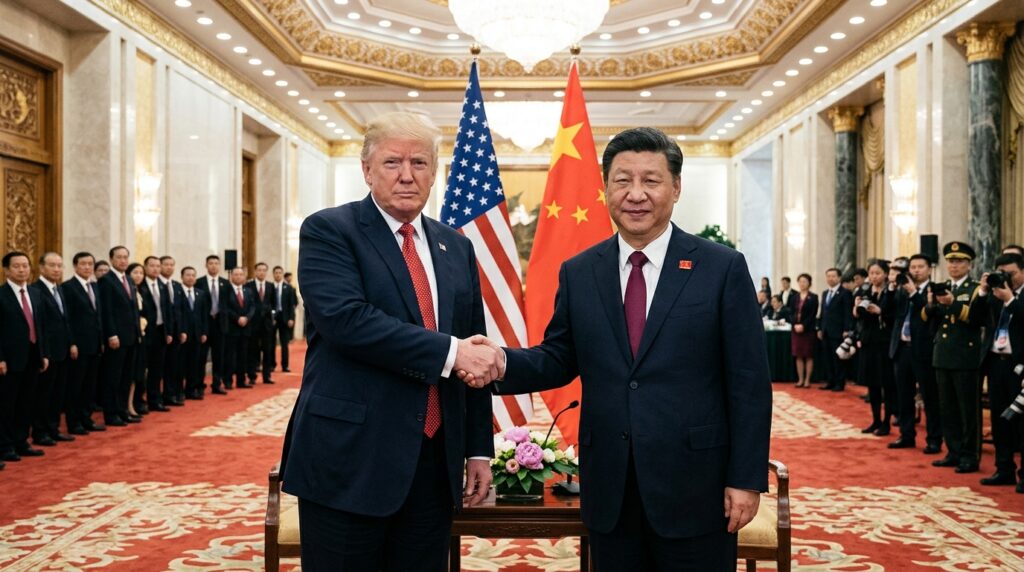
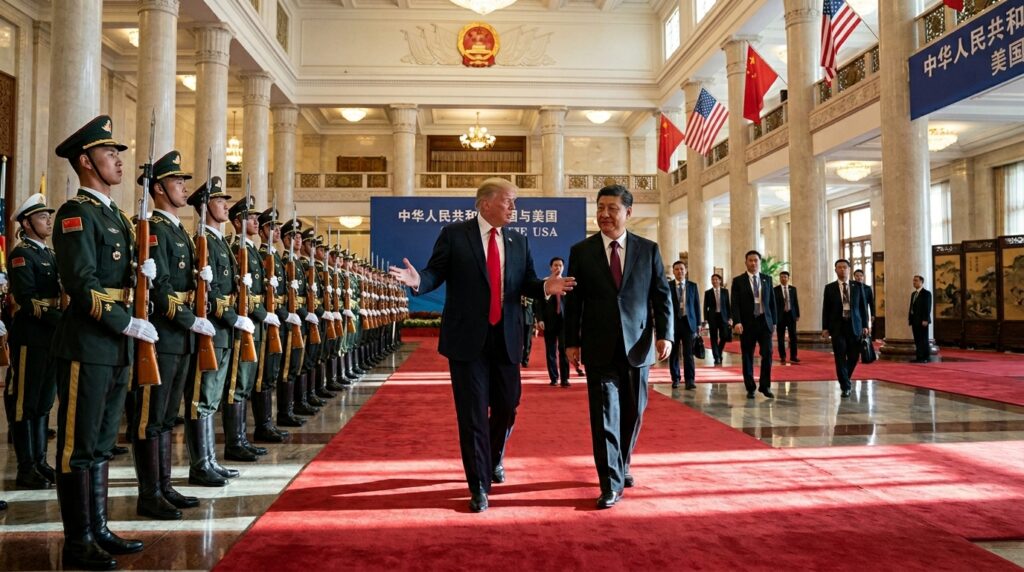
Inside Trump’s 2026 China Summit, as of the morning of Thursday, May 14, 2026, the second day of the Beijing Summit has moved from ceremonial greetings to the “hard bargaining” phase. President Trump and President Xi have concluded their first round of bilateral meetings at the Great Hall of the People, and the following sections have been integrated to reflect the latest developments for your investigative report.
https://mrpo.pk/trumps-visit-to-china/
Purpose of the Article
The purpose of this report is to pull back the curtain on the secret negotiations happening in the Great Hall of the People. We will look at why tech giants like Elon Musk are on the trip, the diplomatic tricks used to get officials into the room, and how these talks affect your wallet.
Xi warns Trump, China and US could ‘come into conflict’ if Taiwan issue mishandled, report
Xi Jinping has told Donald Trump their countries could come into conflict if the issue over self-ruled Taiwan claimed by Beijing is mishandled, Chinese state media said.
“The Taiwan question is the most important issue in China-US relations,” Xi said at their summit, according to state broadcaster CCTV.
If mishandled, the two nations could collide or even come into conflict, pushing the entire China-US relationship into a highly perilous situation.”

Chinese state-run news agency Xinhua quoted Xi as telling Trump that if the Taiwan issue was not handled well, the two countries would clash or even come into conflict, pushing China-US relations into “a very dangerous place”.
“We are looking for a fair deal, a great deal, and a deal that brings peace back to the Middle East,” President Trump told reporters before landing. “The world is watching, and we are ready to lead.”
The “Great Big Hug” vs. The Four Red Lines
While President Trump arrived banking on his personal “iron fist” chemistry with President Xi—even publicly predicting a “great big hug”—the Chinese side has remained intellectually rigid. As the motorcade rolled past skyscrapers lit with “Beijing Welcome,” the Chinese Embassy took to social media to reiterate the Four Red Lines.
The diplomatic tension is palpable: Trump is pushing for “Corporate Magic,” while Xi has spent the morning warning of “confrontation” if the Taiwan Question (the First Red Line) is not handled with extreme prudence.
A Big Deal for the World: Inside Trump’s 2026 China Summit
The world is watching as President Donald Trump visits President Xi Jinping in Beijing, China. This visit, happening in May 2026, is one of the most important meetings in recent history. It isn’t just about two leaders talking; it’s about money, technology, and trying to stop a war.
Why is Trump Visiting China Right Now?
The main reason for this trip is the Iran crisis. Right now, there is a conflict involving Iran that has made the price of gas and oil go up everywhere. Because China is the biggest buyer of oil from Iran, President Trump needs China’s help to make things peaceful again.
While the U.S. says it is very strong, new reports show that Iran still has many missiles. Trump wants to use his “deal-making” skills to get China to tell Iran to stop blocking the Strait of Hormuz, which is a very important path for ships carrying oil.
Four Critical Real-time Details for the May 2026 Summit
1. The “U.S. MATCH Act” Tension
One of the biggest missing pieces is the U.S. MATCH Act. This is a new law moving through Congress that aims to block China from getting the best AI chips.
Why it matters: China is furious about this. They are using this meeting to try and convince Trump to stop the Act. If it passes, China has threatened to cut off “Rare Earth Minerals”—special materials the U.S. needs to build everything from iPhones to electric car batteries.
2. The “Nuclear Trio” Proposal
President Trump has brought up a bold new idea: a three-way nuclear arms deal between the U.S., China, and Russia.
-
The Conflict: Traditionally, China has refused to join these deals because it has fewer bombs than the U.S. or Russia. Pointing out this disagreement adds a layer of “investigative” detail regarding global safety.
3. The “Rubio” Diplomatic Workaround
There is a very interesting “behind-the-scenes” detail regarding Secretary of State Marco Rubio.
-
The Problem: China actually had Rubio on a “sanction list” (meaning he wasn’t allowed in the country).
The Fix: Diplomats had to find a creative “workaround”—essentially a temporary name-translation adjustment—just so he could join the meeting. This shows how much “red tape” both sides are willing to cut to make the summit happen.
4. The Human Rights “Leverage”
While the CEOs are focused on money, Trump has specifically mentioned he will bring up the cases of political prisoners in Hong Kong (like Jimmy Lai).
-
The Strategy: Some experts believe Trump is using these human rights cases as “bargaining chips.” He may offer to stop talking about them if China gives him a better deal on trade or Iran.
China’s “Four Red Lines” and the Sovereignty Clash
Immediately preceding Trump’s arrival, the Chinese Ministry of Foreign Affairs and its US embassy issued a firm warning regarding four “red lines” that are non-negotiable:
1. Taiwan: Beijing rejects any consultation regarding US arms sales to the island.
2. Political System: China asserts its right to its own governance model without Western “lectures.”
3. Democracy and Human Rights: China views US criticism as hypocritical, given the current global conflicts.
4. Development Rights: This includes the right to trade and innovate without US-imposed technology “choke points.”
First-Time vs. Customary Statement
Historically, China has used broader terms like “core interests” in official communiqués. However, branding them as “Four Red Lines” in a public, social-media-focused warning specifically for a Presidential visit is a strategic move to set a pre-emptive boundary.
-
Logical Goal: Beijing is signalling that, unlike the 2017 visit, China now views itself as a peer power capable of setting the terms of the engagement.
-
The “Busan Context”: These lines were reinforced following the 2025 Busan summit, but their explicit use now serves as a defensive wall against Trump’s “deal-maker” style, ensuring he knows which “chips” are off the table before negotiations begin.
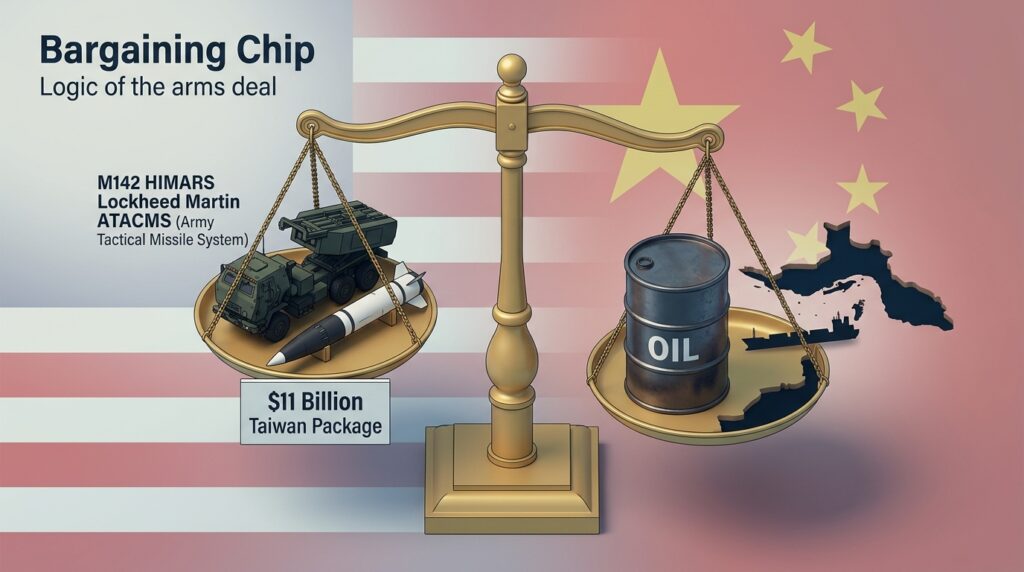
Analysis of Significance: The “Iran-Taiwan Quid Pro Quo”
The “Iran for Taiwan” trade-off. This is the most critical and logical question of the summit:
Question: Will Trump reduce U.S. arms sales or diplomatic support for Taiwan in exchange for China forcing Iran to end the Strait of Hormuz blockade?
Logical Explanation:
- The Pressure Point: The U.S. economy is reeling from surging oil prices due to the Iran conflict. Trump needs a “quick win” to stabilise global markets before the 2026 midterm elections.
- China’s Leverage: China is the only nation with enough economic pull over Tehran to force a de-escalation.
-
The Danger: Geopolitical experts warn that if Trump treats Taiwan as a “negotiable asset” rather than a “security commitment,” it could permanently shift the balance of power in the Indo-Pacific, potentially leading to a “Finlandization” of the region.
Analysis of Significance: The “Iran-Taiwan Quid Pro Quo”
The “Power Team” of Business Leaders
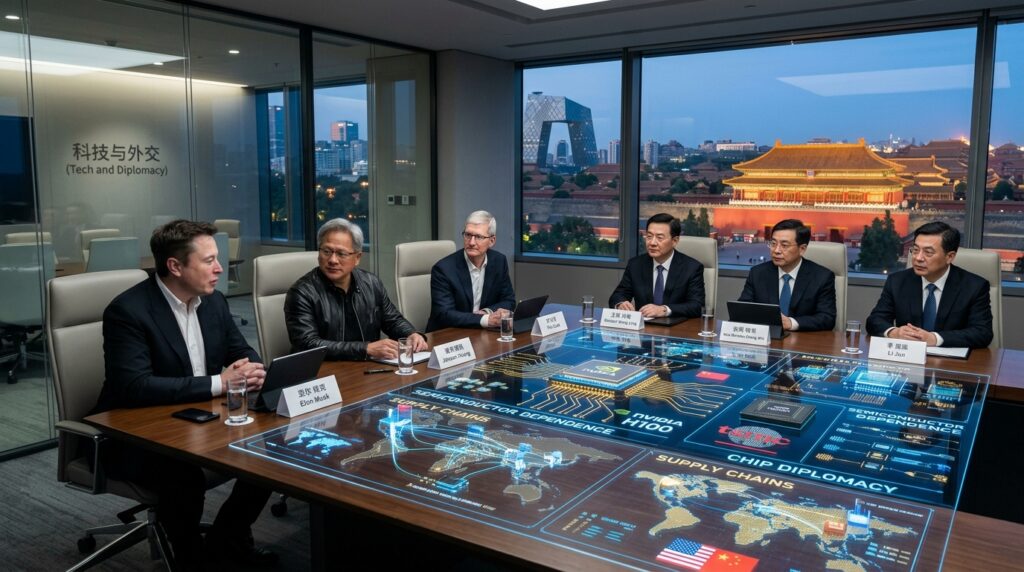
President Trump didn’t go alone. He took a group of the world’s most famous CEOs on his plane. This includes Elon Musk (Tesla) and Tim Cook (Apple). One of the most significant updates to this trip was the last-minute boarding of Nvidia CEO Jensen Huang onto Air Force One during a refuelling stop in Anchorage, Alaska.
Why are these CEOs there?
- The “Board of Trade”: A key deliverable is the creation of a joint “Board of Trade” to oversee purchase agreements (like soybeans and aircraft) to prevent the “failed promises” of the 2020 Phase One deal.
- Technology Diplomacy: Jensen Huang’s presence is a direct appeal to Xi to “open up” while simultaneously pressuring the U.S. government to loosen export controls on AI chips.
-
Strategic Shield: For Trump, the delegation provides “political cover” so that he can frame any concessions as necessary wins for American jobs and industry.
Important Questions Still Need to Be Answered
As the meetings continue, there are five big questions that experts are asking:
-
The Trade-Off: Will Trump promise to stop selling weapons to Taiwan if China helps stop the war in Iran?
-
The “Rubio” Problem: How will China talk to the U.S. Secretary of State, Marco Rubio, since they had previously banned him?
-
The Ceasefire: Will the temporary “peace” in the trade war between the two countries last?
-
Nuclear Weapons: Can the U.S. and China agree to have fewer nuclear bombs?
-
Technology Secrets: Will the U.S. allow China to buy its best computer chips again?
How Can the U.S. Compete with China?Inside Trump’s 2026 China Summit
A famous point raised by a BBC’s Laura Bicker and other correspondents is that the U.S. cannot win just by trying to “stop” China. China has become a leader in green energy (like electric cars) and Artificial Intelligence (AI).
The BBC expert explains that for the U.S. to stay ahead, it needs to build things faster and invest more money in schools and new inventions at home. Instead of just using taxes (tariffs) to make Chinese goods expensive, the U.S. must focus on making better products than anyone else.
Inside Trump’s 2026 China Summit: The Conflict of Interest
| Component | Official U.S. Stance | The “180-Degree” Reality |
| $11B Arms Sale | Essential for deterrence. | Potentially a “trading card” for a better trade deal. |
| Red Line #1 | U.S. law mandates Taiwan’s defence. | Trump signals personal chemistry with Xi can replace formal defence. |
| Corporate Interests | Use tech to stay ahead of China. | CEOs are pushing for “market access” which requires de-escalating Taiwan. |
Summary: A Balance of Power
This visit is a “detente,” which is a fancy word for two rivals deciding to be calm and talk instead of fighting. President Trump wants to fix the economy and stop a war, while President Xi wants to show that China is a world leader. The result of these talks will affect the price of things we buy and the peace of the world for years to come.
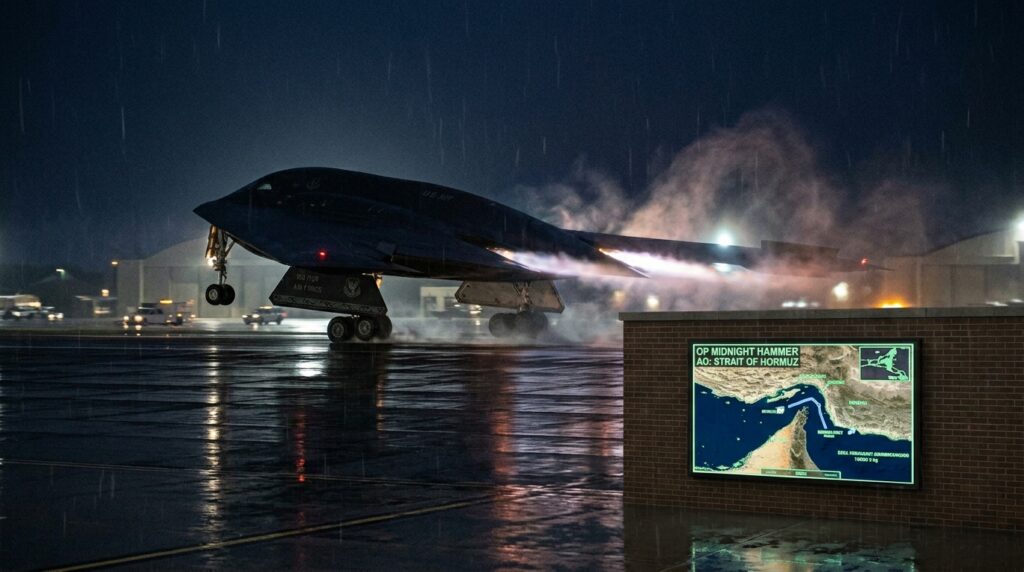
Operation Midnight Hammer and the “Strait of Hormuz” Trade
A major emerging development is the role of Secretary of State Marco Rubio, who confirmed this morning that the U.S. is explicitly asking China to play an “active role” in ending the 2026 Iran War.
-
The Logic: Following the B-2 bomber strikes of Operation Midnight Hammer, the U.S. is facing a logistical stalemate in the Persian Gulf.
Operation Midnight Hammer and the “Strait of Hormuz” Trade
The Trade: News from the summit suggests Trump is offering to “consult” with Xi on the delivery schedule of the $11 billion Taiwan weapons package in exchange for China using its leverage as Iran’s top oil buyer to force a ceasefire and reopen the Strait of Hormuz.
The Temple of Heaven: Symbolic Closure?
As of 10:30 AM IST, the leaders are scheduled to visit the Temple of Heaven. Logically, this choice of venue is no accident. In Chinese tradition, it is where the Emperor prayed for a “Good Harvest.”
For the “Trump 180-Degree Turn,” the harvest being sought is a Grand Bargain:
-
For the U.S.: An end to the Iran War and lower energy prices.
-
For China: A freeze or “tactical delay” on the $11 billion in HIMARS and missiles heading to Taiwan.
Investigative Note: Watch for the joint communique tomorrow. If there is no mention of “Taiwan” but a strong statement on “Global Energy Security,” it will confirm that the $11 billion package has been successfully traded for an Iranian exit strategy.
The world is watching the May 2026 Trump-Xi summit with a mixture of intense anxiety and cautious hope. Because these two leaders control the world’s largest economies, their “body language” in Beijing is being analysed by every major government and stock market on the planet.
Global Markets: The “Predictability” Test
Investors are not looking for a “happily ever after” story. Instead, they are looking for predictability.
-
The Oil Market: With the war in Iran making gas prices jump, traders are watching to see if China will use its influence to keep oil flowing. If the meeting goes well, gas prices might drop. If it ends in an argument, prices could skyrocket.
- The Tech Industry: Companies that make smartphones, electric cars, and defence tech are nervous about rare earth minerals. China controls most of these, and the world is watching to see if they will keep the supply open or “turn off the faucet” to pressure the U.S.
2. Europe and Asia: Watching the “Busan Truce”
In late 2025, the U.S. and China agreed to a temporary “peace treaty” regarding taxes (tariffs) in Busan, South Korea.
-
Europe’s Concern: The European Union (EU) is terrified that the truce will fail. If Trump and Xi start a new trade war, it could cause a global recession that hits Europe the hardest.
- Asian Neighbours: Countries like Japan, South Korea, and Vietnam are watching closely to see if Trump makes any secret deals regarding Taiwan. They worry that a shift in U.S. support could change the safety of the entire region.
3. The Media: Two Different Stories
The way the meeting is being reported depends on where you live:
-
In China, State media is showing President Xi as a strong, calm leader who is “standing up” to the U.S. while being a gracious host. They are highlighting the “Red Lines” to show that China is now an equal power to the United States.
-
In the US, Major networks like CBS and Fox News are focusing on the “Deal-Maker” image of Trump. They are highlighting the CEO delegation to show that the U.S. is focused on bringing back jobs and fixing the economy.
-
International (BBC/El País): Reporters are calling this “Tactical Stabilisation.” This means they don’t think the two countries will become friends; they just think they are trying to stop things from getting worse.
4. The “Midterm” Pressure
Global political experts note that 2026 is an election year in the U.S. The world knows that Trump needs a “big win” to show voters back home. This gives China a bit of an advantage in negotiations, as they know the U.S. President is under pressure to bring home a successful deal.
The “Empty Seat” at the Table: Russia
One final thing the world is watching is who comes after Trump. Vladimir Putin is expected to visit Beijing shortly after Trump leaves. Global leaders are watching to see if President Xi gives Putin a “warmer” welcome than Trump, which would signal that China’s true alliance still lies with Russia.
6 Frequently Asked Questions (FAQs)
1. Is the U.S. going to stop a war during this trip?
Trump is asking China to use its influence to stop Iran from blocking oil paths. If China agrees, the 2026 Iran crisis could cool down significantly.
2. Why are there so many CEOs on the trip?
They represent American jobs. By making deals directly with the Chinese government, they hope to sell more “Made in America” products.
3. Will the price of gas go down because of this?
If the two leaders agree on a plan for the Middle East, oil prices—and gas prices—are expected to drop almost immediately.
4. What is the “MATCH Act”?
It is a U.S. law designed to make sure the most powerful AI technology stays in American hands for safety reasons.
5. How does this affect my job?
If the proposed “Board of Trade” is created, it will be easier for American farmers and factories to sell products to China, which helps keep U.S. jobs stable.
6. What happens if the meeting fails?
If the talks fail, we could see higher taxes (tariffs) on things like electronics and a continuation of the high gas prices caused by the Iran conflict.
Summary: A Strategic Timeout
This visit is a detente, a strategic “timeout” where both sides stop fighting long enough to see if they can help each other. Neither side expects to be best friends, but both know they need each other to keep the world running.
References & Sources
-
Dr Moeed Pirzada, “Iran in Trouble: Russia and China involvement” (May 13, 2026).
-
Ather Kazmi, “US-China Diplomacy & The Trump Visit” (May 13, 2026).
-
BBC World News, “The Industrial Race: US vs China Development” (2026).
-
Wall Street Journal, “Tech Titans in Beijing: The CEO Delegation” (May 2026).