
Table of Contents
ToggleFrom Inner Cohesion to Global Respect
Re-Thinking the Foundations of National Strength and Prosperity
Author: Ehsan Mughees
Theme
From inner cohesion to global respect, nations do not decline merely because their enemies grow stronger; they decline when the internal bonds that sustain them begin to weaken. Moral erosion, social fragmentation, and institutional decay quietly dismantle even the most powerful states. True strength and lasting prosperity, therefore, emerge not from external projection but from internal order and cohesion.
Aim
This study seeks to redefine national strength and prosperity beyond material indicators and establish a principled framework—grounded in historical observation and Islamic civilizational wisdom—for reversing decline and achieving enduring stability, with particular relevance to Pakistan.
https://mrpo.pk/pakistans-roadmap-to-navigate-multipolarity/
Scope
This paper re-examines the meaning of strength and prosperity, identifies the principles behind civilizational rise and decline, applies these insights to Pakistan’s present condition, and proposes a pathway of renewal rooted in social reform, ethical economics, and just governance. At its core lies a universal doctrine: enduring strength develops from the inside outward.
Introduction
History repeatedly demonstrates a profound truth: nations rarely collapse because they are defeated from the outside. Rather, they fall when their internal foundations erode. Empires once rich, militarily powerful, and globally influential ultimately succumbed not to superior enemies, but to internal decay—families weakened, institutions lost credibility, leadership pursued privilege over service, and societies exchanged purpose for comfort.
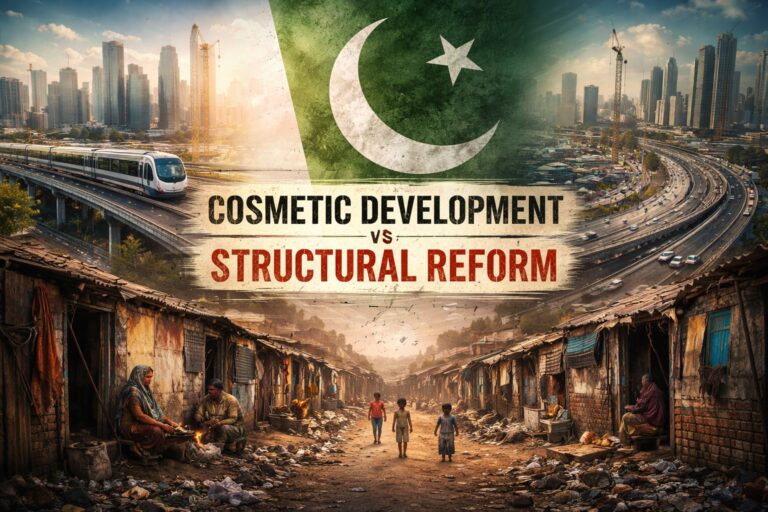
Pakistan today faces a similar paradox. Economic instability, social fragmentation, weakening institutions, and strategic dependence cannot be resolved merely through military modernisation, foreign alliances, or economic growth. These are outward instruments of power, but without internal coherence, they remain fragile.
Previous work by the author has emphasised that national decline is fundamentally civilizational. It is not merely political or economic; it is rooted in the moral and structural fabric of society. External alignment and diplomatic manoeuvring cannot substitute for internal strength.
The central thesis of this paper is therefore clear:
Enduring national strength flows from the inside outward.
Social cohesion, ethical governance, and institutional trust form the roots from which all sustainable power grows.
Part I: Defining National Strength and Prosperity
Modern discourse tends to measure strength through visible indicators—military capability, GDP, infrastructure, and alliances. Prosperity is similarly reduced to wealth, consumption, and technological advancement. Yet these metrics reflect capacity, not cohesion.
A deeper understanding reveals that national strength operates across layered dimensions:
| Layer | Description |
|---|---|
| Moral Strength | Social trust, justice, family integrity, and shared purpose |
| Institutional Strength | Courts, governance, markets, and education are aligned with societal values |
| Strategic Strength | Military and diplomacy rooted in moral and institutional foundations |
Prosperity, in this framework, is not mere wealth but sustained dignity and well-being across society. A truly prosperous nation ensures that the poor live with dignity, opportunity is accessible, and justice is trusted.
The relationship between strength and prosperity is asymmetrical:
Strength sustains prosperity, but prosperity alone cannot generate strength.
This leads to a necessary reversal of modern assumptions. Contemporary statecraft often follows the sequence:
Alliances → Security → Growth → Stability
Yet historical experience suggests the opposite:
Social Order → Justice → Institutional Trust → Strategic Confidence
Part II: Principles of Rise vs Causes of Decline
Civilisations rise when certain principles are upheld and decline when they are abandoned.
Societies that flourish prioritise unity over fragmentation, justice over expansion, duty over entitlement, and service over privilege. Leadership emerges from contribution, and institutions reflect the moral values of the people they serve. The Qur’anic principle captures this unity succinctly: “The believers are but a single brotherhood” (49:10).
In contrast, decline begins subtly. Consumption replaces contribution, identity fragments into competing factions, leadership seeks legitimacy from external powers, and security mechanisms replace social harmony. Power becomes an end in itself, disconnected from purpose.
The Qur’an articulates the law governing this transformation:
“Indeed, Allah does not change the condition of a people until they change what is within themselves” (13:11).
Thus, the collapse of nations is not sudden—it is the cumulative result of internal imbalance.
Part III: Pakistan — From Present Condition to Renewal
Pakistan’s path to renewal lies not in isolated reforms but in a comprehensive internal transformation.
Socially, the restoration of family structures, simplification of marriage norms, and revival of intergenerational respect are essential. Communities must rediscover civic responsibility, as social cohesion is the bedrock of national strength.
Economically, the system must shift from speculative gains toward ethical finance and equitable opportunity. Wealth must circulate rather than concentrate, ensuring dignity across all segments of society.
In governance, justice must become visible and impartial. Corruption must be reduced not only through enforcement but through moral accountability. Leadership must transition from authority-driven to service-oriented.
Strategically, alignment between the people, military, and state institutions is critical. External projection of power must follow internal unity—not precede it.
Part IV: Universal Principle and Philosophical Synthesis
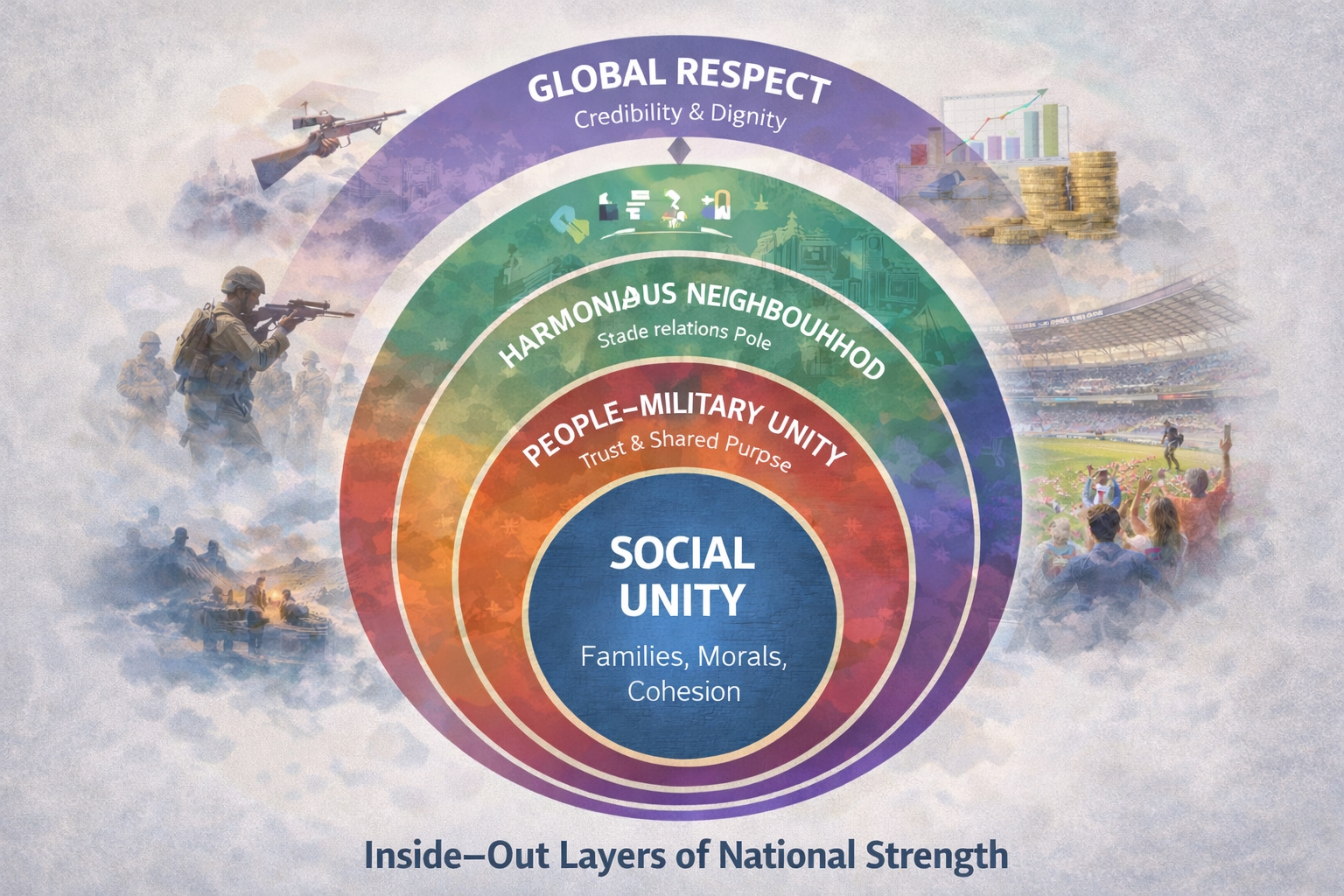
The architecture of national strength can be understood as an inside-out model, where each layer builds upon the one beneath it.
Inside–Out Layers of National Strength
▲
REGIONAL ENGAGEMENT
(Trade, Influence, Role)
▲
HARMONIOUS NEIGHBOURHOOD
(Stable Relations)
▲
GOVERNANCE ALIGNMENT
(State reflects People)
▲
PEOPLE–MILITARY UNITY
(Trust & Shared Purpose)
▲
SOCIAL UNITY
(Families, Justice, Cohesion)
This structure illustrates a fundamental law:
Internal order sustains external power; external power cannot compensate for internal disorder.
At its foundation lies social unity—strong families, shared identity, and moral cohesion. This enables trust between citizens and institutions, which in turn produces legitimate governance. Only then can stable regional relations and meaningful global engagement emerge.
Global respect, therefore, is not a starting point but an outcome.
Conclusion
True national strength and prosperity arise from within. Pakistan’s revival depends on restoring social cohesion, building an ethical economic system, ensuring just governance, and aligning state institutions with the people.
External alliances and recognition are consequences of internal integrity—they cannot replace it.
Recommendations
A comprehensive national renewal strategy must focus on strengthening family systems, promoting ethical economic practices, ensuring justice and transparency in governance, and prioritising internal cohesion before external strategic ambitions.
Final Word
Strength is cultivated, not borrowed. Prosperity is dignity, not wealth. Nations that pursue power outwardly without internal cohesion become dependent and fragile. Those who build inwardly develop resilience, stability, and lasting respect.
The path is clear:
Society → Unity → Governance → Neighbours → Region → World
References
- Mughees, Ehsan. From Inner Cohesion to Global Respect. MRPO, 2026.
- The Qur’an: Surah Al-Hujurat (49:10), Surah Ar-Ra’d (13:11)
- Historical studies on civilizational rise and decline (Toynbee, Spengler)