

Īmān bil-Ghayb and Modern Epistemology, Knowledge Beyond the Narrow Window of the Senses¹

-
The Epistemic Crisis of Modernity²
https://mrpo.pk/%d8%b5%d8%b1%d8%a7%d8%b7%d9%90-%d9%85%d8%b3%d8%aa%d9%82%db%8c%d9%85/
Modern civilization prides itself on being the most knowledgeable in human history. Scientific sophistication, technological mastery, and analytical precision are often cited as evidence of epistemic maturity. Yet paradoxically, this confidence is accompanied by a deep and widening sense of existential unease.
Despite possessing vast quantities of information, modern humanity struggles with meaning, purpose, moral grounding, and metaphysical certainty. This contradiction points not to a lack of intelligence, but to a crisis of epistemology—a confusion regarding what constitutes legitimate knowledge and which sources are worthy of trust³.
Islamic thought approaches this problem differently. Rather than assuming that all reality must submit to human verification, it begins by acknowledging the limits of human cognition and situates knowledge within a broader, divinely grounded framework.
-
The Architecture of Modern Epistemology⁴
Modern epistemology is primarily shaped by three disciplines: science, logic, and philosophy. These are often treated as neutral tools, yet in practice they function as architectures of exclusion, defining in advance what may be known and what must be ignored.
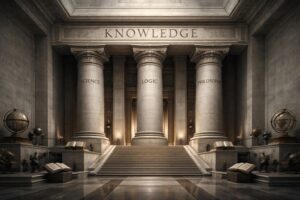
Science restricts knowledge to what is observable, measurable, and repeatable. Logic confines truth to internal consistency within formal systems. Philosophy, particularly in its modern forms, often avoids metaphysical commitment altogether, retreating into scepticism or linguistic analysis.
Each discipline is powerful within its domain. The problem arises when their methodological boundaries are mistaken for the boundaries of reality itself.
3 The Fovea-Centric Window of Knowledge⁵
Together, science, logic, and philosophy form what may be described as a fovea-centric epistemology—a sharply focused but extremely narrow field of vision.
Like the fovea of the human eye, this epistemic model provides clarity only within a limited range. Everything beyond that range is either ignored or declared unknowable. Transcendence, purpose, and metaphysical causality are dismissed not because they are false, but because they do not fit within the accepted frame.
This model does not merely limit knowledge; it reshapes reality itself to fit human sensory and rational constraints.
-
When Method Becomes Metaphysics⁶
A critical epistemic error occurs when methodology is elevated to metaphysics.
When it is asserted that God cannot be known because He cannot be empirically demonstrated, the claim reveals more about the method than about God. Empirical tools are designed to investigate objects within the universe, not the Source of existence itself.
To demand sensory proof of God is to commit a category error—akin to demanding a microscope to measure justice or a ruler to quantify meaning.
-
Īmān bil-Ghayb: Knowledge Beyond Perception⁷
The Qur’ānic worldview introduces a fundamentally different epistemic orientation:
“This Book—there is no doubt in it—is guidance for those who believe in the unseen.” (2:2)
Here, Ghayb does not signify non-existence⁸. It refers to realities that exist beyond human sensory access—realities known through Divine disclosure rather than human discovery⁹.
God, angels, the Hereafter, and Divine decree are unseen, not unreal. Their knowledge originates from a source unbound by time, space, or perception.
Īmān bil-Ghayb thus represents epistemic humility paired with ontological realism.
-
Reason as Instrument, Not Sovereign¹⁰
Islam does not reject reason; it repositions it.
Human intellect (‘Aql) is honoured as a faculty for recognising coherence, discerning signs (Āyāt), and preventing superstition¹¹. Yet it is not granted sovereignty over all existence.
When reason is absolutised—when it claims final authority over reality—it collapses under questions it cannot answer. Revelation does not negate reason; it completes and disciplines it.
-
Existential Anxiety and Epistemic Narrowing¹²
Modern existential anxiety is often attributed to excessive thinking or information overload. In reality, it arises from epistemic narrowing—from severing inquiry from transcendence.
When meaning is reduced to utility, morality to preference, and existence to biology, questions multiply without resolution. Anxiety is not produced by questioning itself, but by questioning within a truncated epistemology.
Īmān bil-Ghayb restores equilibrium by allowing mystery without nihilism and certainty without arrogance.
-
Civilizational Consequences of Epistemic Choices¹³
Civilizations are shaped not merely by what they know, but by what they permit themselves to know.
A civilisation that restricts knowledge to the visible inevitably reduces ethics to pragmatism and power to legitimacy. A civilisation grounded in Īmān bil-Ghayb anchors morality in accountability, knowledge in humility, and power in justice.
Epistemology, therefore, is not an abstract concern—it is a civilizational destiny.
What Is the Belief in the Unseen (Iman bil-Ghayb)?
Belief in the Unseen (Iman bil-Ghayb) is one of the core principles of Islamic faith, which refers to believing in aspects of the world that are beyond human perception and understanding, such as the existence of Allah, angels, the afterlife, and other unseen realities.
Key Aspects of Iman bil-Ghayb:
- Core to Faith: It emphasises the importance of belief in what is not physically observable, yet is affirmed by divine revelation.
- Spiritual Significance: Believing in the unseen requires trust in Allah’s guidance and the teachings of the Prophet Muhammad (PBUH).
- Examples of the Unseen: This includes belief in the angels, the Day of Judgment, paradise and hell, and divine predestination.
Importance of Iman bil-Ghayb:
- It is central to the foundation of Islamic belief and sets Islam apart from materialistic worldviews.
- It teaches the believers to live with a sense of accountability to Allah, knowing that their actions have consequences beyond the visible world.
- It fosters spiritual growth, relying on faith, trust, and divine wisdom.
Written by AI. A more correct, God given, explanation can be found here.
Conclusion: Beyond the Window¹⁴
Modern epistemology illuminates reality through a narrow window of sensory and rational verification. Revelation opens a horizon beyond that window.
To deny the horizon because the window is small is not intellectual rigor—it is epistemic confinement.
Īmān bil-Ghayb does not oppose knowledge. It liberates it.
Endnotes
- Epistemology — The study of the nature, sources, scope, and limits of knowledge.
- Epistemic Crisis — A condition in which existing knowledge frameworks fail to provide meaning or coherence.
- Epistemic Authority — The recognized source from which knowledge claims derive legitimacy.
- Epistemic Architecture — The structural framework that defines what a knowledge system admits or excludes.
- Fovea-Centric Epistemology — A metaphor describing knowledge systems confined to narrow, senses-based perception.
- Method Elevated to Metaphysics — Treating methodological limits as statements about ultimate reality.
- Īmān bil-Ghayb — Faith in unseen realities grounded in Divine revelation rather than empirical proof.
- Ghayb — That which exists beyond sensory perception; unseen, not unreal.
- Waḥy (Revelation) — Divine communication conveying knowledge inaccessible through human reason alone.
- Reason as Instrument, Not Sovereign — The view that intellect serves truth but does not define it absolutely.
- ‘Aql — Human intellect in Islamic thought; a faculty for recognizing signs and coherence.
- Epistemic Narrowing — The reduction of knowledge to limited methodological sources.
- Civilizational Epistemology — The dominant knowledge framework shaping a civilization’s values and direction.
- Narrow Window of Knowledge — A metaphor for sensory-restricted modern epistemology.