
A Forensic Look at FIA Immigration Practices at Pakistan’s Airports
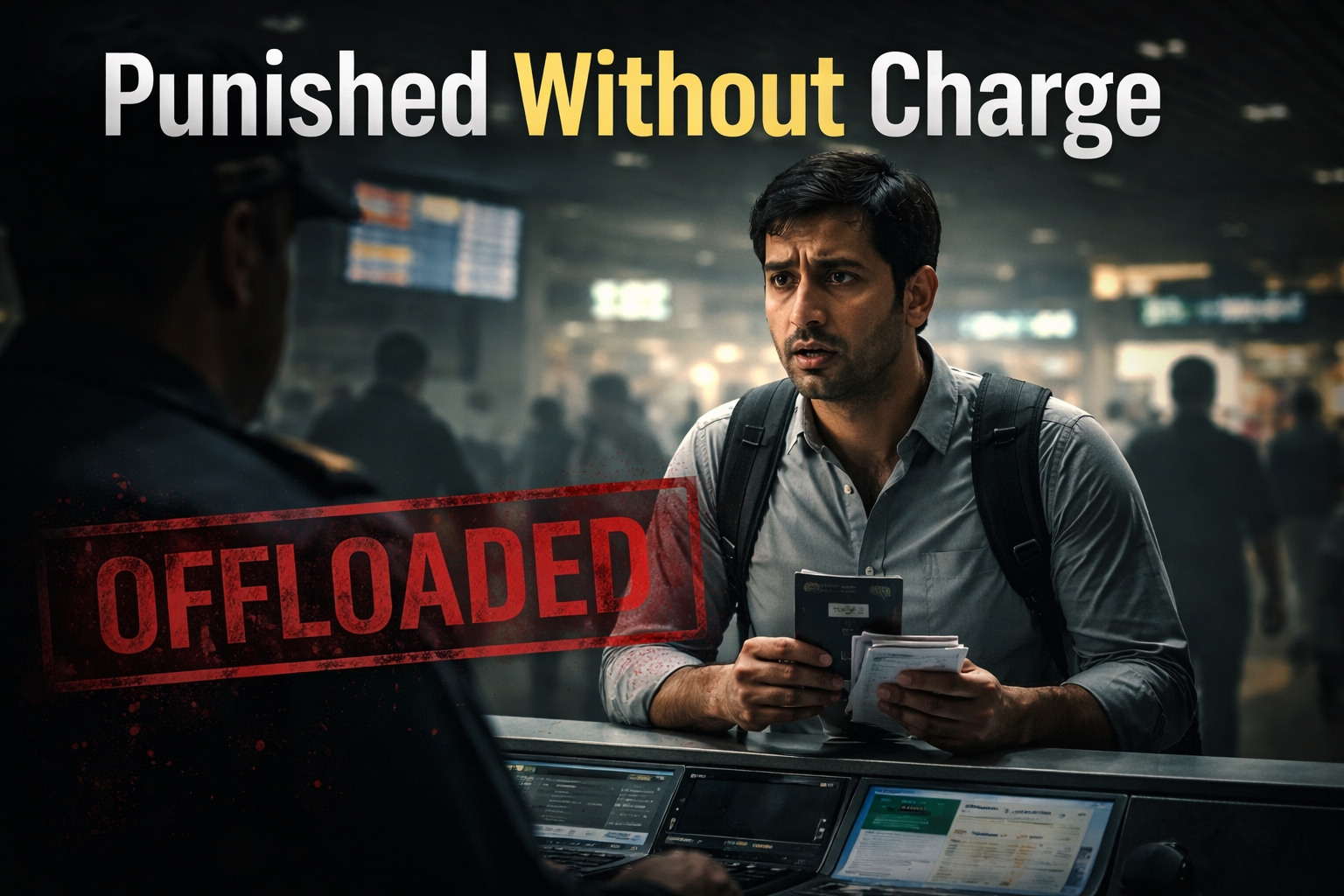
At an airport counter, a man stood quietly, clutching his passport and a folder of carefully arranged documents. His Umrah visa was stamped, his return ticket confirmed, his hotel booked in Makkah. It had taken him two years of savings to reach this moment. Yet within minutes, that journey ended—not in departure, but in silent denial.
A few routine questions were asked. Then he was told to step aside. No written explanation followed. No formal accusation was made. His flight departed without him. There was no FIR, no documented order, no opportunity to appeal. He returned home not as someone proven guilty, but as a citizen denied his right to travel—punished without ever being charged.
This is no isolated incident. Across airports in Lahore, Karachi, and Islamabad, similar experiences are quietly unfolding. Behind the counters of immigration control, a difficult national question is emerging: can a state pursue aggressive anti-smuggling enforcement without compromising the dignity and rights of its own lawful citizens?
The urgency of enforcement is not in dispute. The 2024 boat tragedy near Greece exposed the brutality of human-smuggling networks and forced Pakistan to reassess its exit control mechanisms. In response, the Federal Investigation Agency intensified its vigilance. Immigration counters transformed into high-alert checkpoints. Passenger questioning became more rigorous, databases were enhanced, and the number of offloads rose sharply.
By 2025, over 22 million passengers had been processed nationwide, and more than 66,000 were offloaded—nearly double the previous year. The majority of these cases involved individuals traveling on work, visit, tourist, or even Umrah visas that were deemed “questionable” at the counter. The intention was clear: stop exploitation before it begins. Yet the outcome has produced a troubling category of citizens—those who are stopped, but never formally accused.
The law does empower immigration authorities to act. Under statutes such as the Emigration Ordinance of 1979, the Prevention of Trafficking in Persons Act 2018, and the Passport Act of 1974, officers are authorized to question travelers, examine documentation, and prevent illegal emigration. However, these powers are not without limits. Internal procedural guidance cautions against acting on mere suspicion and requires that reasons for such actions be recorded.
It is precisely here that the system begins to blur. While the authority to stop exists, the obligation to document often does not materialize in practice. Decisions are made in real time, at crowded counters, under pressure, and frequently without a written trail. This gap between authority and accountability creates a grey zone—one where administrative discretion can impose immediate consequences without leaving behind a record.
The scale of this grey zone becomes evident when one examines what follows an offload. Thousands of passengers are stopped each year, yet only a small fraction of these cases translate into formal FIRs. Fewer still proceed to prosecution. In most instances, the suspicion that justified the offload does not evolve into a legal case. For the state, the matter ends at prevention. For the individual, however, the consequences are tangible and often severe—financial loss, missed opportunities, reputational damage, and a lingering sense of injustice.
This disconnect has not gone unnoticed. In December 2025, the Lahore High Court addressed the issue directly, ruling that offloading a passenger without providing written reasons violates the principles of natural justice. The judgment underscored a simple but fundamental principle: a citizen has the right to know why he or she is being restrained. Transparency, the court implied, is not an obstacle to enforcement—it is its foundation.
Yet on the ground, the reality appears slower to change. Reports continue to suggest that undocumented, on-the-spot decisions remain part of routine practice. This persistence reveals that the problem is not merely legal, but structural.
Adding to the complexity is a troubling paradox within the enforcement system itself. While ordinary passengers are subjected to intense scrutiny, internal accountability actions within the agency tell another story. In recent years, over 200 officials have faced penalties for corruption, indiscipline, or alleged links to trafficking networks. Some immigration personnel have even been arrested for facilitating the very smuggling operations the system seeks to prevent.
This contradiction—where elements within the system undermine its own mission—deepens the sense of imbalance. The burden of suspicion falls heavily on citizens, while systemic weaknesses continue to erode institutional credibility from within.
The implications of this situation extend far beyond individual inconvenience. Pakistan’s economic and social fabric is deeply tied to mobility. Overseas employment fuels remittances, students seek education abroad, families undertake religious journeys, and businesses rely on international travel. When lawful travelers are unpredictably stopped without explanation, the consequences ripple outward. Trust diminishes, reputations suffer, and opportunities quietly slip away—not just for individuals, but for the country as a whole.
Understanding this issue requires looking beyond individual actions to the design of the system itself. Officers operate under immense pressure to prevent smuggling, often without the support of structured decision-making tools. There is no universally enforced requirement for issuing written offload orders in real time. Supervisory review at the moment of decision is limited. Passenger rights are not visibly articulated at immigration counters. Technology, which could reduce reliance on subjective judgment, remains underutilized. In such an environment, discretion inevitably expands—and with it, the risk of inconsistency and injustice.
Yet the path forward is neither complex nor unattainable. Around the world, effective immigration systems balance enforcement with transparency through simple but firm safeguards. A written offload slip stating the reason for restraint, the identity of the officer, and a summary of the concern can transform a moment of confusion into one of clarity. Immediate supervisory review can prevent arbitrary decisions. CCTV-backed counters and retained footage can ensure accountability. Technology-driven risk assessment can reduce reliance on intuition. A visible Passenger Rights Charter can empower citizens, while an independent grievance mechanism can provide timely recourse.
Such measures do not weaken enforcement; they strengthen it by anchoring it in legitimacy.
The challenge, ultimately, is one of balance. Human smuggling is a grave threat that demands vigilance and decisive action. The state has both the right and the responsibility to prevent it. But in doing so, it must ensure that its methods do not undermine the very trust it seeks to protect.
The question is not whether suspicious travelers should be stopped. It is whether they should be stopped without being told why.
A nation is defined not only by how it confronts threats, but by how it treats its own citizens in the process. No individual should leave an airport feeling condemned without accusation, restrained without explanation, or punished without charge.
Pakistan does not need less enforcement. It needs enforcement that is visible, documented, and accountable. Until every offload is accompanied by a clear, written, and reviewable reason, the grey zone will persist—quietly eroding confidence, dignity, and trust.
For a country whose people travel in hope—of livelihood, learning, and faith—that is a cost far too great to accept.