
European troops in Greenland: Greenland at the Centre of a New Arctic Power Struggle
What if the next global power struggle doesn’t erupt in the Middle East or the Pacific, but beneath the ice of the Arctic? https://mrpo.pk/you-voted-for-peace/
Introduction: Why a Frozen Island Suddenly Matters So Much
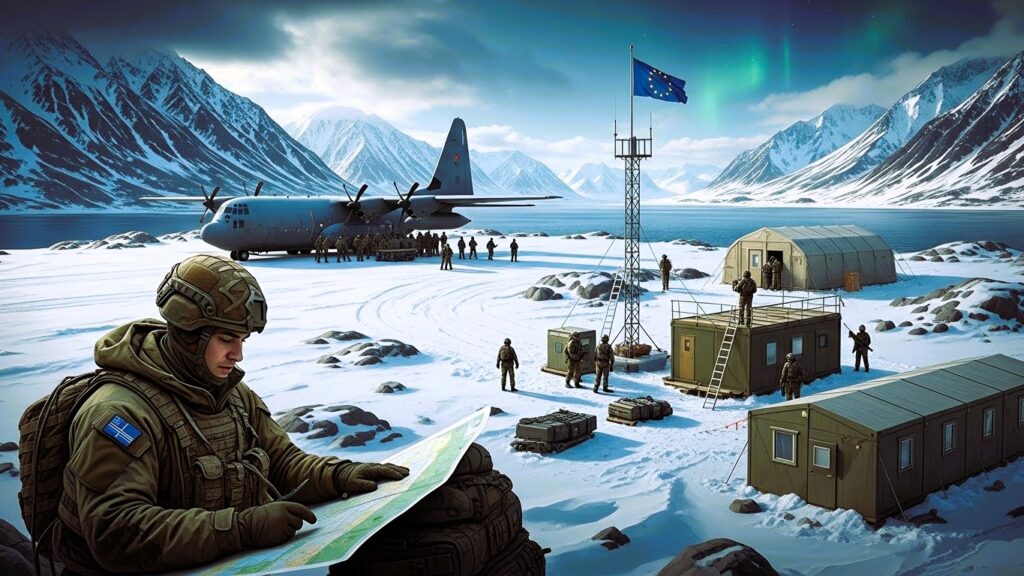
European troops in Greenland, often imagined as a quiet land of ice and snow, have suddenly become one of the most important places in global politics. In recent months, troops and naval vessels from several European countries, including Germany, France, the United Kingdom, Sweden, Norway, Finland, and the Netherlands, have arrived on the island in limited numbers.
At the same time, renewed statements by U.S. President Donald Trump about acquiring Greenland have reopened an old but sensitive debate. These developments are closely connected. Together, they show how Greenland has moved from the margins of world affairs to the very heart of a new Arctic power struggle.
Once ignored by the world, Greenland is now being quietly repositioned on the global chessboard — not by one power, but by many.
EP — Executive Perspective
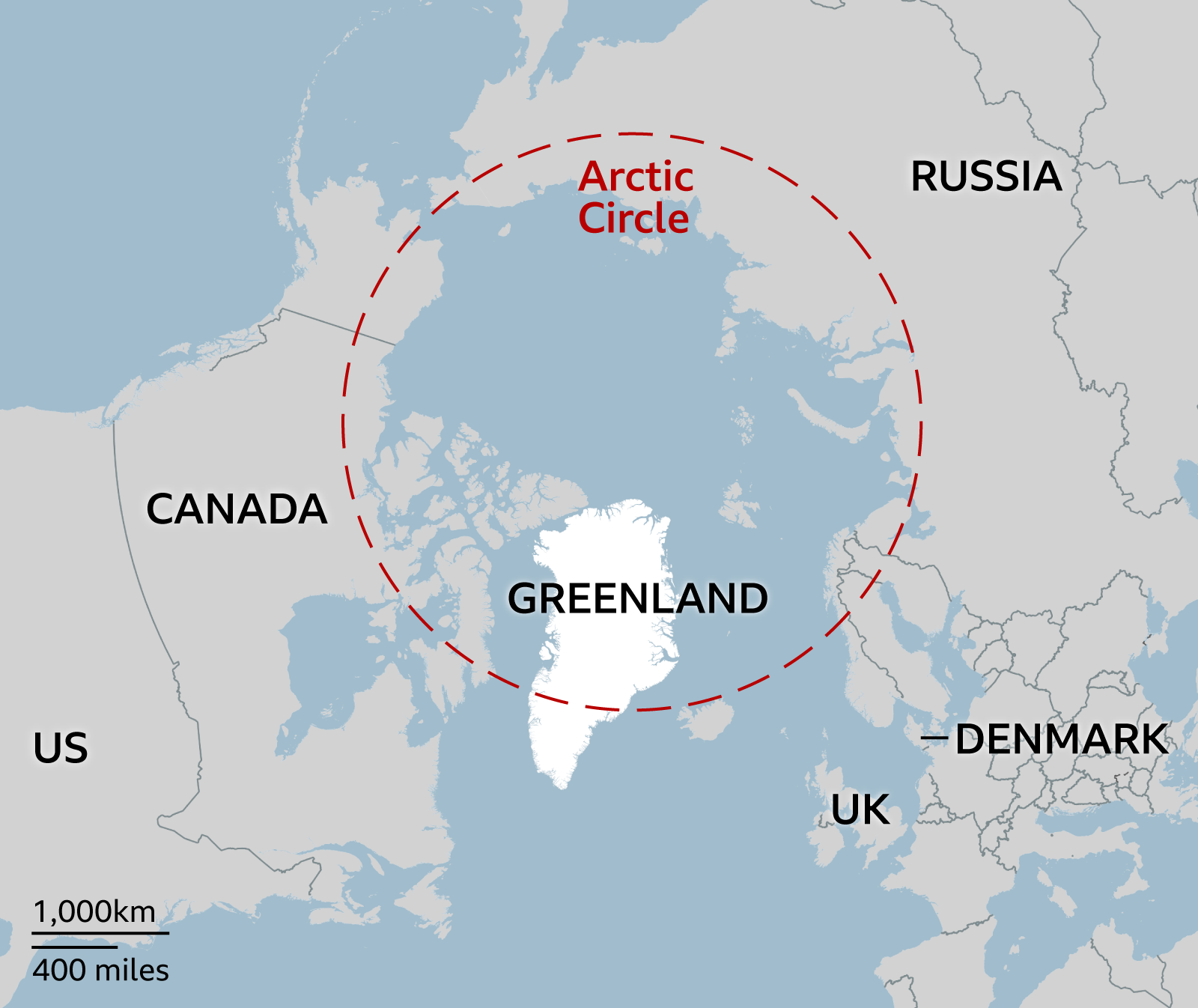
To understand what is happening in Greenland today, one must look beyond troop movements and political headlines. Greenland represents the point where climate change, global security, natural resources, and alliance politics intersect.
The European presence is not preparation for conflict, but a strategic signal reinforcing collective defence, protecting sovereignty, and quietly responding to unilateral ambitions. Greenland’s story reflects how global power is being renegotiated in a warming and increasingly competitive Arctic.
Greenland’s Deep History: From Indigenous Homeland to Strategic Territory
Long before generals, presidents, and alliances argued over Greenland, the island already had a history of being claimed and reclaimed by distant powers.
Long before global powers took an interest, Greenland was home to Inuit communities who developed resilient cultures adapted to extreme Arctic conditions. Their connection to the land remains central to Greenland’s identity today.
European involvement began in the 10th century with Norse settlers, but lasting control emerged centuries later. In 1721, Denmark reasserted authority, eventually making Greenland a colony and, in 1953, an official part of the Danish kingdom.
Over time, governance evolved. Home Rule in 1979 and expanded Self-Rule in 2009 granted Greenland control over domestic affairs and natural resources. However, defence and foreign policy remained with Denmark a distinction that continues to shape today’s geopolitical debates.
World War II and the Cold War: Why the U.S. Never Left
Greenland’s strategic role became unmistakable during World War II. When Denmark was occupied by Nazi Germany, the United States stepped in to prevent Greenland from falling into enemy hands. Airfields and military infrastructure built during this period permanently linked the island to American defence planning.
That connection deepened during the Cold War. Greenland became a critical early-warning location between the United States and the Soviet Union. The construction of Thule Air Base, now known as Pituffik Space Base, placed Greenland at the centre of missile detection and space surveillance systems.
Even after the Cold War ended, the U.S. presence remained. Greenland continued to serve as a silent but essential shield in North Atlantic and Arctic security.
A Changing Arctic: Climate, Resources, and Renewed Competition
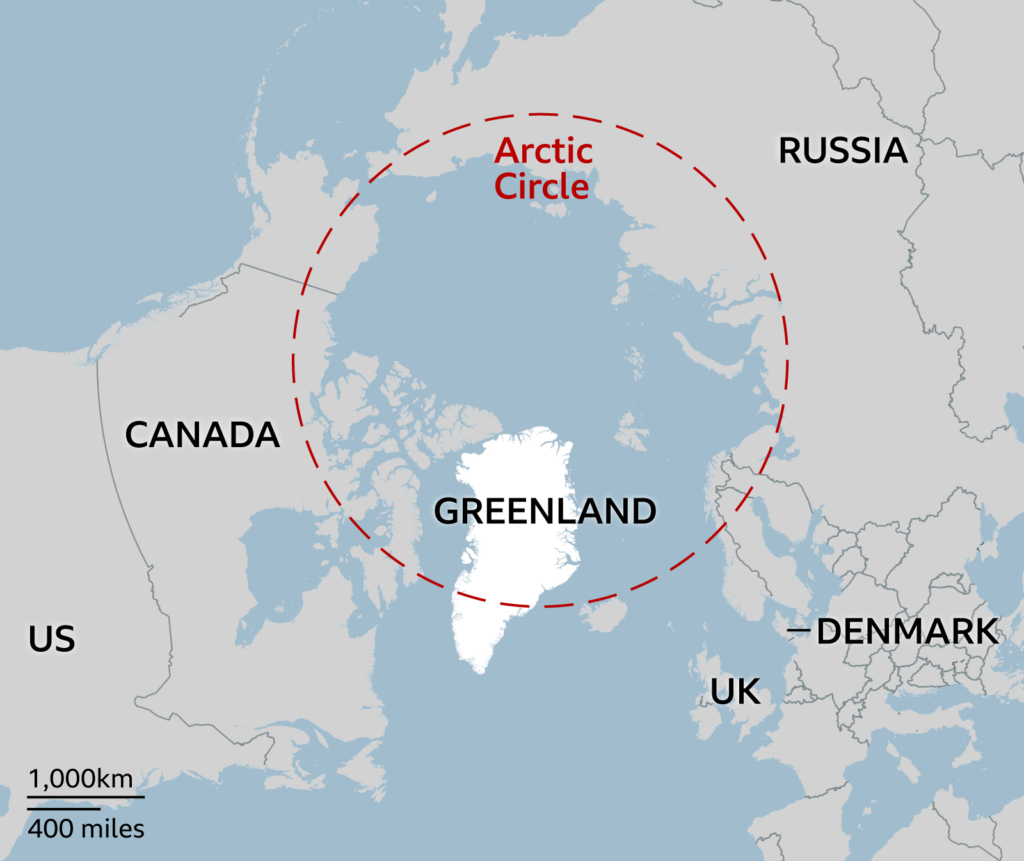
While military importance never disappeared, the Arctic’s transformation in the 21st century brought Greenland back into sharper focus. Climate change melted ice barriers, opened new shipping routes, and exposed valuable resources beneath Greenland’s surface.
These changes attracted renewed attention from global powers. Russia expanded its Arctic military posture, China increased economic and research involvement, and the United States reassessed Greenland’s long-term strategic value. Geography once again placed Greenland at the crossroads of global competition.
Trump’s Greenland Ambitions: Shock That Carried Meaning
Few political statements in recent history sounded more absurd and yet revealed more than the idea of buying Greenland.
Against this backdrop, Donald Trump’s remarks about acquiring Greenland landed with unusual force. First voiced publicly in 2019 and later repeated, the idea challenged diplomatic norms and unsettled allies.
Denmark rejected the proposal immediately, and Greenland’s leaders made their position clear: the island was not for sale. Yet the significance of Trump’s statements lay not in feasibility, but in what they revealed a willingness to frame Greenland as an object of acquisition rather than cooperation.
In a world already sensitive to questions of sovereignty and territorial ambition, this rhetoric carried consequences far beyond words.
So What Makes Trump Different?
Trump’s Distinction (Why It Shocked the World)
| Aspect | Previous Presidents | Trump |
|---|---|---|
| Interest in Greenland | Quiet, strategic | Public, blunt |
| Diplomatic tone | Private negotiations | Media statements |
| Respect for allies | Carefully managed | Often confrontational |
| Language used | Security cooperation | Ownership & acquisition |
| Reaction triggered | Minimal | European troop deployments |
Trump turned a behind-the-scenes strategic idea into a headline-driven political statement.
Has Any Other Country or U.S. President Sought Greenland Before Trump?
Trump was not the first to desire Greenland, but he was the first to say it out loud.
Although Trump’s approach was unprecedented in tone, interest in Greenland is not new. The United States has viewed the island strategically for more than a century.
In 1867, shortly after purchasing Alaska, U.S. officials quietly explored acquiring Greenland and Iceland. During World War II, the U.S. defended Greenland with Denmark’s consent, establishing a lasting military presence. In 1946, President Harry S. Truman formally offered Denmark $100 million in gold to purchase Greenland — an offer that was firmly rejected.
During the Cold War, American influence expanded through NATO agreements rather than ownership. Other countries showed interest only in limited ways. Nazi Germany attempted wartime weather stations, while Russia and China have focused on influence rather than annexation.
What sets Trump apart is not the idea itself, but its public revival. He transformed a historically discreet strategic concept into an open political declaration, altering how allies and rivals interpreted American intentions.
European military personnel arrive in Greenland as Trump says US needs island
A small French military contingent has arrived in Greenland’s capital Nuuk, officials say, as several European states deploy small numbers in a so-called reconnaissance mission.
The limited deployment, which also involves Germany, Sweden, Norway, Finland, the Netherlands and the UK, comes as US President Donald Trump continues to press his claim to the Arctic island, which is a semi-autonomous part of Denmark.
French President Emmanuel Macron said the initial contingent would be reinforced soon with “land, air, and sea assets”.
Senior diplomat Olivier Poivre d’Arvor saw the mission as sending a strong political signal: “This is a first exercise… we’ll show the US that Nato is present.”
https://www.bbc.com/news/articles/cd0ydjvxpejo
European Troops in Greenland: Signal, Not Escalation
When soldiers arrive without fanfare, it often means the message is meant for capitals, not cameras.
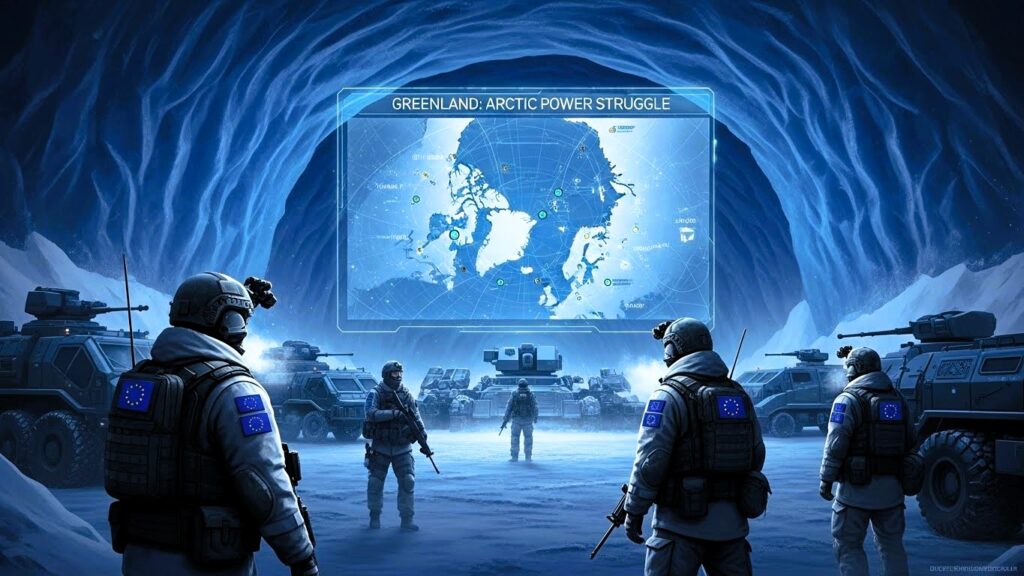
It is within this historical and political context that the arrival of European troops must be understood. These deployments are limited, carefully coordinated, and framed as joint exercises and Arctic readiness efforts.
Their importance lies less in military scale and more in symbolism. European allies are affirming that Greenland’s security is a shared responsibility and that its future will be shaped through alliances and international norms, not unilateral decisions.
This is not a confrontation with the United States, but a reinforcement of collective principles at a moment of uncertainty.
The View from Greenland
While global powers debate strategy, Greenlanders are asking a simpler question: who decides our future?
For Greenlanders themselves, the debate is deeply personal. While many seek greater independence over time, there is little support for replacing one external authority with another.
Greenland’s leadership has consistently emphasised that decisions about the island’s future must involve its people. Security, economic development, and environmental protection matter, but so does dignity and self-determination.
Why Greenland Matters Beyond the Arctic
Greenland’s situation mirrors a broader global shift. As climate change reshapes geography, regions once considered distant are becoming central to global politics.
The Arctic is no longer a peripheral space. It is a testing ground for how modern powers balance rivalry, cooperation, and restraint in a rapidly changing world.
Conclusion: A Cold Place with Hot Politics
The coldest places on Earth are no longer politically quiet.
Greenland may be covered in ice, but the politics surrounding it are heating up. European troop deployments and renewed American ambitions are signals of a world adjusting to new realities.
What is ultimately at stake is not just territory, but the rules that govern power, sovereignty, and alliance behaviour in the 21st century. How Greenland’s future is handled will echo far beyond the Arctic, shaping trust, stability, and cooperation in a warming world.