Thirty Years of ‘Imminence’: Deciphering the Contradictory Signals for an Attack on Iran
The Fog of ‘Epic Fury’: Navigating the Post-Strike Rhetoric
Excerpt (Article Purpose): Contradictory statements attack Iran: Thirty years of Imminence. From the UN “Cartoon Bomb” of 2012 to the unilateral strikes of 2026, the pretexts for military action against Iran have been in a state of permanent motion. This investigation deconstructs three decades of shifting rationales from Western officials, revealing a pattern of contradictory statements, intelligence mismatches, and a profound asymmetry in media visibility.
By analysing documented evidentiary gaps, it exposes how the definition of a “justifiable conflict” has been manipulated to serve immediate political and strategic goals.
On February 28, 2026, the world watched as a coordinated U.S.-Israeli kinetic operation, code-named “Operation Epic Fury,” struck deep into Iranian territory. The headlines were definitive: a “necessary defensive action” to prevent a nuclear “breakout” that, according to the official administration line, was just “weeks away.” Yet, in the aftermath, the clarity of that premise has been replaced by a growing “credibility deficit.”
https://mrpo.pk/the-age-of-trumplization/
In serious policy circles and rigorous journalism, the question isn’t whether Iran poses a challenge, but whether the specific rationale for this specific war holds under cross-examination. This article investigates a disturbing three-decade pattern in which the “imminence” of the threat is constant, while the evidence used to justify it is in perpetual motion.
If the current threat was so immediate, why did the administration’s own intelligence assessments contradict the President’s public warnings by nearly a decade?
Neither preemptive nor legal, US‑Israeli strikes on Iran have blown up international law
The joint US-Israeli strikes on Iran represent a further erosion of the international legal order. Under international law, these attacks are neither preemptive nor lawful.
Israel and the United States launched Operation Shield of Judah and Operation Epic Fury while diplomatic negotiations between Washington and Tehran were actively underway on Iran’s nuclear program.
Just two days earlier, the most intense round of US-Iran talks concluded in Geneva, with both sides agreeing to continue. US President Donald Trump indicated he would give negotiators more time. Then came the bombs.
The illegality of the attack
Israel said the strikes were “preventive”, meaning they were to prevent Iran from developing a capacity to be a threat. But preventive war has no legal basis under international law. The UN Security Council did not authorise any military action, meaning the sole lawful pathway for the use of force for self-defence was never pursued.
The Thirty-Year Projection: Netanyahu’s Longitudinal Pattern of Alarmism
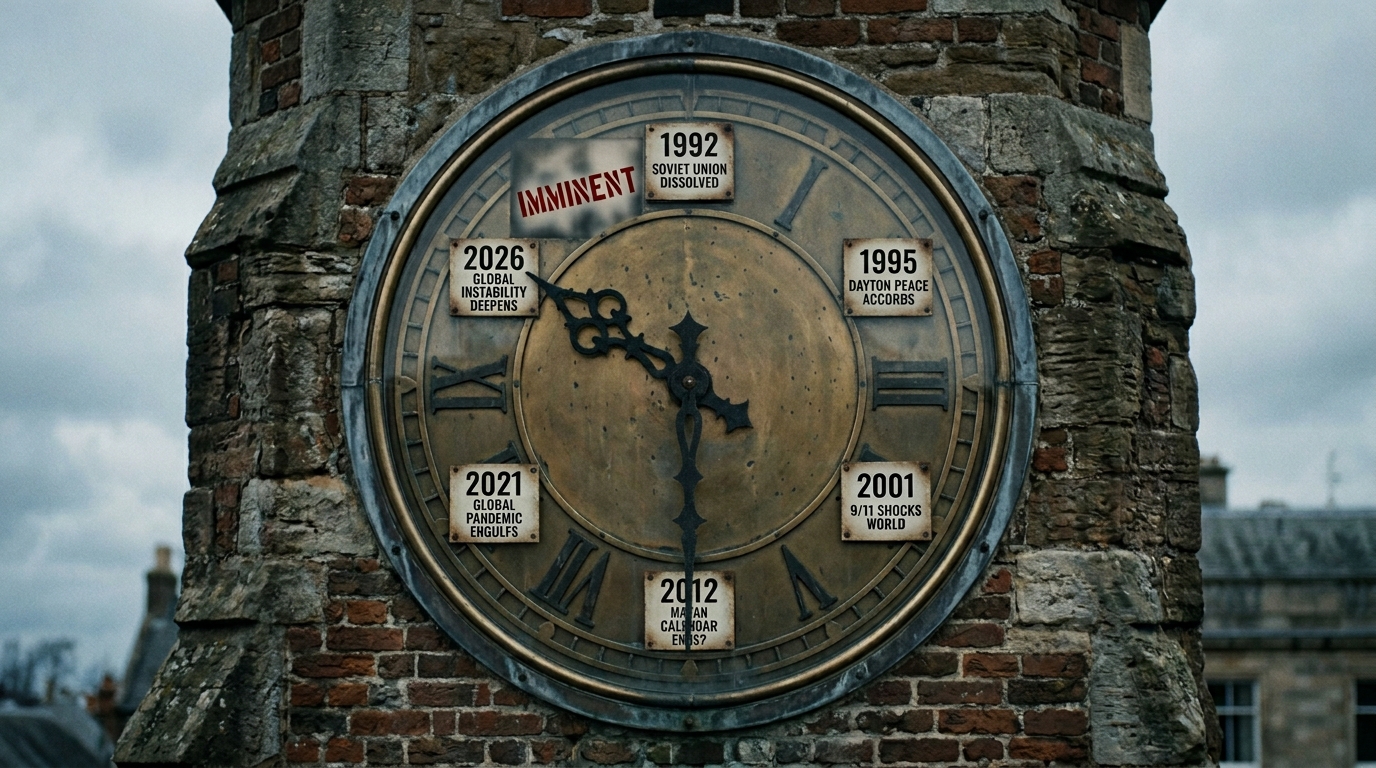
To understand the 2026 conflict, one must look at the historical architectural blueprint that built it. A critical study reveals a longitudinal pattern of “alarmist” rhetoric that spans over thirty years, primarily championed by a single figure: Prime Minister Benjamin Netanyahu. This is not a partisan critique; it is a survey of the public record. In 1992, for example, Netanyahu claimed Iran was three to five years from a nuclear weapon, a projection that did not materialise. The most famous moment in this long cycle occurred in 2012 when he stood before the UN General Assembly with a cartoon bomb drawing, illustrating a “red line” that Iran was poised to cross by mid-2013.
Yet, contemporaneous Mossad documents leaked in 2015 revealed that the Israeli intelligence community did not share the Prime Minister’s public alarmism. This mismatch between political rhetoric and analytical assessment continued through the 2025 “Twelve-Day War,” always framed by a new cycle of “imminence” that seemed to retreat whenever an actual non-proliferation milestone was achieved. This history establishes a crucial precedent: the official reason for a potential conflict is often detached from the observable technical capability of the state being targeted.
The Shift in 2026: An Era of Contradictory Baselines
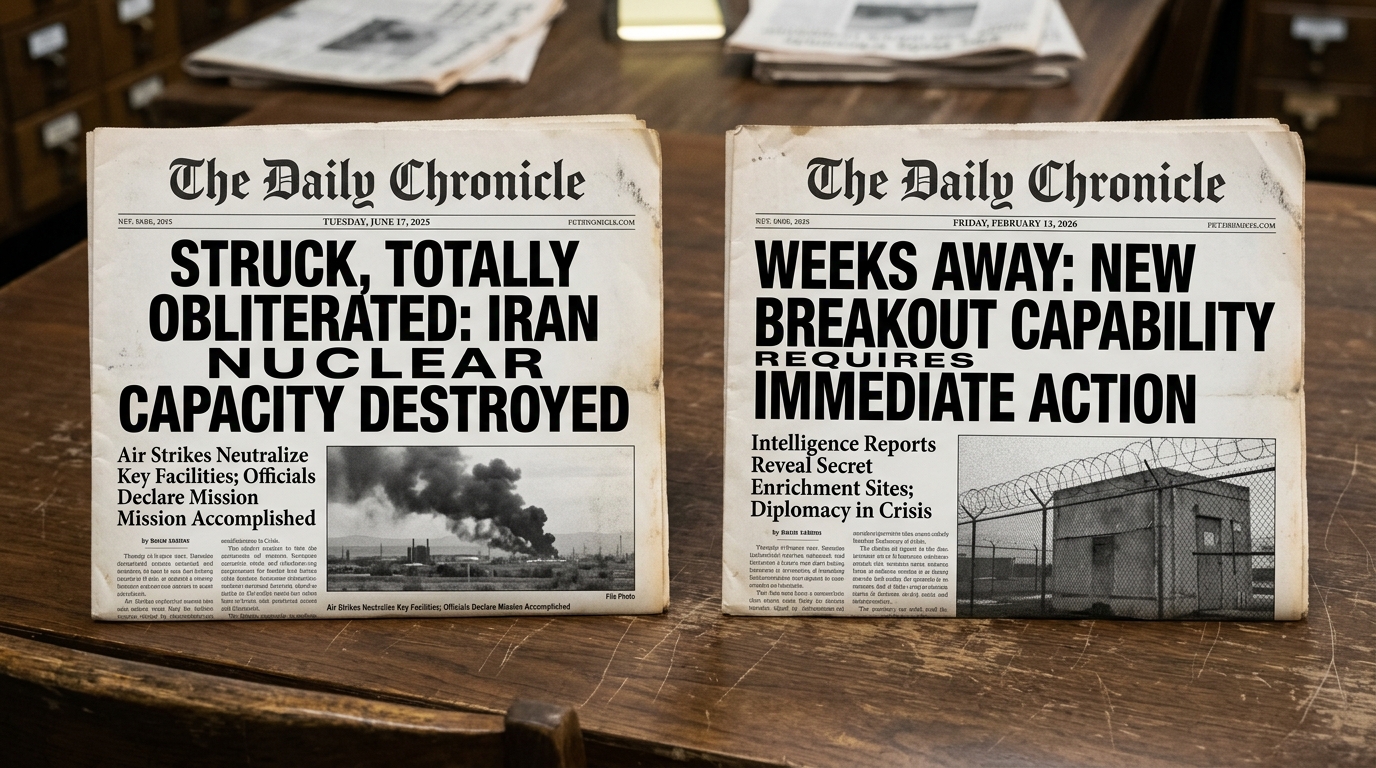
The justification for the 2026 strikes presented an even starker example of shifting baselines. The administration’s public-facing narrative focused exclusively on a “weeks-away” nuclear scenario. But this was immediately complicated by two major inconsistencies. First, just months prior, in late 2025, officials had boasted that the June 2025 “proactive disruption” strikes had “totally obliterated” Iran’s enrichment infrastructure.
This created a paradoxical situation where Iran was described as simultaneously having its capabilities destroyed and, moments later, possessing an imminent breakout capacity. Second, and more importantly, the Defence Intelligence Agency (DIA) in May 2025 and subsequent IAEA quarterly reports stated that while enrichment continued, there was no evidence of a “structured program” to manufacture nuclear weapons at that time. These neutral, evidentiary findings were seemingly disregarded in favour of the political requirement for action.
This pattern of shifting rationales, from nuclear prevention to regional deterrence, raises a fundamental question: What is the true objective of this conflict if the nuclear premise is continually moving?
The Battle in Congress: The Legal Threshold and “Regime Change”
This evidential gap has ignited a constitutional standoff in Washington over the scope of Executive power. The administration initially framed the strikes to the UN Security Council as “anticipatory self-defence” under Article II of the Constitution and Article 51 of the UN Charter, an argument usually reserved for repelling “sudden attacks.” However, this narrative was fractured when the President simultaneously called for the Iranian people to “take over” their government.
Lawmakers on both sides of the aisle, particularly through actions like the Kaine Resolution and H. Con. Res. 38, began a legal pushback. They argued that if the goal was “regime change,” the operation required a formal Declaration of War from Congress under Article I, not a defensive pretext stretched to its breaking point. This shift from a defensive military goal (neutralising missiles) to an offensive political one (toppling a sovereign state) is a central legal critique, suggesting that the “nuclear threat” may have been a rhetorical vehicle for a broader, pre-existing strategic ambition.
The Geography of Access: Disparate Realities and the War Censor’s Mandate
The most definitive proof of a “credibility deficit” isn’t in what is said, but in what is seen. In a volatile conflict, the public depends on a consistent application of journalistic standards to understand the actual costs. Here, we find the most profound asymmetry. During and after the 2026 strikes, international journalists from CNN, the BBC, and other major bureaus were roaming Iranian cities (Tehran, Isfahan) independently.
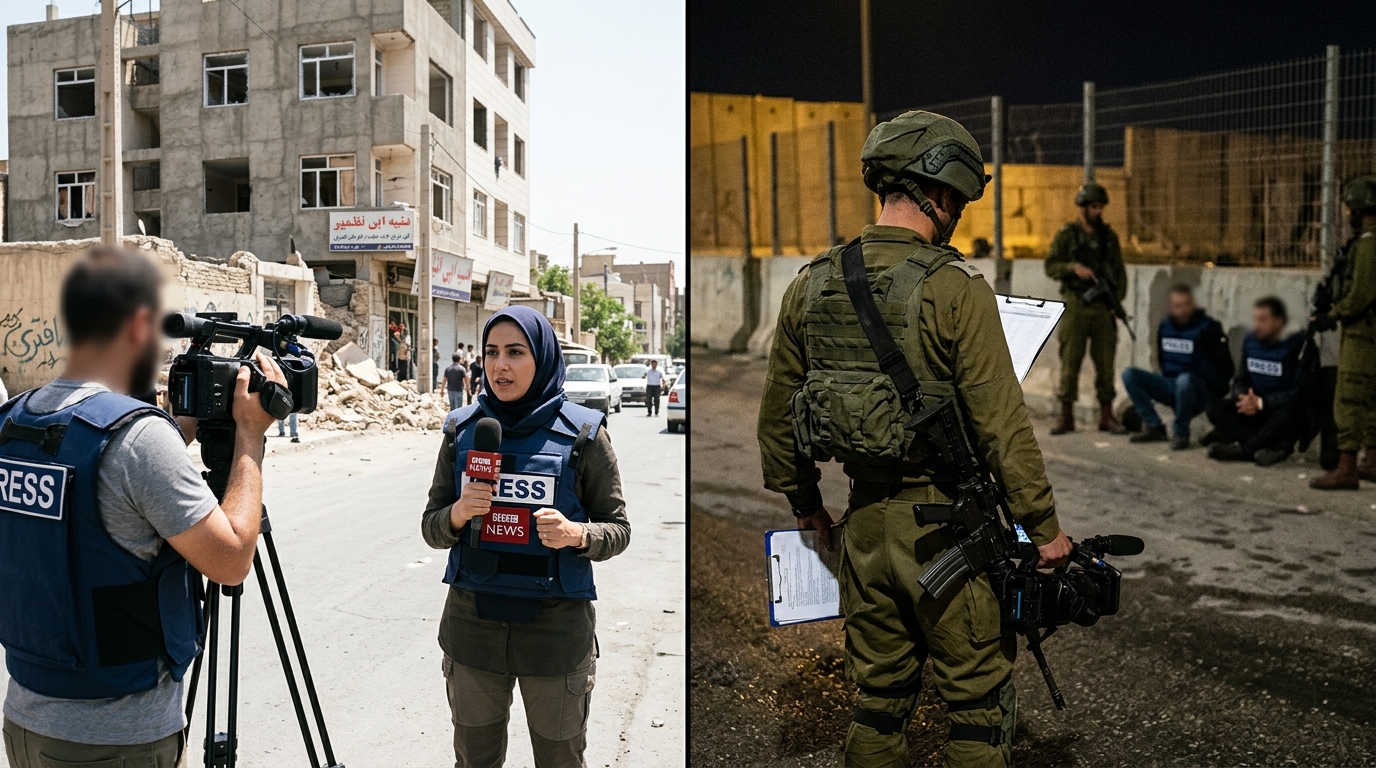
Their live dispatches provided real-time, high-definition evidence of non-military infrastructure damage, like the widely documented strike on the Gandhi Hospital and, tragically, the mass casualty event at the Shajareh Tayyebeh girls’ school in Minab. Contrast this with the flow of information from within Israel.
Under the authority of the Israeli Chief Military Censor, explicit prohibitions were placed on broadcasting live footage of missile interceptions or any imagery revealing the impact sites of Iranian retaliatory projectiles (Operation True Promise IV). This was reinforced by the highly publicised March 2026 detention of international news crews attempting to document the strike aftermath. This disparity means the public is offered a curated narrative: Iranian damage is hyper-visible and unauthorised, while Israeli damage is protected by a state-enforced informational vacuum.
The “Credibility Deficit” in Modern Conflict
By comparing the 30-year lineage of Netanyahu’s public alarmism with the immediate rhetorical contradictions and media asymmetries of 2026, an objective investigator must conclude that the rules-based order of military justification is being superseded by a narrative-based order. When “imminence” becomes a perpetual baseline used to bypass congressional and international oversight, and when the visual record of the conflict is selectively sanitised, the public’s ability to provide informed consent for war is fundamentally compromised.
The burden of proof for offensive action must remain a pillar of any functioning democracy. The 2026 conflict is less a definitive military solution than it is a failure of sustained, fact-based diplomacy, illustrating that the greatest threat to security may not only be the weapons in the silos, but the casual erosion of the truth in the halls of power.
FAQs: Deciphering the Conflict with Objective Evidence
Q1: What is the primary contradiction in the 2026 justification for the attack on Iran?
The most significant discrepancy involves the timeframe of the nuclear threat. The Executive Branch claimed Iran was “weeks away” from a nuclear bomb to justify immediate strikes. However, this contradicted the DIA’s May 2025 assessment (which saw no ICBM threat before 2035) and subsequent IAEA verifications found no evidence of a “structured weapons program” at the time. This mismatch suggests a political rather than a technical rationale for the war.
Q2: Why is Prime Minister Netanyahu’s historical “alarmism” relevant to the current conflict?
It establishes a critical precedent showing how a public rationale for war can be detached from technical capabilities. For thirty years (starting in 1992), Netanyahu has consistently warned of “imminent” nuclear capabilities that never materialised. This historical longitudinal pattern demonstrates that the narrative of a “near-term threat” is a recurring rhetorical tactic that has consistently preceded calls for proactive military disruption, regardless of the actual stage of Iranian enrichment.
Q3: How do the June 2025 strikes complicate the official narrative for the 2026 operations?
Following the June 2025 “proactive disruption” strikes, administration officials touted the complete neutralization of Iran’s enrichment capabilities. However, to justify the 2026 strikes, the President had to simultaneously argue that the earlier operations were entirely successful while also claiming that Iran had managed to “rapidly rebuild” the same sophisticated facilities, a premise that has drawn scrutiny for its apparent internal contradiction.
Q4: What is the primary constitutional conflict regarding the war with Iran?
The core debate centres on Executive power vs. Legislative authorization. The administration justified unilateral strikes as “anticipatory self-defence” under Article II of the Constitution to prevent an imminent threat, an action that does not require prior congressional approval. However, the pushback from Congress (like H. Con. Res. 38) argues that if the operation includes goals like “regime change”—as the President’s own statements suggested—the action is inherently an offensive operation, which requires a formal Declaration of War from Congress under Article I.
Q5: Is there proof of a double standard in the Western media coverage of the conflict?
There is a documented “informational asymmetry.” International journalists (CNN, BBC) are operating independently in Iranian urban centres, allowing for widespread coverage of civilian infrastructure damage (like the Shajareh Tayyebeh school). In contrast, similar reporting from within Israel is strictly governed by Military Censorship laws, which legally prohibit broadcasting footage of successful Iranian missile hits, creating a perception of visual and strategic asymmetry that skews public understanding of the war’s actual reciprocity.
Q6: What are the primary references and documents that form the basis of this critique?
This investigative article relies on verified public documents and independent agency findings. Key sources include: IAEA Quarterly Reports (confirming non-weapons program findings); The DIA’s May 2025 Assessment (refuting long-range missile threats); the text of the Kaine Resolution (challenging Article II pretext); Israeli Military Censorship Office warnings (proving media suppression); and contemporary Committee to Protect Journalists (CPJ) reports on reporter detentions in Israel.
Author Profile: Hamid Mahmood
MA Political Science | LLB | PGD HRM
Hamid Mahmood is a distinguished geopolitical analyst and legal scholar with a multidisciplinary background in Political Science, Law, and Human Resource Management. This unique academic trifecta allows him to dissect international conflicts through a rigorous lens that balances political strategy, constitutional legality, and organisational behaviour.
With a Master’s in Political Science and an LLB, Hamid specialises in the legalities of kinetic warfare, focusing on the tensions between executive military action and legislative oversight. His investigative work centres on the “Credibility Deficit” in modern diplomacy, providing evidence-based critiques of state-led narratives and the historical longitudinal patterns of regional “alarmism.”
Known for his commitment to unbiased, evidentiary journalism, Hamid’s work is dedicated to exposing the informational asymmetries that define modern conflict. He advocates for transparency and the protection of independent war correspondence, ensuring that international law and human rights remain at the forefront of the global conversation.
Connect with Hamid:
-
Expertise: International Relations, Constitutional Law (Article II & War Powers), Geopolitical Risk Assessment.
-
Editorial Mandate: “Verifiable truth over rhetorical convenience.”
References & Documentary Evidence
This investigation is anchored in a comparative analysis of the public record, utilising evidence-based neutral journalism standards and authoritative documentary sources:
-
International Oversight and Intelligence Assessments: Analysis relies on verifiable quarterly reports from the International Atomic Energy Agency (IAEA) (e.g., March 2026 verification), which consistently provide objective findings on uranium enrichment levels, contrasting with the administration’s “breakout” rhetoric. Historical data includes the leaked 2012 Mossad cables (published by Al Jazeera/Guardian), which exposed discrepancies between Benjamin Netanyahu’s UN “red line” address and his own intelligence agency’s assessments.
-
Legal and Congressional Records: The constitutional and War Powers analysis is grounded in the formal text of the Kaine Resolution and H. Con. Res. 38, introduced in response to the 2026 strikes. Congressional hearing transcripts—specifically the testimony from undersecretaries to the Senate Intelligence Committee—provided crucial data regarding the actual “imminence” threshold, which was not supported by the DIA’s May 2025 Long-Range Missile Forecast.
-
Media and Journalist Liberty Oversight: Documentation of the informational vacuum comes from specific warnings issued by the Israeli Military Censor (e.g., the March 6, 2026, broadcast prohibitions) and corroborated by Committee to Protect Journalists (CPJ) statements detailing the detention of crews from CNN Türk. Eyewitness reporting on civilian infrastructure damage in Iran, including the Minab Girls’ School tragedy, were verified through local medical authorities in the hormozgan province and human rights briefings (e.g., HRW/Amnesty International), which contrasted sharply with the sanitised official military damage assessments released by U.S. and Israeli commands.