
Borrowed Grandeur and Cosmetic Governance: A Structural Analysis of Development Optics in Pakistan
Abstract
Borrowed Grandeur and Cosmetic Governance, this study critically examines the recurring pattern of “cosmetic development” in Pakistan’s governance model, wherein successive political regimes have prioritised high-visibility, debt-financed infrastructure projects over deep structural economic reforms. While such projects often create a perception of rapid progress, they have contributed little to long-term economic resilience. Instead, they have intensified fiscal fragility, widened external imbalances, and reinforced dependence on external financing. By tracing historical patterns since the 1990s and analysing contemporary manifestations, this paper argues that Pakistan’s development paradigm remains fundamentally misaligned with the requirements of sustainable growth. The study concludes with policy recommendations advocating a transition toward productivity-driven, fiscally disciplined governance.
https://mrpo.pk/inner-cohesion-to-global-respect/
Introduction
Over the past three decades, Pakistan’s political economy has been characterised by a recurring tension between visible development and structural stability. Governments across different political periods have consistently showcased large-scale infrastructure projects—highways, metro systems, energy initiatives, and, more recently, luxury state acquisitions—as symbols of national progress. These projects, often politically marketable and publicly visible, have served as instruments of legitimacy and electoral appeal.
However, beneath this surface lies a persistent structural weakness. Key economic indicators reveal a fragile foundation marked by low export competitiveness, chronic fiscal deficits, heavy reliance on external borrowing, mounting circular debt in the energy sector, weak industrial depth, and insufficient investment in human capital. The central paradox that emerges is both striking and consequential: while visible development has expanded, economic resilience has remained stagnant.
This contradiction forms the core concern of this research.
Conceptual Framework: Cosmetic vs. Structural Development
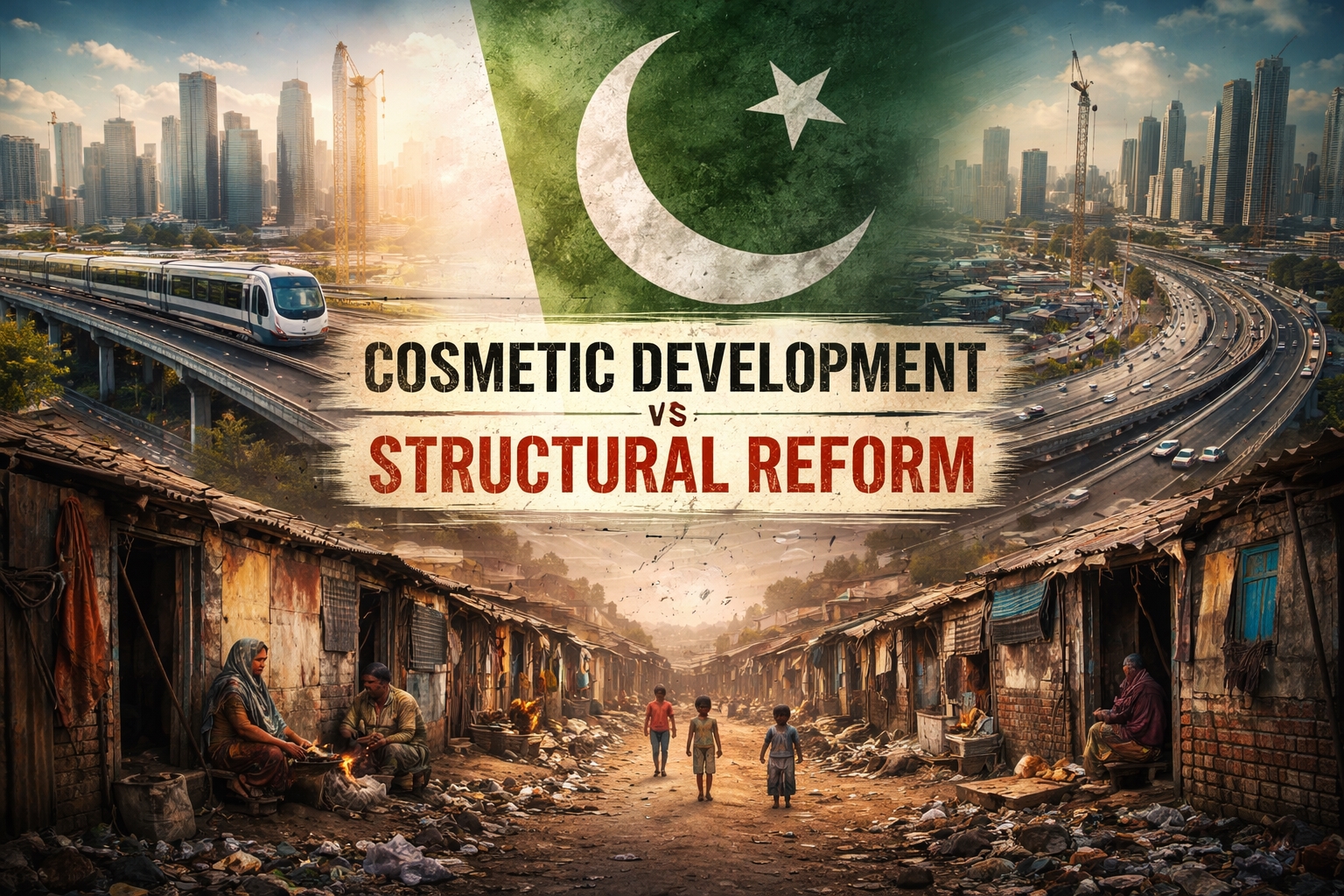
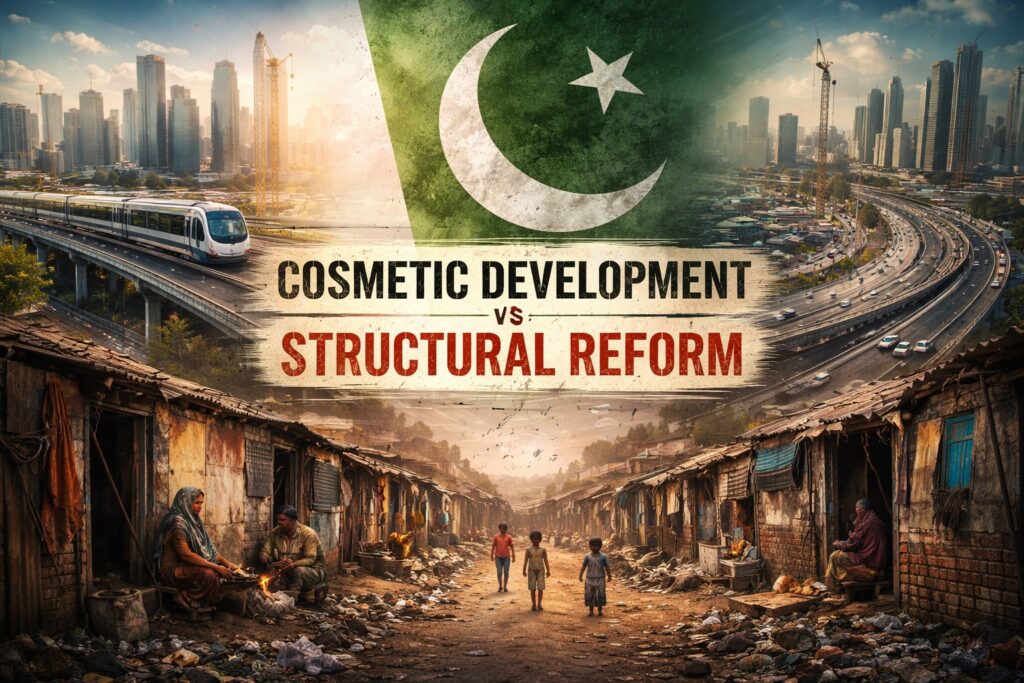
The distinction between cosmetic and structural development is essential to understanding Pakistan’s economic trajectory. Cosmetic development refers to highly visible, politically attractive projects that generate immediate public recognition. These include large infrastructure schemes, prestige expenditures, and governance centred around symbolic achievements.
In contrast, structural development encompasses deeper, less visible transformations that strengthen the economy over time. These include enhancing export competitiveness, expanding the tax base, improving industrial productivity, reforming institutions, investing in human capital, and maintaining fiscal discipline.
The central argument of this study is that Pakistan has repeatedly prioritized cosmetic development while postponing or neglecting structural reforms, thereby undermining long-term sustainability.
Historical Evolution of Optics-Driven Governance
The 1990s: Foundations of Debt-Financed Visibility
The early 1990s marked the emergence of development strategies centered on political visibility. Infrastructure expansion was pursued aggressively, often financed through external borrowing. While these initiatives created an impression of modernization, they were not accompanied by corresponding growth in exports or industrial capacity. As a result, debt levels increased while fiscal discipline weakened, leaving the economy vulnerable to repayment pressures.
Late 1990s: Prestige Amid Fragility
By the late 1990s, large-scale motorway projects symbolized national ambition and modernity. However, these developments coincided with rising external debt, declining foreign exchange reserves, and slowing economic growth. The absence of structural transformation meant that such capital-intensive investments failed to generate sustainable economic returns.
The 2000s: Stability Through External Dependence
The early 2000s witnessed a period of relative economic stability. However, this stability was largely driven by external inflows, debt rescheduling, and geopolitical factors rather than domestic structural reform. When these inflows slowed, underlying weaknesses quickly resurfaced, highlighting the fragility of an externally dependent growth model.
Post-2008: Energy Crisis and Fiscal Stress
Following the global financial crisis, Pakistan’s economy came under increasing strain. Rising energy inefficiencies, growing circular debt, and escalating fiscal pressures forced governments to adopt short-term corrective measures. These measures, however, lacked systemic depth and failed to address the root causes of economic dysfunction.
2013–2018: The Megaproject Expansion
A renewed emphasis on infrastructure development emerged during this period, with major investments in urban transport systems, expressways, rail projects, and energy parks. While these initiatives improved urban mobility and enhanced the visual landscape of development, they were largely financed through foreign loans.
By the end of this phase, external debt had risen significantly, current account deficits had widened, and circular debt had intensified. Many projects required ongoing subsidies, further burdening the fiscal framework. Despite the scale of investment, structural indicators such as export growth and industrial productivity showed limited improvement.
Contemporary Manifestation: Prestige Expenditure in Aviation
Recent developments involving the acquisition of high-value luxury aircraft by a provincial government illustrate the استمرار (continuity) of optics-driven governance. Such expenditures, justified under the framework of public sector initiatives, raise critical questions regarding fiscal priorities and economic rationality.
At a time when debt servicing consumes a substantial portion of national revenue, and when social sectors remain underfunded, the allocation of resources toward elite-oriented assets reinforces perceptions of misaligned priorities. The limited commercial viability of such acquisitions further amplifies concerns regarding their long-term economic justification.
Persistent Structural Weaknesses
Pakistan’s economic challenges are rooted not in the absence of infrastructure but in the neglect of foundational sectors.
Export performance remains constrained by a narrow and low-value product base, resulting in persistent trade deficits and continued reliance on external financing. Industrial productivity suffers from policy inconsistency, technological stagnation, and energy inefficiencies, limiting competitiveness in global markets.
Fiscal fragility is another defining feature, with a significant share of government revenue absorbed by debt servicing. This leaves limited fiscal space for development expenditure, particularly in critical areas such as education and healthcare.
The energy sector continues to be burdened by circular debt, driven by inefficiencies, governance failures, and structural imbalances. Meanwhile, chronic underinvestment in human capital has constrained productivity, innovation, and long-term growth potential.
Consequences of Cosmetic Governance
The long-term consequences of prioritizing cosmetic development are profound. Intergenerational debt burdens increase as borrowing is undertaken without corresponding structural returns. Economic vulnerability deepens due to dependence on external financing and rollovers. Political incentives remain skewed toward short-term visibility rather than long-term stability, reinforcing a cycle of superficial progress.
Public trust is also eroded when visible luxury expenditures coexist with inadequate public services. Perhaps most critically, the opportunity cost of such governance is immense. Resources allocated to prestige projects are diverted away from sectors that could generate sustainable economic growth.
The Core Issue
The evidence suggests that Pakistan’s governance model has often equated development with construction rather than competitiveness. Infrastructure, while necessary, cannot substitute for structural reform. Without improvements in exports, industrial capacity, taxation, and human capital, infrastructure risks becoming a financial liability rather than a growth multiplier.
Sustainable development requires a fundamental shift in priorities. It demands a transition from visibility-driven governance to productivity-driven policy frameworks, where long-term resilience takes precedence over short-term political gains.
Conclusion
Pakistan’s economic trajectory reveals a recurring cycle: external borrowing is used to finance visible development, which generates political capital but leads to fiscal strain. This strain necessitates external stabilization, often through international financial institutions, after which the cycle repeats.
This model has reached its limits. Debt levels are high, fiscal space is constrained, and structural weaknesses remain unresolved. The challenge facing Pakistan is not the absence of infrastructure, but the absence of productivity and reform.
The country does not lack roads; it lacks competitiveness.
It does not lack projects; it lacks structural transformation.
Recommendations
A sustainable path forward requires a decisive shift in governance priorities. Economic policy must move away from debt-driven infrastructure toward export-oriented industrialization. Fiscal discipline must be strengthened through tax base expansion and improved revenue governance. The energy sector requires comprehensive structural reform rather than temporary adjustments.
Equally important is sustained investment in education, technology, and workforce development to enhance productivity. Large public expenditures must be subjected to transparent and rigorous cost-benefit analysis, and prestige spending should be curtailed during periods of fiscal stress.
Final Reflection
Nations are not built by what shines; they are built by what sustains. Infrastructure may symbolize progress, but only structural reform can secure it. Borrowed grandeur may create temporary applause, but economic sovereignty demands discipline, productivity, and foresight.
Pakistan stands at a critical juncture. The choice is no longer between development and stagnation, but between illusion and sustainability. The direction it chooses will determine whether future generations inherit economic stability or prolonged vulnerability.