
Air Cargo as the Weak Link in Pakistan’s Export Strategy
A Strategic Assessment of Constraints, Opportunities, and Policy Imperatives
Abstract
Pakistan possesses vast agricultural potential arising from its diverse climate, fertile land, and large rural workforce. However, despite being among the world’s leading producers of fruits, vegetables, livestock, and horticultural products, Pakistan’s share in high-value global agricultural trade remains disproportionately low.
This study argues that the principal bottleneck is not production, but the absence of a robust air cargo–based agro-logistics ecosystem. The paper critically examines the structural mismatch between the perishability of agricultural products and existing logistics capacity, evaluates the economic rationale for air cargo in selected agrarian exports, and proposes a strategic framework for integrating air transport into Pakistan’s export-oriented agro-logistics system.
THE VALUE OF AIR TRANSPORT TO
PAKISTAN
The air transport sector significantly contributes to Pakistan’s economy
There are different ways of measuring air
transport’s impact on an economy. Two key
indicators are the number of jobs and the
contribution to gross domestic product
(GDP) generated by the aviation sector,
including airlines, airport operators and onsite businesses, air navigation service
providers (ANSPs), and manufacturers
(“direct” aviation players). In Pakistan,
56,700 people are directly employed in
aviation, generating USD 2.1 billion
of economic output, equal to 0.6% of
total GDP.
Additional benefits are generated by the
wider supply chain, employee spending,
and tourism activities contributing a total of
USD 5.6 billion to GDP and 683,900 jobs.
Tourism supported by aviation contributes.
Introduction
Agriculture remains the backbone of Pakistan’s economy, contributing significantly to GDP, employment, and rural livelihoods. Yet, agricultural exports are dominated by low-value, bulk commodities, while high-value, time-sensitive produce remains largely excluded from international markets.
Globally, agricultural trade has shifted from volume-based competition to value-based competition, where freshness, quality, certification, and speed determine market access. In this environment, air cargo is not a transport luxury but a strategic enabler. Pakistan’s failure to align its air transport capacity with its agricultural potential represents a critical structural gap in the national export strategy.
Agricultural Potential and Export Reality
2.1 Production Strengths
Pakistan produces:
- World-class mangoes, citrus (kinnow), dates, and guava
- A wide range of vegetables and herbs
- Livestock products with a halal market advantage
- Floriculture and off-season horticultural produce
The country’s agro-ecological diversity allows counter-seasonal production, a key advantage in premium export markets.
2.2 Export Performance Gap
Despite this potential:
- Post-harvest losses remain high
- Export volumes of fresh produce are limited
- Most exports rely on sea transport, unsuitable for perishables
- Quality rejections and price discounts are common
This gap highlights a logistics and value-chain failure rather than an agricultural failure.
The Time–Value Economics of Perishable Produce
Perishable agricultural goods follow a non-linear value curve:
- Value peaks immediately after harvest
- Declines rapidly with time and temperature deviation
- Becomes uneconomical beyond a short logistics window
For such products, speed to market is equivalent to value preservation. Road and sea transport, even when refrigerated, often fail to meet the strict timelines required for premium markets. Air transport uniquely compresses time, preserving both quality and price realisation.
-
Limitations of Food Preservation and Processing Capacity
While food processing is often cited as an alternative to air transport, Pakistan faces constraints:
- Limited advanced food technologists
- Insufficient export-grade processing clusters
- High energy costs are affecting cold storage
- Weak certification, traceability, and branding systems
As a result, a significant share of produce cannot be economically processed and must reach markets fresh. Until preservation capacity matures, air cargo remains indispensable for value capture.
Current State of Air Cargo Infrastructure in Pakistan
5.1 Structural Weaknesses
Pakistan’s air cargo ecosystem is characterised by:
- Heavy reliance on passenger aircraft’s belly cargo
- Minimal dedicated freighter capacity
- Inadequate cold storage at airports
- Weak farm-to-airport refrigerated logistics
- Fragmented institutional coordination
Most airports function as passenger hubs rather than export logistics nodes.
5.2 Operational Consequences
These weaknesses result in:
- Temperature breaks
- Delays in clearance
- Quality deterioration
- Export rejections and financial losses
The absence of agro-dedicated air cargo terminals significantly undermines competitiveness.
Economic Justification for Air Cargo in Agriculture
Air transport is often dismissed as “too expensive.” This perception ignores value density economics.
- High-value perishables generate more revenue per kilogram
- Freight cost becomes a smaller proportion of the final price
- Export earnings per unit increase significantly
A kilogram of premium fruit, flowers, or chilled meat exported by air can generate multiple times the foreign exchange of bulk commodities shipped by sea.
Thus, air cargo should be evaluated per unit value preserved, not per unit cost incurred.
Strategic Role of Air Cargo within a National Logistics Hierarchy
Air transport should not compete with rail or sea; it should complement them.
| Mode | Best Suited For |
| Road | Farm to collection / last mile |
| Rail & Waterways | Bulk, non-perishable goods |
| Sea | Low-value, high-volume exports |
| Air | High-value, time-sensitive perishables |
This hierarchy ensures economic rationality and avoids misallocation of resources.
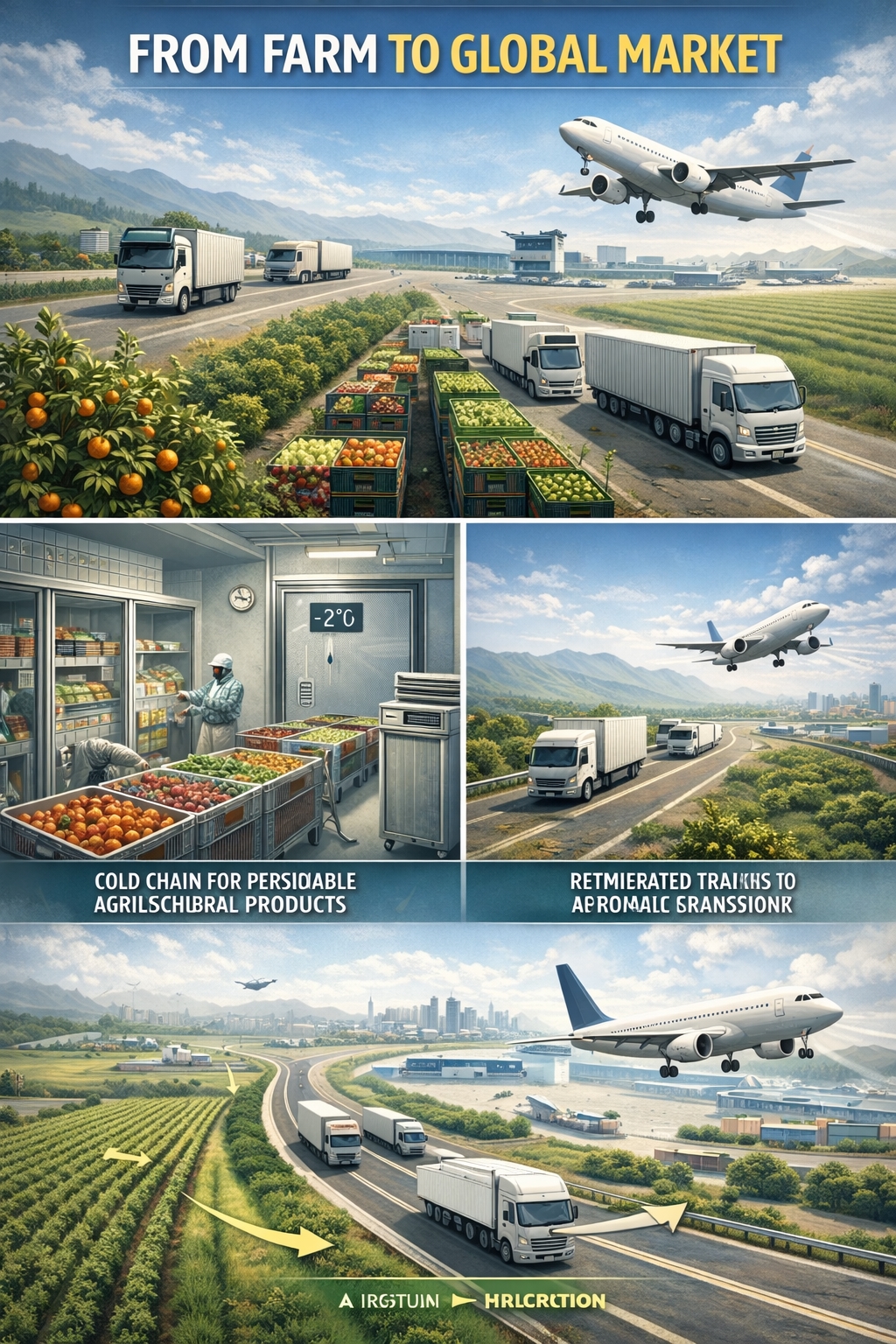
Conceptual Agro-Air Logistics Framework
An effective system would include:
- Export-Oriented Agro Clusters
Crop selection aligned with air export feasibility. - Packhouses & Pre-Cooling Facilities
Immediate post-harvest intervention near farms. - Refrigerated Short-Haul Transport
Reliable farm-to-airport connectivity. - Agro-Dedicated Air Cargo Terminals
Cold storage, fast handling, priority clearance. - Dedicated or Block Space Cargo Capacity
Regular access to target export markets. - Quality, Certification & Traceability Systems
Compliance with international standards.
Institutional and Policy Gaps
Key challenges include:
- Fragmented governance between agriculture, aviation, and trade bodies
- Absence of a national agro-air cargo policy
- Limited incentives for cargo airlines
- Weak public-private collaboration
Without institutional alignment, infrastructure investments alone will not deliver results.
Policy Recommendations
Short Term
- Designate agro-export airports
- Introduce priority handling for perishables
- Incentivise cargo operators through fee rationalisation
Medium Term
- Develop agro-cargo terminals via PPPs
- Promote export-oriented crop zoning
- Invest in food technologist training
Long Term
- National agro-logistics master plan
- Integration with trade diplomacy and market access strategies
- Branding Pakistan as a reliable supplier of fresh produce
Strategic Conclusion
Pakistan’s agricultural future lies not in exporting more volume, but in exporting more value. This transition cannot occur without air cargo logistics designed specifically for agriculture. While rail and waterways are indispensable for bulk efficiency, air transport is the gateway to premium markets, rural income growth, and export diversification.
Ignoring air cargo in agricultural strategy condemns Pakistan to remain a supplier of low-value commodities. Integrating it intelligently positions agriculture as a driver of foreign exchange, employment, and national competitiveness.
Relationship to Companion Study
This paper complements:
“Rethinking Pakistan’s Inland Logistics: From Road Dependency to an Integrated Multimodal Transport System”
by addressing the high-value, time-critical export dimension that inland systems alone cannot resolve.