
AI Mental Health Care & Digital Therapy: When Help Comes Through a Screen
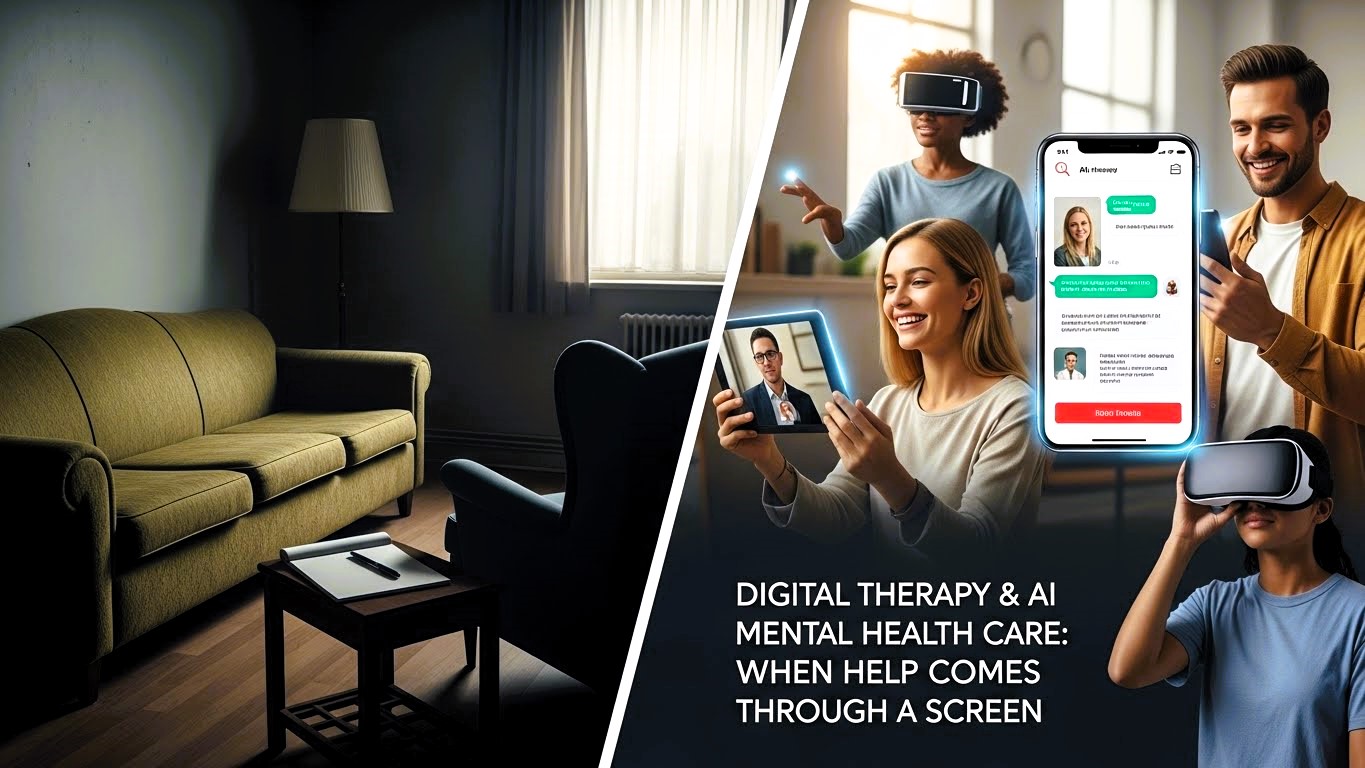
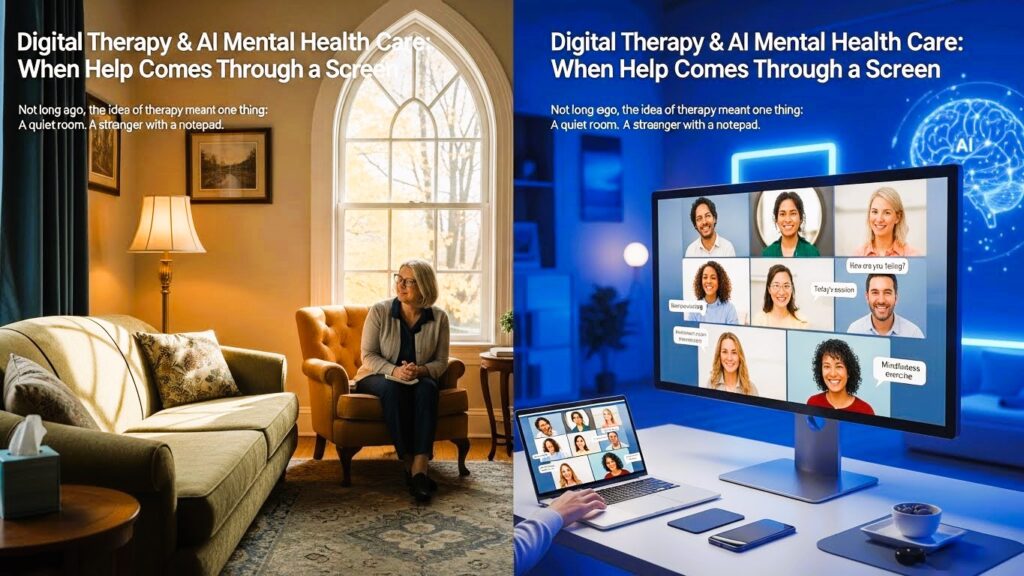
Not long ago, the idea of therapy meant one thing:
A quiet room.
A couch.
A stranger with a notepad.
Today, help might arrive through a screen you already hold in your hand.
And for many people, that raises a quiet question they don’t say out loud:
“Can online or AI-based mental health support really help someone like me?”
The short answer is:
Yes, but not in the way most people imagine.
Role of Technology in Mental Health
The role of technology in mental health is in three ways with accessibility, personalization, and prevention. Treatment by media that are digital can be done irrespective of where one is based or their economic status they have. All the technology-based form of access to care allows one to act early and follow up at all times, something one requires in dealing with chronic psychological disorders.
Technology enables individuals to monitor symptoms and engage in behavior with smarter devices, and the patient is able to conduct therapy sessions or self-help exercises without stigma.
https://instacare.com.pk/technology-in-mental-health/
Why So Many People Are Searching for Digital Therapy
The rise in searches for online counselling, telehealth, and AI mental health tools isn’t accidental.
It’s happening because traditional help hasn’t always been accessible.
People are tired of:
- Long waiting lists
- High costs
- Fear of being judged
- Lack of privacy
- Cultural stigma around “seeing a therapist”
For many, especially in countries like Pakistan, the problem isn’t a lack of willingness.
It’s access without exposure.
Digital mental health tools quietly offer something radical:
Help without having to explain yourself to the world first.
What Digital Therapy Actually Is (And What It Isn’t)
Let’s clear the confusion early.
Digital therapy does NOT mean:
- Talking to a robot instead of a human
- Being diagnosed by an app
- Replacing doctors or psychologists
Digital mental health care includes:
- Online therapy sessions with licensed professionals
- Telehealth counselling via video or audio
- Mental health apps that guide reflection, grounding, or emotional tracking
- AI-assisted tools that help you notice patterns in mood, stress, or sleep
AI doesn’t “feel” your pain.
But it can help you notice it sooner.
Why This Feels Safer for Many People
Here’s what people rarely admit:
Talking about mental health is hardest before you feel understood.
Digital support reduces that first barrier.
Real-life example:
A working woman feels emotionally exhausted but can’t visit a clinic without questions from her family.
An online session during lunch break feels possible.
And that first step matters more than perfection.
Another example:
A man struggling with anxiety doesn’t know how to explain it out loud.
A guided mental health app helps him name what he’s feeling, quietly.
This isn’t a weakness.
It’s an adaptation.
How AI Fits Into Mental Health (Without Replacing Humans)
AI in mental health is often misunderstood.
It’s not there to replace therapists.
It’s there to support the gaps between sessions or before sessions even begin.
AI tools can help with:
- Mood tracking
- Identifying emotional patterns
- Guiding breathing or grounding exercises
- Offering reflective prompts when anxiety spikes
Think of AI like a mental mirror, not a therapist.
It doesn’t heal you.
It helps you see yourself more clearly.
What Research Says (In Simple Terms)
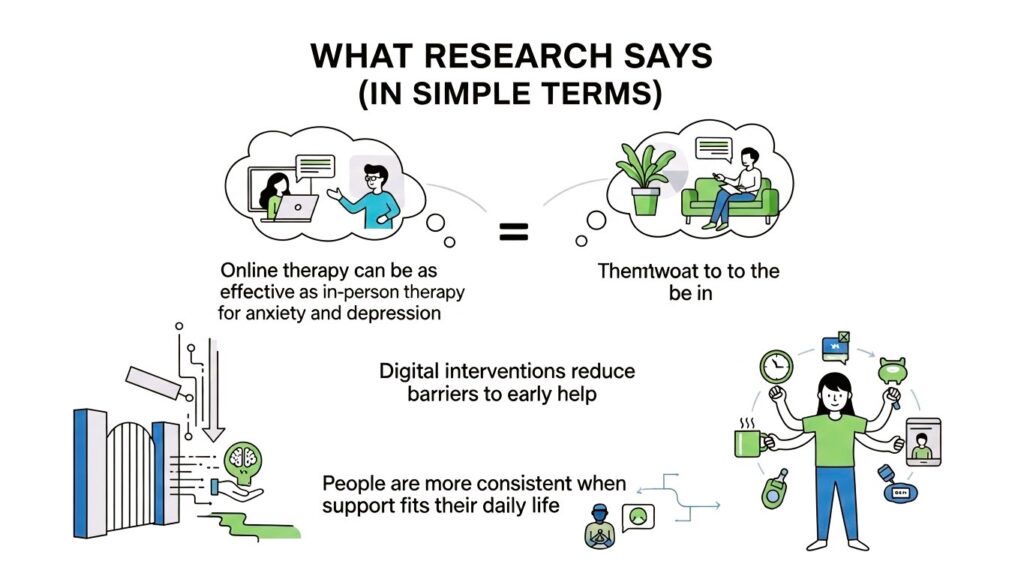
Studies over the past few years show:
- Online therapy can be as effective as in-person therapy for anxiety and depression
- Digital interventions reduce barriers to early help
- People are more consistent when support fits their daily life
Especially for mild to moderate distress, digital care can help prevent issues from escalating into crises.
Early help is quieter and often more effective.
Who Digital Mental Health Helps the Most
People who feel “not sick enough” for therapy
Digital tools feel less intimidating.
Those with busy or unpredictable schedules
Help without travel or waiting rooms.
People are afraid of stigma
Privacy reduces fear.
Young adults & teens
Digital spaces feel familiar, not threatening.
Those starting their healing journey
It’s often a first step, not the last one.
What Digital Care Cannot Do
Honesty matters.
Digital tools cannot:
- Replace emergency care
- Fully treat severe mental illness alone
- Replace deep human connection
They are bridges, not destinations.
And sometimes, a bridge is exactly what someone needs to cross fear.
How to Know If Digital Therapy Is Right for You
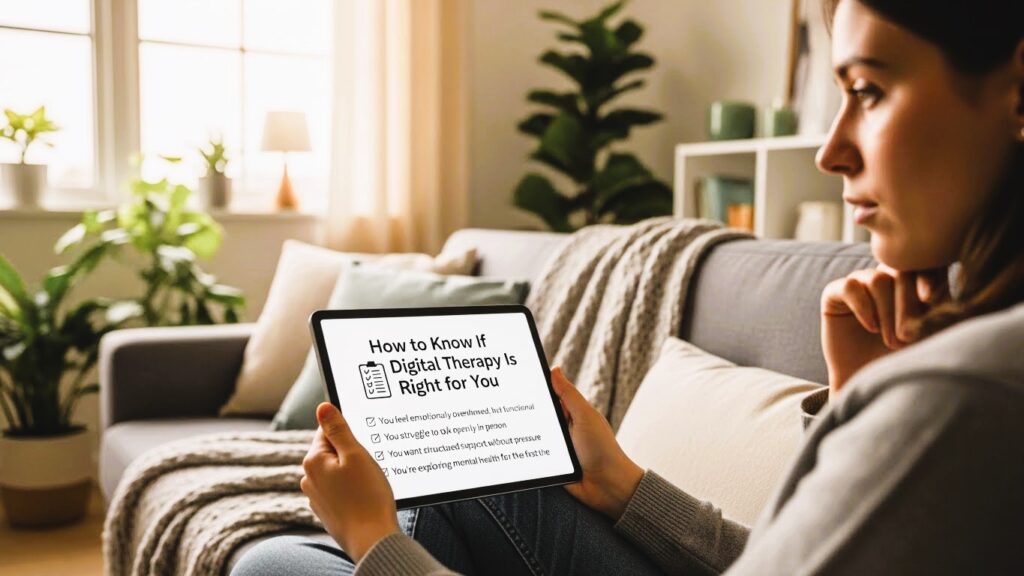
It may help if:
- You feel emotionally overwhelmed, but functional
- You struggle to talk openly in person
- You want structured support without pressure
- You’re exploring mental health for the first time
It may not be enough if:
- You experience severe suicidal thoughts
- You’re in crisis
- You need medical supervision
In those cases, digital tools should be supportive, not standalone.
How This Connects to the Rest of the Series
If you’ve followed this journey, you’ll notice a pattern:
- Burnout taught us that exhaustion hides behind productivity
- Numbness showed us silence can be loud
- Anxiety without a cause revealed the nervous system’s memory
- Strength for everyone exposed to emotional loneliness
Digital therapy doesn’t replace these insights.
It meets them where people already are.
Often, on a phone.
Late at night.
Quietly searching for relief.
Frequently Asked Questions
Q1: Is online therapy effective?
Yes, research shows comparable outcomes to in-person therapy for many conditions.
Q2: Can AI replace a therapist?
No. AI supports awareness, not deep emotional processing.
Q3: Is digital therapy confidential?
Reputable platforms prioritise privacy, but users should always review policies.
Q4: Is this suitable in Pakistan?
Yes, especially where stigma, distance, or access are barriers.
Q5: Can I use digital tools without committing to therapy?
Yes. Many people start with tools before seeking human support.
Q6: Is it okay to prefer online help?
Absolutely. Healing doesn’t require public approval.
A Gentle Closing
Healing doesn’t always arrive in dramatic ways.
Sometimes it comes quietly
through a message,
a screen,
a moment of being heard without being seen.
Getting help doesn’t mean you failed.
It means you adapted.
And in a world that demands constant strength,
choosing support, even digitally it
is not a weakness.
It’s wisdom.
https://mrpo.pk/anxiety-without-a-cause/
Disclaimer: The content in this article is intended for informational and educational purposes only. It provides insights, tips, and general guidance on health, beauty, and wellness, but it is not a substitute for professional medical advice, diagnosis, or treatment.
Always consult a qualified healthcare professional for personal medical concerns. For more information about our approach to health and wellness content, please read our Health & Wellness Disclaimer.