Trump’s Gaza Peace Board 2026: Billions Pledged, But Palestinian Exclusion and Ally Snubs Raise Serious Questions
EP:
Trump’s Gaza Peace Board 2026, an analytical perspective on historical and contemporary patterns of power and influence. It does not target any individual, nation, or group, and all terms or concepts used are intended descriptively, not pejoratively. The goal is to explore systemic dynamics, historical legacies, and policy choices to foster understanding and informed discussion.

https://mrpo.pk/the-age-of-trumplization/
The article is updated with the latest verified details from February 2026 reporting: the inaugural meeting occurred on February 19, 2026, in Washington, D.C.; pledges totaled $7 billion from nine member countries (e.g., UAE, Kuwait, Saudi Arabia, Qatar, Morocco, Bahrain, Kazakhstan, Azerbaijan, Uzbekistan) plus a $10 billion US commitment (requiring congressional approval, source unclear);
additional contributions like FIFA’s $75 million and UN’s $2 billion; plans for a 5,000-person military base and international stabilisation force; expansion beyond Gaza; no Palestinian representatives (only a proposed technocrat committee); criticisms of undermining the UN, colonial undertones, and investor-focused “Riviera” vision amid ongoing suffering.
Explore Trump’s Gaza Peace Board inaugural meeting in February 2026—$17B+ pledges, key participants, why Europe/Canada stayed away, criticisms of Israeli influence, and hypocrisy in excluding Palestinians. Balanced analysis for global readers.
The Board of Peace (BoP), colloquially the peace board, is an international organization[2][3][4] with the stated purpose of promoting peacekeeping around the world. Established by Donald Trump and led by the government of the United States, the board is named in United Nations Security Council Resolution 2803 as a body tasked with overseeing the processes of the Gaza peace plan.[2] The Board of Peace was proposed in September 2025 and formally established on the side-lines of the 56th World Economic Forum in January 2026.[5][6][7]
Resolution 2803 welcomed the board to aid with reconstruction efforts in the Gaza Strip, via the National Committee for the Administration of Gaza (NCAG), and authorized it to deploy a temporary peacekeeping force.[8] Participating countries are required to contribute US$1 billion to the organization to renew membership after the first three years.[9] As of 2026, 25 of the 62 invited countries have signed the board’s charter.[10][11][12]
Several policy analysts and officials have expressed concerns about the board’s governance model, raising concerns over the decision-making authority concentrated in its chair. European nations have expressed concern over the possibility of the board usurping the role of the United Nations.[13][11]
Trump has stated that the BoP could potentially replace the United Nations while also expressing continued support for the UN, and has defended the board’s reputation describing it as “the most prestigious Board ever assembled, at any time, any place”.[5][14][15]
Trump’s Gaza Peace Board 2026: Billions Pledged, But Palestinian Exclusion and Ally Snubs Raise Serious Questions

Imagine billions flowing into Gaza’s reconstruction, yet the people most affected have no real voice at the table. That’s the stark reality emerging from President Donald Trump’s inaugural **Board of Peace** meeting on February 19, 2026, in Washington, D.C. Trump, as lifetime chairman, announced over $7 billion in pledges from nine member nations, plus a $10 billion US commitment, framing it as a game-changer for peace.
But for many in the US, Europe, and Canada, it feels more like a high-stakes power play than genuine diplomacy marked by exclusions, controversies, and a noticeable lack of buy-in from traditional allies.
As global tensions simmer, this initiative tests faith in international cooperation. Drawing from reports across Reuters, Al Jazeera, The New York Times, The Guardian, AP, BBC, CNN, and PBS, we’ll unpack the facts, the criticisms, and what it means for a world watching closely.
The Board’s Structure and Trump’s Central Role
Trump’s Board of Peace, endorsed by a UN Security Council resolution, aims to oversee Gaza’s post-ceasefire stabilisation, reconstruction, and governance, with the potential to expand to global conflicts. Trump chairs it permanently, supported by an executive board including Secretary of State Marco Rubio, Jared Kushner, former UK PM Tony Blair, billionaire Marc Rowan, and others.
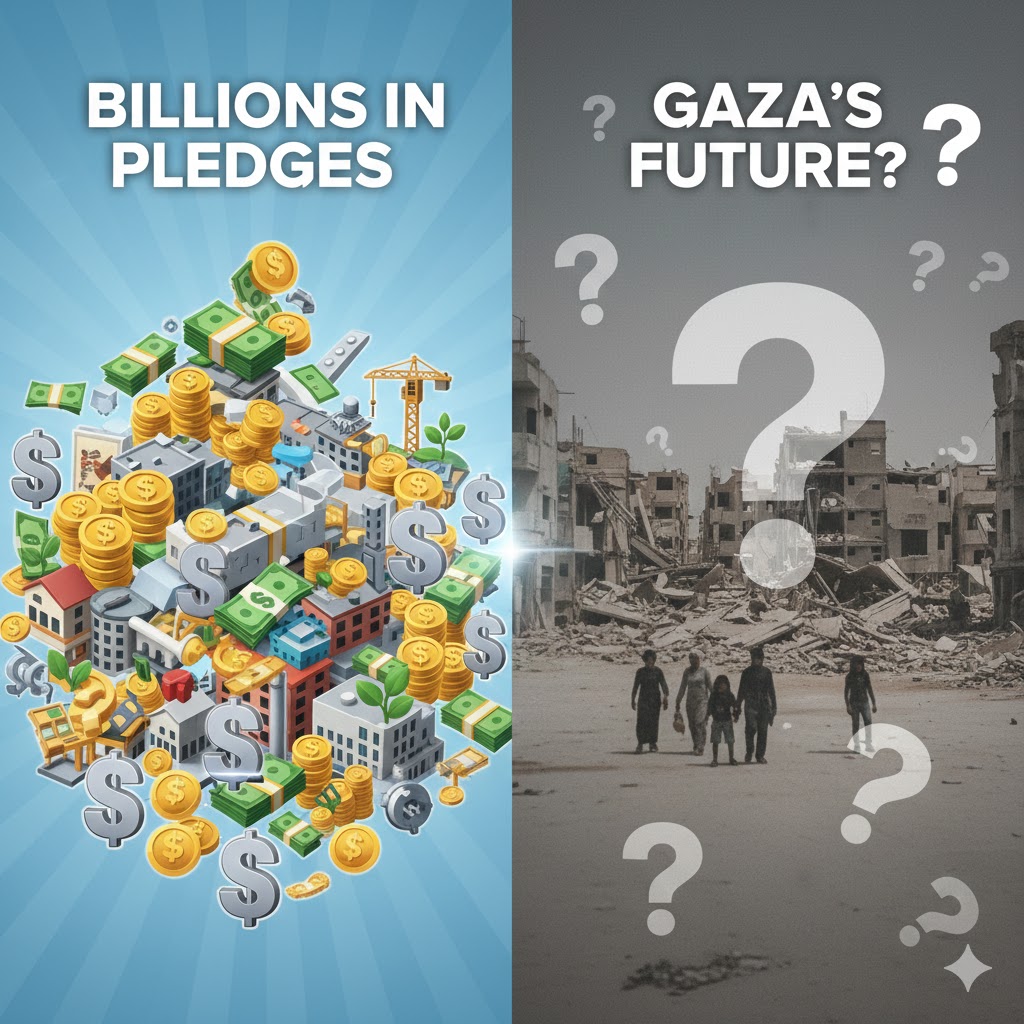
At the February 19 meeting, Trump boasted of the “most consequential” body ever, claiming the Gaza war was “effectively over” despite fragile ceasefires and ongoing issues. Pledges included $7 billion from members (e.g., UAE and Kuwait at $1.2 billion each), FIFA’s $75 million for soccer projects, and the UN’s $2 billion for humanitarian aid. The US pledged $10 billion, though details on sourcing and congressional approval remain unclear.
Plans involve demilitarising Hamas, deploying an international stabilisation force (with offers like Indonesia’s up to 8,000 troops), and even a proposed 5,000-person US-linked military base. Critics see this as shifting from UN-led efforts to a Trump-centric model, potentially rivalling established institutions.
Trump’s Gaza Peace Board 2026: Who’s In and the Notable Absences
Nearly 50 countries sent representatives, with 27 as full members (e.g., Israel, Saudi Arabia, UAE, Qatar, Jordan, Bahrain, Morocco, Turkey, Egypt, Argentina, Hungary, Kazakhstan, Indonesia, Pakistan, Albania, Azerbaijan). Observers included the EU, Italy, Greece, South Korea, Germany, the UK, and others.
Yet major Western allies gave it a cold shoulder: France, Germany, the UK, Spain, Norway, Canada (explicitly “won’t pay” the $1 billion permanent seat fee), and the EU (sending a lower-level rep but declining membership). Reasons cited include ambiguity, risks to UN authority, and invitations to ICC-wanted figures like Netanyahu (who sent his foreign minister) and Putin (uncommitted).
China, Russia (invited but absent/undecided), and India (no confirmation) also stayed out, highlighting broader global divisions. Even Pope Leo XIV declined, adding moral weight.
These absences underscore concerns: Is this a truly inclusive peace effort, or a selective club favouring certain agendas?
Perceptions: An Israeli Plan Advanced Through Trump’s Diplomacy
Many observers view the board as heavily aligned with Israeli interests. Israel holds a key role (despite Netanyahu’s absence), with no Palestinian representation, only a vague “Palestinian technocrat committee” for day-to-day governance. Critics, including in Al Jazeera and Responsible Statecraft, describe it as a “colonial structure” or “imperial agenda,” allowing Israel influence over reconstruction while sidelining Palestinian self-determination.
Trump’s boastful announcements, lifetime chairmanship, dramatic pledges, and praise for figures like Hungary’s Viktor Orban fit his limelight-seeking style, while advancing Netanyahu-aligned goals amid his pro-Israel stance. Former officials and analysts note it resembles a privatised UN with pay-to-play elements, raising questions about whose “peace” is being built.
Trump’s Gaza Peace Board 2026:The problem: Israel’s conduct in the Gaza war
After Hamas’s bloody attack against southern Israel in October 2023 that launched the war in Gaza, Israel targeted and killed Palestinian civilians rather than limiting itself to militants in the Strip, as Amnesty International and Human Rights Watch have concluded. The Palestinian Ministry of Health in Gaza estimate of overall numbers killed, now even accepted by the Israel Defense Forces, exceeds seventy thousand as of December 2025, more than 3 percent of Gaza’s pre-war population. Moreover, some 171,000 were wounded as of late November. In addition, since the cease-fire began on October 10, 2025, hundreds of Palestinians have been killed and over a thousand wounded in Israeli attacks. Although the health ministry numbers do not distinguish between militants and non-combatants, civilians in Gaza comprise 83 percent of total casualties, according to a leaked Israeli military estimate.
During its Gaza campaign, Israel killed health care professionals, first responders, aid workers, and journalists. Moreover, the UN’s Office of the High Commissioner for Human Rights reported that, as of mid-July 2025, 875 people were killed while seeking food, including 674 who were targeted near sites of the Israel-backed Gaza Humanitarian Foundation.
The UN estimates that some 92 percent of Gaza’s residential buildings have been damaged or completely destroyed. The Israeli military has also attacked educational, medical, religious, and international facilities in Gaza. While Israel correctly points to Hamas’s use of civilian facilities to conceal weapons caches or operational centers, it is improbable that 92 percent of Gaza’s residential buildings had a militant presence. Even in cases where Hamas operatives had a presence at a civilian site, it remains Israel’s operational—and moral—determination whether to use air power to destroy the entire facility, including its civilian residents, or to target operatives more surgically.
The Hypocrisy: Excluding the Main Affected Parties

The most painful aspect: Palestinians and Gazans, the core victims of the conflict, have no direct seat. No Hamas or Palestinian Authority input; governance falls to external oversight, with reconstruction tied to disarmament and Israeli security concerns. Amid pledges, reports highlight ongoing humanitarian crises, displacement, and doubts about aid delivery.
This exclusion draws sharp hypocrisy accusations—especially with controversial invites and visions of Gaza as an investor “Riviera” (e.g., $50-115 billion in “unlocked” value per some board members). Rights groups and Palestinian voices see it as entrenching asymmetries rather than resolving them.
Global and Western Implications
For US, European, and Canadian audiences, the board strains alliances: Allies prioritise UN mechanisms over this ad-hoc body, potentially weakening transatlantic coordination on Middle East issues. Snubs from China, Russia, and India signal resistance to US unilateralism in a multipolar world.
Risks include escalating tensions, legitimising contested actions, or expanding to other conflicts (e.g., Ukraine) without broad support. Comparisons to the Abraham Accords exist, but lacking inclusivity, sustainability is questioned.
Conclusion
Trump’s Gaza Peace Board promises bold reconstruction but delivers deep divisions, billions pledged, yet Palestinians sidelined, allies wary, and questions of influence lingering. As developments unfold, inclusive, transparent processes remain essential for lasting peace.
In a complex world, informed dialogue matters. This analysis draws on diverse, credible sources to provide balance and stay engaged as events progress.
Frequently Asked Questions (FAQs)
1. What is Trump’s Gaza Peace Board?
A US-led initiative chaired by Trump to oversee Gaza reconstruction, stabilisation, and potentially global conflicts, launched post-ceasefire with a February 19, 2026, inaugural meeting.
2. How much money was pledged?
$7 billion from nine members (e.g., Gulf states), plus $10 billion from the US, FIFA’s $75 million, and the UN’s $2 billion—totalling over $19 billion in announcements.
3. Why are Western allies like Europe and Canada not joining?
Concerns over scope ambiguity, potential UN undermining, pay-to-play fees, and controversial invites (e.g., to ICC-wanted leaders); many sent observers but declined membership.
4. Is the board seen as an Israeli plan?
Critics argue yes. Due to Israel’s central role, Palestinian exclusion, and alignment with Netanyahu’s security priorities, framed through Trump’s diplomacy.
5. Why no Palestinian involvement?
No direct representatives; a technocratic committee is proposed for governance, drawing widespread criticism as hypocritical, given the focus on Gaza’s people.
6. What happens next for the board?
Implementation of stabilisation force, reconstruction fund (via World Bank), and potential expansion, though success depends on addressing exclusions and gaining broader support.
References
– Reuters (Feb 19, 2026): Board debut and pledges.
– Al Jazeera (Feb 20, 2026): Gaza skepticism and Palestinian views.
– The Guardian (Feb 19, 2026): Military base plans and criticisms.
– The New York Times (Feb 19, 2026): Few details on implementation.
– AP News (Feb 19, 2026): Participants list.
– BBC (Feb 2026): $7bn pledges overview.
– CNN (Feb 19, 2026): Meeting live updates.
– PBS News (Feb 19, 2026): US $10bn pledge analysis.
– Council on Foreign Relations (Feb 19, 2026): Agenda and implications.