
Does History Repeat Itself? Lessons from 9/11, Iraq, and the 2008 Crisis for the Modern West
Executive Statement
This article Does history repeat itsel? explores why advanced Western societies often repeat historical mistakes despite access to information and institutional knowledge. By analyzing events from 9/11, the Iraq War, and the 2008 financial crisis to contemporary political polarization and rising military spending, it highlights the recurring patterns of overconfidence, short-term thinking, and strategic miscalculations. The goal is not to assign blame but to reflect on the importance of humility, foresight, and accountability in shaping future policy and public discourse.
What if Modern Democracies don’t Fall Because they Lack Information, but because they Believe They are Immune to History?
The West prides itself on being historically aware, technologically advanced, and institutionally mature.
And yet, familiar patterns quietly reappear:
- Expanding military budgets
- Rising debt
- Deep political polarization
- Extended foreign interventions
History is not silent. It documents patterns. The question is whether confidence prevents us from recognising them.

Fixing the Meaning of 9/11: Hegemony, Coercion, and the Road to War in Iraq
As the costs of the invasion and occupation of Iraq mount, scholars have sought to explain how the United States came to launch this war in the first place. Many have focused on the “inflation” of the Iraq threat, and indeed the Bush administration did frame the national dialogue on Iraq. We maintain, however, that the failure of most leading Democrats to challenge the administration’s case for war in 2002–2003 cannot be explained fully by the bully pulpit, Democrats’ reputation for dovishness, or administration misrepresentations.
Rather, we argue that leading Democrats were relatively silent in the run-up to war because they had been “rhetorically coerced”, unable to advance a politically sustainable set of arguments with which to oppose the war. The effective fixing of the meaning of the September 11 attacks in terms of the “War on Terror” substantially circumscribed political debate, and we explain why this discourse became dominant. The Bush administration then capitalized on the existing portrait of Saddam Hussein to bind Iraq tightly into the War on Terror and thereby silence leading Democrats and legitimate the war.
The story of the road to war in Iraq is not only one of neoconservative hubris and manipulated intelligence. It is also the story of how political actors strove effectively after 9/11 to shape the nation’s discourse of foreign affairs and of how the resulting dominant narratives structured foreign policy debate. Behind the seemingly natural War on Terror lurk political processes of meaning-making that narrowed the space for contestation over Iraq.
The Shock of 9/11 and the Long Shadow of War
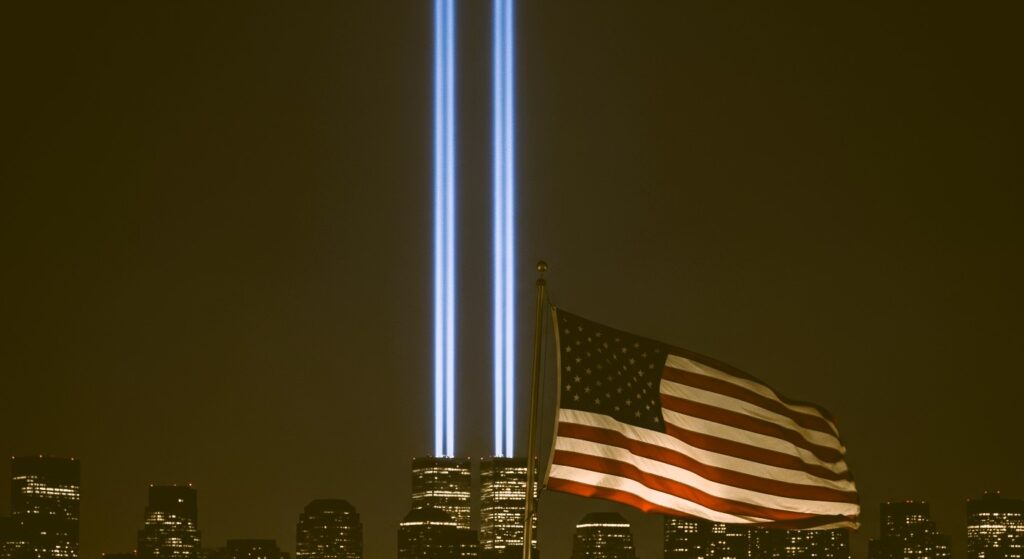
The attacks of September 11 attacks killed nearly 3,000 people on American soil.
For the United States, it was not just a security breach. It was a psychological rupture.
The sense of invulnerability vanished overnight.
To speak of a new regional architecture or order in the Middle East beyond the Iraq War requires evidence of significant changes,a move from old to new alliances, relationships and patterns of behaviour.1 It does not require that architecture to be entirely stable or unified, but implies that any return to a prior order, like that of the Cold War or early post-Cold War period, is unlikely, if not impossible.
As this article argues, even as the region continues to show volatility in the face of multiple challenges, there have been significant, irreversible changes linked directly to the consequences of the Iraq War. As simply stated by the British Iraq Inquiry in 2016: ‘The consequences of the invasion and of the conflict within Iraq which followed are still being felt in Iraq and the wider Middle East.’2
They are also visible in the shifting international alignments in a region now involving, albeit unequally, three major powers,the United States, Russia and China; in its balance of power, dominated by the Saudi–Iranian rivalry, to which other actors are obliged to accommodate themselves; and in its regional institutions, all of which show marked changes and new orientations.
https://academic.oup.com/ia/article/99/2/567/7034357
The response reshaped global politics:
- Military operations began in Afghanistan in 2001
- In 2003, the U.S. invaded Iraq, citing alleged weapons of mass destruction (which were never found)
According to the Costs of War Project (Brown University):
- Hundreds of thousands of direct war deaths occurred across Iraq, Afghanistan, and the surrounding regions
- Indirect deaths linked to war-related instability number in the millions
- U.S. spending related to these conflicts exceeds $8 trillion
- Millions were displaced, and infrastructure across large parts of the Middle East was devastated
The key lesson is not whether a response was needed; it was. The lesson lies in scale, duration, and unintended consequences.
History follows a predictable pattern:
Trauma → Urgency → Broad intervention → Long-term consequences
Even the most institutionally advanced, intelligence-equipped coalition can miscalculate when confidence replaces caution.
The Iraq War and the Weapons of Mass Destruction Controversy

The 2003 invasion of Iraq highlights a recurring historical phenomenon: overconfidence in strategic planning.
- Intelligence failures on WMDs created a credibility gap
- Regional power vacuums reshaped alliances
- Public trust in Western foreign policy declined
History shows that great powers rarely anticipate second- and third-order consequences. What seems like decisive action often becomes a cautionary tale.
The 2008 Financial Crisis: A Warning Ignored

The 2008 financial crisis revealed systemic fragility in advanced financial systems.
- Banks were “too big to fail”
- Leverage and risk were mispriced
- Regulators intervened, but the appetite for risk persisted
Today:
- U.S. federal debt exceeds $34 trillion
- Global debt surpasses $300 trillion (IIF, 2023)
- Asset markets remain historically elevated
- Algorithmic and AI-driven trading increases systemic risk
Technology evolves faster than human psychology. The lesson? Knowledge alone does not prevent repetition.
Rising Global Military Spending and Strategic Confidence
According to SIPRI, global military spending exceeded $2.4 trillion in 2023, the highest ever recorded.
After World War II, Europe built integration mechanisms and the European Union to prevent large-scale conflict.
Yet Europe faces its largest armed conflict since 1945 on its borders. History does not disappear; it waits.
Political Polarisation in the United States and Europe
In the United States, Pew Research shows ideological divides at historic highs.
Europe experiences rising populism, declining trust in institutions, and fragmented political landscapes.
Democracies weaken gradually:
- Public trust erodes
- Institutions politicize
- Shared narratives fracture
History confirms that internal erosion often precedes crises more than external threats.
Rising Global Military Spending and Strategic Confidence
According to SIPRI, global military spending exceeded $2.4 trillion in 2023, the highest ever recorded.
After World War II, Europe built integration mechanisms and the European Union to prevent large-scale conflict.
Yet Europe faces its largest armed conflict since 1945 on its borders. History does not disappear; it waits.
What History Actually Teaches About Power and Humility

The West is informed.
It knows the patterns.
Yet information without humility breeds overconfidence, and overconfidence is history’s quiet prelude to correction.
The question is not whether modern democracies are strong.
The question is whether they are self-aware enough to avoid becoming another historical case study.
Frequently Asked Questions (FAQs)
1. Is this argument anti-West?
No. It is pro-accountability. Strong societies survive by confronting hard truths, not avoiding them.
2. Was the response to 9/11 unjustified?
The initial response was necessary. The debate concerns scale, strategic assumptions, and unintended consequences of extended interventions.
3. Are today’s geopolitical tensions comparable to WWII?
Not identical. But structural patterns, arms buildup, alliance stress, nationalism show striking similarities.
4. Can advanced institutions prevent collapse?
Institutions help. But they depend on trust, fiscal discipline, and responsible leadership.
5. Is rising military spending inherently dangerous?
Not automatically. But history shows sustained militarisation increases miscalculation risk.
6. What is the central lesson?
Humility must evolve as quickly as power.
References
- Stockholm International Peace Research Institute (SIPRI) – Global Military Expenditure Database
- Costs of War Project – Brown University
- Institute of International Finance (IIF) – Global Debt Monitor
- Pew Research Centre – Political Polarization Studies
- OECD – Trust in Government Surveys
- U.S. Treasury Department – Federal Debt Data
- European Central Bank – Public Debt Statistics