Alice Walton Medical School: How the Richest Woman is Reimagining Health
Have you ever walked into a doctor’s office and felt like just a number on a clipboard? Alice Walton, the daughter of the man who started Walmart, wants to change that forever. She isn’t just the richest woman on the planet; she’s a woman on a mission to prove that art, food, and feelings are just as important as medicine.
Who is Alice Walton?
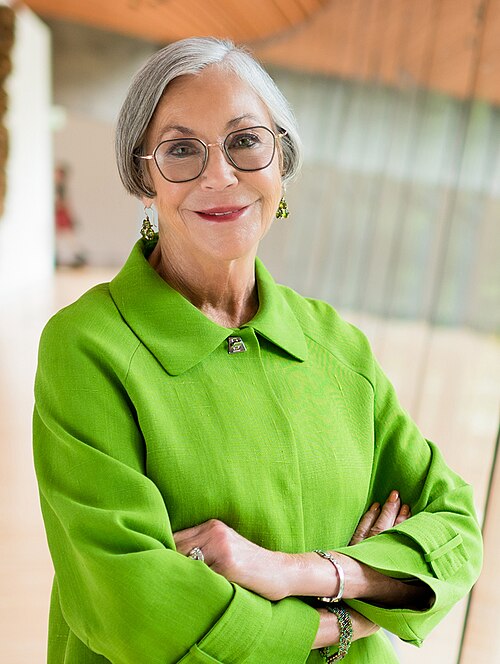
Alice Walton is a billionaire who is passionate about art. After a serious accident left her in pain, she realised that looking at beautiful paintings and being in nature helped her feel better [28:42]. She decided that future doctors shouldn’t just learn about germs and bones—they should learn how to heal the whole person.
In 2025, she opened the Alice L. Walton School of Medicine (AWSOM) in Bentonville, Arkansas. It is a “non-profit” school, which means its main goal is to help people, not to make money [28:32].
The Alice L. Walton School of Medicine (AWSOM) is a bold reimagining of medical education located in Bentonville, Arkansas. It officially welcomed its inaugural class of 48 students in July 2025.
1. The “Whole Health” Curriculum
The school uses a custom-designed curriculum called ARCHES (Art of Healing, Research, Clinical, Health Systems Science, Embracing Whole Health, and Science of Medicine). Key highlights include:
Nutrition & Culinary Arts: Students receive over 50 hours of nutrition training, far more than the national average. They even have access to a teaching farm and gardening space to learn how food acts as medicine.
The Arts and Humanities: Because the school is physically connected to the Crystal Bridges Museum of American Art, students use art to sharpen their observational skills and cultivate empathy.
Self-Care for Doctors: To combat physician burnout, the school treats the students’ own well-being as a priority, teaching them “self-care” as a professional competency.
Perhaps the most significant detail is the school’s financial model:
-
Free Tuition: To attract a diverse range of students and ensure they aren’t burdened by debt, the school is providing full tuition waivers for its first five cohorts of students.
Focus on the “Heartland”: A primary goal is to train doctors who will stay and serve in rural and underserved communities in Arkansas and the surrounding regions.
3. A “Healing” Campus: The 154,000-square-foot facility doesn’t look like a standard hospital or school. It features:
-
Biophilic Design: The building is integrated into the Ozark landscape, featuring a massive rooftop park and “healing gardens.”
-
Public Integration: Parts of the campus, including trails and community spaces, are open to the public to promote a sense of community wellness.
-
Proximity to Innovation: It shares a campus with the Heartland Whole Health Institute, another of Walton’s initiatives aimed at transforming the national healthcare system.
The Goal: Alice Walton has stated that her mission is to “reinstate humanity into healthcare” by training doctors to be “healers” rather than just technicians.
The School That’s Truly “AWSOM”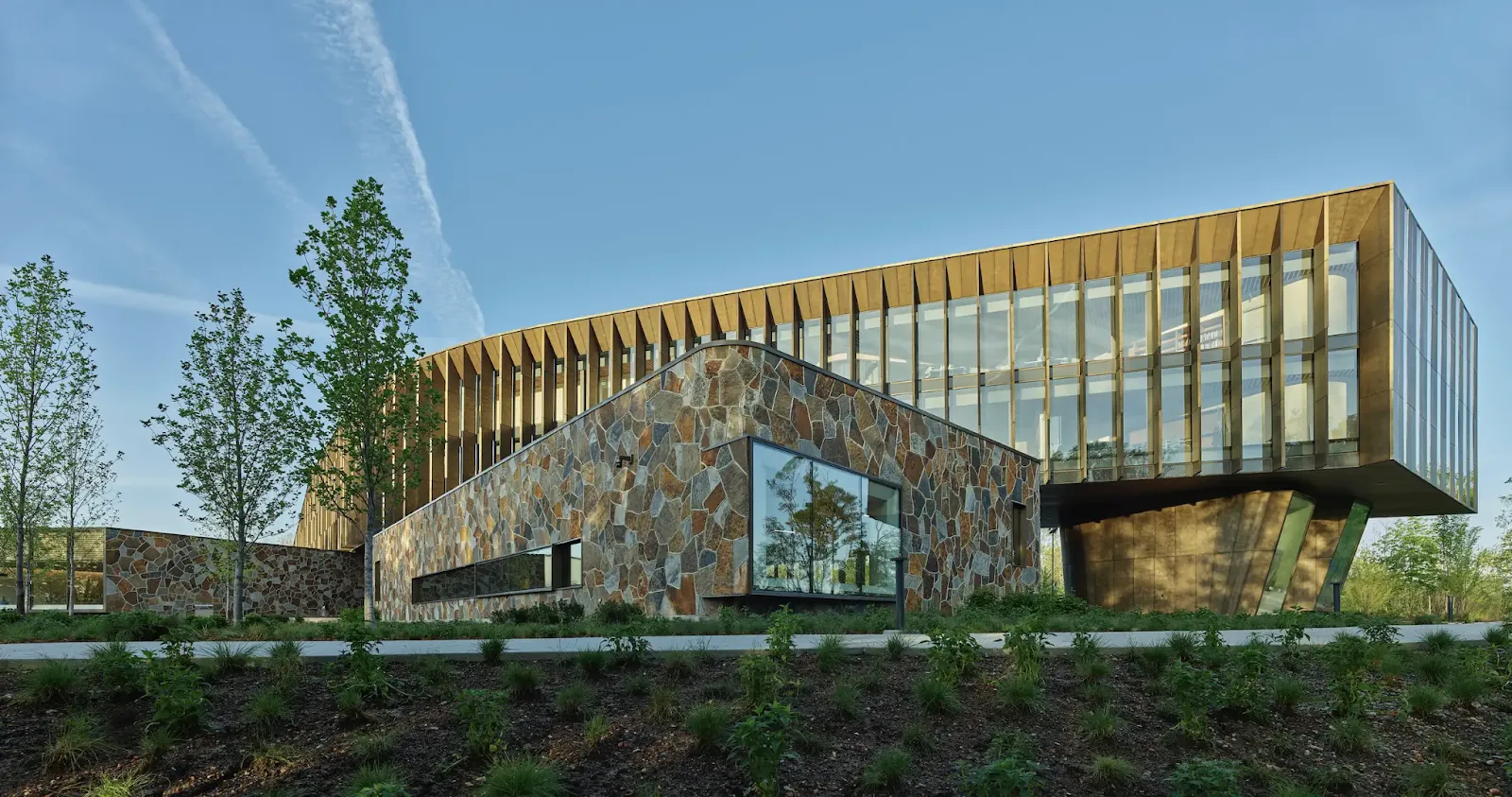
This isn’t your average, boring school building. It’s sitting on 120 acres of beautiful Ozark forest [30:02]. It features:
-
The “Whole Health” Way: This is a philosophy that looks at the “whole person.” It’s not just about managing a disease; it’s about a person’s emotions, their food, and their environment [26:43].
-
Free Tuition: For the first five groups of students, Alice is paying for their classes! This allows students to focus on being great doctors instead of worrying about how to pay back huge loans [05:38].
-
Small Classes: The school only takes about 48 students at a time so that every student gets personal attention from their teachers [13:32].
The ARCHES Plan: How They Learn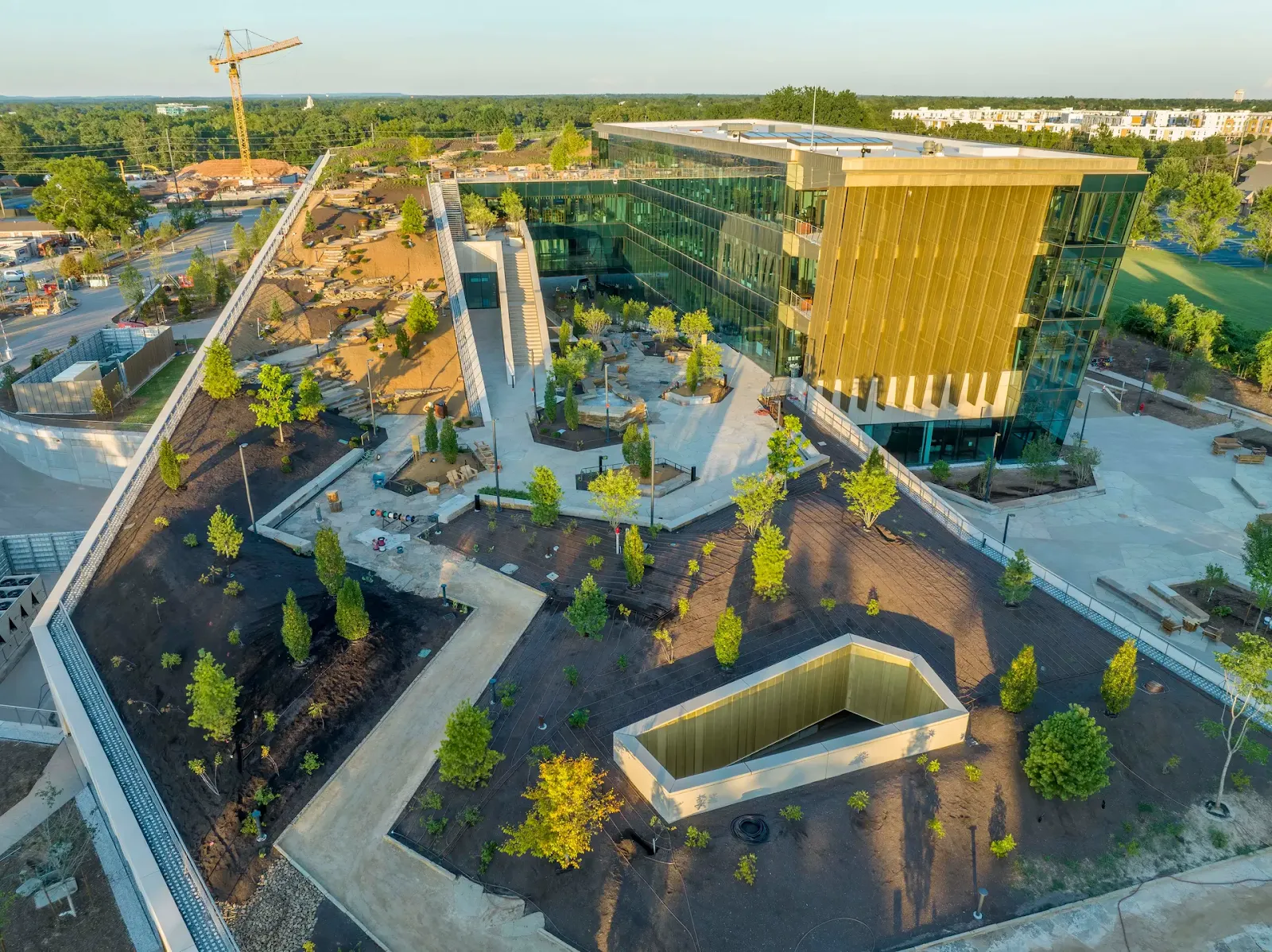
The Alice L. Walton School of Medicine (AWSOM) in Bentonville, Arkansas, has officially welcomed its first class of 48 students. Founded by Walmart heiress Alice Walton, the world’s richest woman, the school offers a new vision for training physicians, one centred on whole-person health, blending conventional medicine with wellness, preventive care, and the healing power of art and nature.
What Sets the Alice L. Walton School of Medicine (AWSOM) Apart
The Alice L. Walton School of Medicine (AWSOM) curriculum weaves traditional medical training with holistic care principles, emphasising emotional well-being, nutrition, lifestyle habits, and preventive care. The school’s lessons are infused with arts and humanities, designed to sharpen empathy and observational skills through experiences like drawing classes at the nearby Crystal Bridges Museum of American Art.
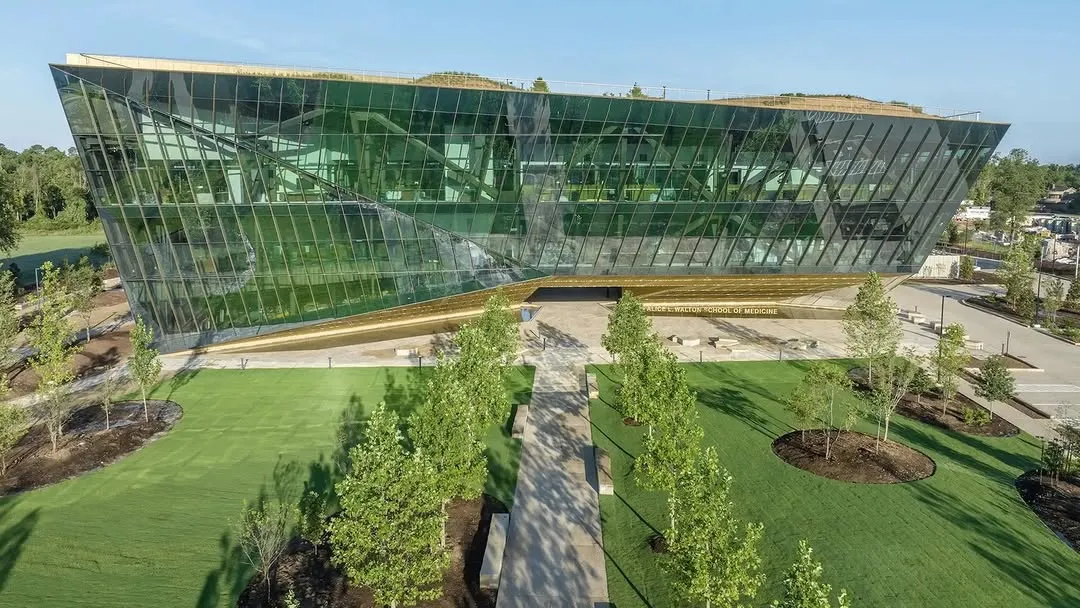
The school is located in a 154,000-square-foot, four-story building designed specifically to support a whole-health philosophy. It accepted less than 3 per cent of over 2,000 applicants and provides free tuition for its first five graduating classes.
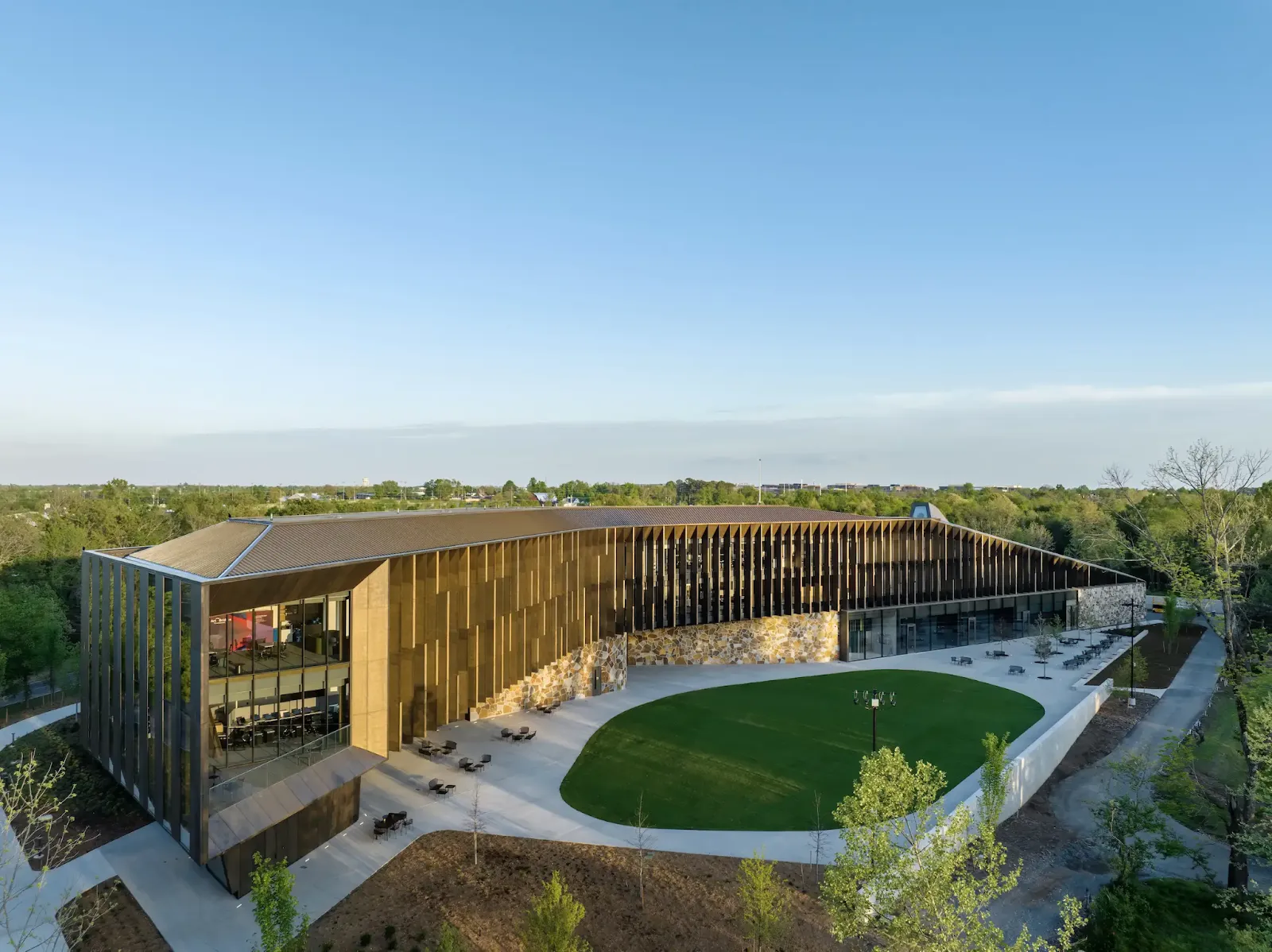
This initiative is part of Alice Walton’s broader healthcare vision, alongside the Heartland Whole Health Institute, located nearby, which aims to transform care in Arkansas and serve as a national model for medical education and health access in underserved communities.
Architecture Inspired by Nature: Healing-Centred Campus Design at AWSOM
Design That Grows From the Land
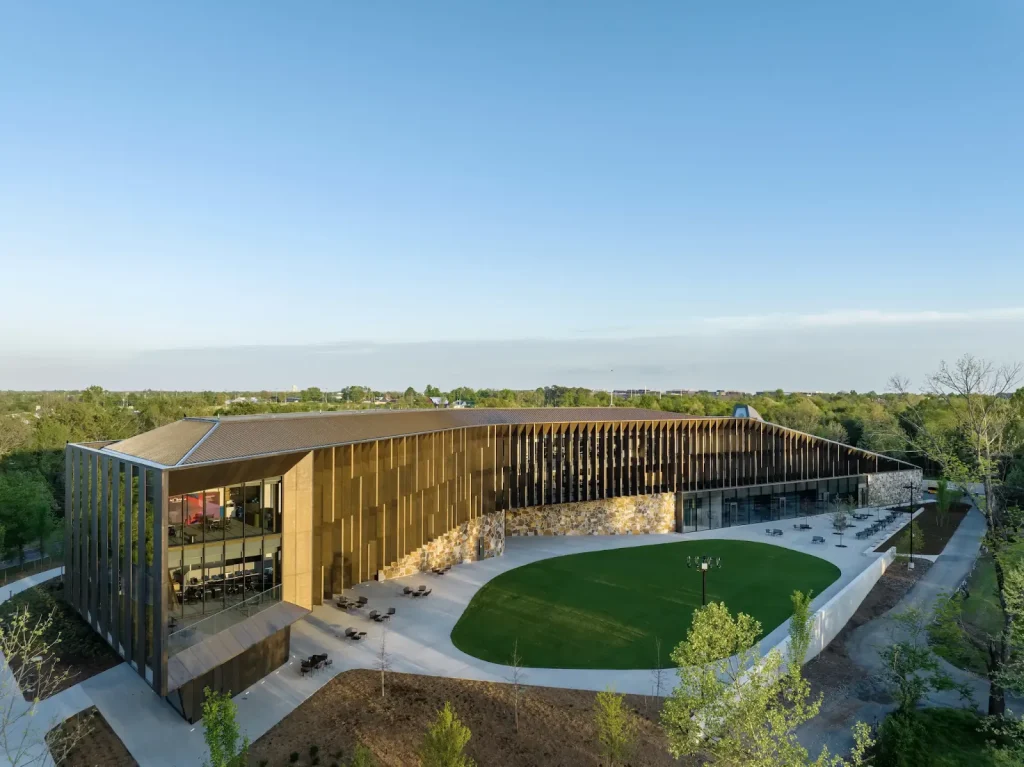
Designed by Polk Stanley Wilcox and landscaped by OSD, the building’s bluff shelter canopy, a dramatic two-story cantilever clad in marine-grade brass, echoes natural limestone overhangs while signaling a welcome. The 154,000-square-foot, four-story building is integrated into its setting, rising from the Ozark landscape rather than sitting upon it.
The ridges of the building form shallow valleys offering natural shade, sculpted views, and a connection to the surrounding woodlands. Cantilever reaches out over 80 feet, welcoming visitors under a symbolic shelter of healing and community.
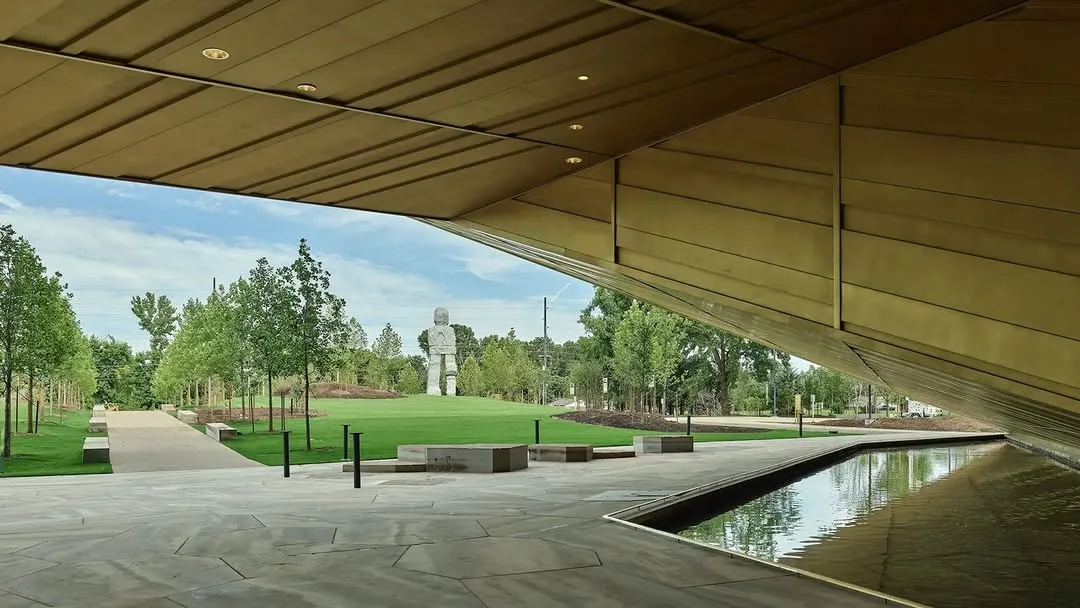
The façade combines glass, precast concrete, and marine-grade brass, including about 8,000 sq ft of perforated brass sunshades. These control light and heat while casting the building in a warm glow, reminiscent of forest light filtering through fall foliage. The approach embraces vernacular “Giraffe Stone”, a regional material, reinforcing a sense of place in every face of the building.

The Alice L. Walton School of Medicine (AWSOM) in Bentonville, Arkansas, has officially welcomed its first class of 48 students. Founded by Walmart heiress Alice Walton, the world’s richest woman, the school offers a new vision for training physicians, one centred on whole-person health, blending conventional medicine with wellness, preventive care, and the healing power of art and nature.
The Alice L. Walton School of Medicine (AWSOM) curriculum weaves traditional medical training with holistic care principles, emphasising emotional well-being, nutrition, lifestyle habits, and preventive care. The school’s lessons are infused with arts and humanities, designed to sharpen empathy and observational skills through experiences like drawing classes at the nearby Crystal Bridges Museum of American Art.
https://mrpo.pk/frank-caprio-the-judge/
The school is located in a 154,000-square-foot, four-story building designed specifically to support a whole-health philosophy. It accepted less than 3 per cent of over 2,000 applicants and provides free tuition for its first five graduating classes.
This initiative is part of Alice Walton’s broader healthcare vision, alongside the Heartland Whole Health Institute, located nearby, which aims to transform care in Arkansas and serve as a national model for medical education and health access in underserved communities.
Architecture Inspired by Nature: Healing-Centred Campus Design at AWSOM
Design That Grows From the Land
Designed by Polk Stanley Wilcox and landscaped by OSD, the building’s bluff shelter canopy, a dramatic two-story cantilever clad in marine-grade brass, echoes natural limestone overhangs while signalling a welcome. The 154,000-square-foot, four-story building is integrated into its setting, rising from the Ozark landscape rather than sitting upon it.
The ridges of the building form shallow valleys offering natural shade, sculpted views, and a connection to the surrounding woodlands. Cantilever reaches out over 80 feet, welcoming visitors under a symbolic shelter of healing and community.
The façade combines glass, precast concrete, and marine-grade brass, including about 8,000 sq ft of perforated brass sunshades. These control light and heat while casting the building in a warm glow, reminiscent of forest light filtering through fall foliage. The approach embraces vernacular “Giraffe Stone”, a regional material, reinforcing a sense of place in every face of the building.
-
A (Art of Healing): Students visit the nearby Crystal Bridges Museum to practice “Close-Looking.” By studying art, they train their eyes to notice subtle details, such as a look of sadness or a change in skin colour [17:22].
-
R (Research & Innovation): Students spend four years working on their own science projects to find new ways to help people [18:08].
-
C (Clinical): Students start working with patients in their very first year! [18:43].
-
H (Health Systems): Learning how the whole medical system works together [19:00].
-
E (Embracing Whole Health): This is the secret sauce. It focuses on nutrition and mental health for both the patient and the doctor [19:33].
-
S (Science of Medicine): The traditional stuff like biology and chemistry, but mixed in with the other parts for all four years [20:07].
The ARCHES curriculum is the academic backbone of the Alice L. Walton School of Medicine. It is designed to be a “longitudinal” framework, meaning these six core themes are woven into every single year of study, rather than being taught as isolated subjects.
The ARCHES Framework
The acronym stands for the following pillars:
-
A – Art of Healing: Merges the humanities and arts with medicine. Students take drawing classes to improve observational skills and visit the neighbouring Crystal Bridges Museum to practice “close-looking,” which helps them notice subtle clinical details in patients.
-
R – Research: Focuses on evidence-based practice. Every student is required to complete a unique scholarly project with a mentor, learning how to synthesise medical literature and apply it to real-world patient care.
-
C – Clinical: Early immersion is key. Unlike traditional schools, where clinical rotations start in Year 3, AWSOM students begin interacting with patients and practising clinical reasoning in their first year.
-
H – Health Systems Science: Students study the “how” and “why” of healthcare delivery, including population health, healthcare economics, policy, and informatics.
-
E – Embracing Whole Health: This is the school’s signature. It includes over 50 hours of nutrition training, culinary medicine, and a “self-care” program where students have 1:1 health coaching to prevent burnout.
-
S – Science of Medicine: The rigorous biological foundation. This covers traditional MD subjects like anatomy, biochemistry, and pathology, but integrates them with patient narratives to provide context.
A Different Way of Learning
The school rejects the “death by PowerPoint” model. Instead, they utilise:
-
Flipped Classrooms: Students study material independently and use class time for active problem-solving.
-
Simulation-Based Learning: Using high-tech “manikins” and standardised patients to master procedures before entering a hospital.
-
Community-Centred Care: Students begin community service within their first three days on campus to understand the social determinants of health (like transportation and food access) in the “heartland.”
The “Self-Care” Requirement
One of the most radical parts of the ARCHES model is the belief that “you cannot pour from an empty cup.” Students are taught:
-
Resilience training to handle the stress of residency.
-
Reflective writing and “narrative medicine” to process the emotional toll of patient care.
-
Physical wellness through the campus’s hiking trails, meditation spaces, and “healing gardens.”
Why It’s a Game Changer
Alice Walton knows that doctors get very tired and stressed. At her school, every student gets a personal advisor to help them stay happy and healthy [15:10]. The school even has “healing spaces” and trails where students can go for a hike to clear their heads [22:36].
By teaching doctors to take care of themselves, Alice believes they will be much better at taking care of us.
FAQs: Everything You Need to Know
1. Is the school really free? Yes! For the first five classes, tuition is covered so students aren’t burdened by debt [05:38].
2. Where is the school located? It’s in Bentonville, Arkansas, right next to the Crystal Bridges Museum of American Art [30:02].
3. Do you have to be an artist to go there? No, but you do need to be a “well-rounded” person who cares about community service and helping others [30:52].
4. When do students start seeing patients? Very early! Unlike most schools, students at AWSOM start clinical training in their first year [18:43].
5. How many students are in a class? The school aims for a small, tight-knit group of about 48 students [13:32].
6. Can anyone apply? The school seeks a diverse group of talented individuals, with a specific goal of having 50% of the students come from the state of Arkansas [34:58].
References:
-
-
Interview with Dr Jerry Castro & Beth Bobbitt, Alice L. Walton School of Medicine. Watch Video
-